Ezekiel 34:11-12, 15-17; Psalm 23, 1 Cor. 15:20-26, 28, Mt. 25:31-46
The first reading from the prophet Ezekiel offers a beautiful image of God as shepherd and king, one who seeks out the lost, gathers the scattered, and cares for those who have been forgotten or forsaken. He tends to the wounded, strengthens the weak, and brings home those who have wandered. Yet the strong and well fed among the flock are not beyond His judgment. In many ways, we can resemble those rams and goats, going about our own way, convinced that our independence is enough while our hearts grow distant from the love and mercy of God. How easily we turn our eyes away from those in need, even when the Shepherd places them directly in our path.
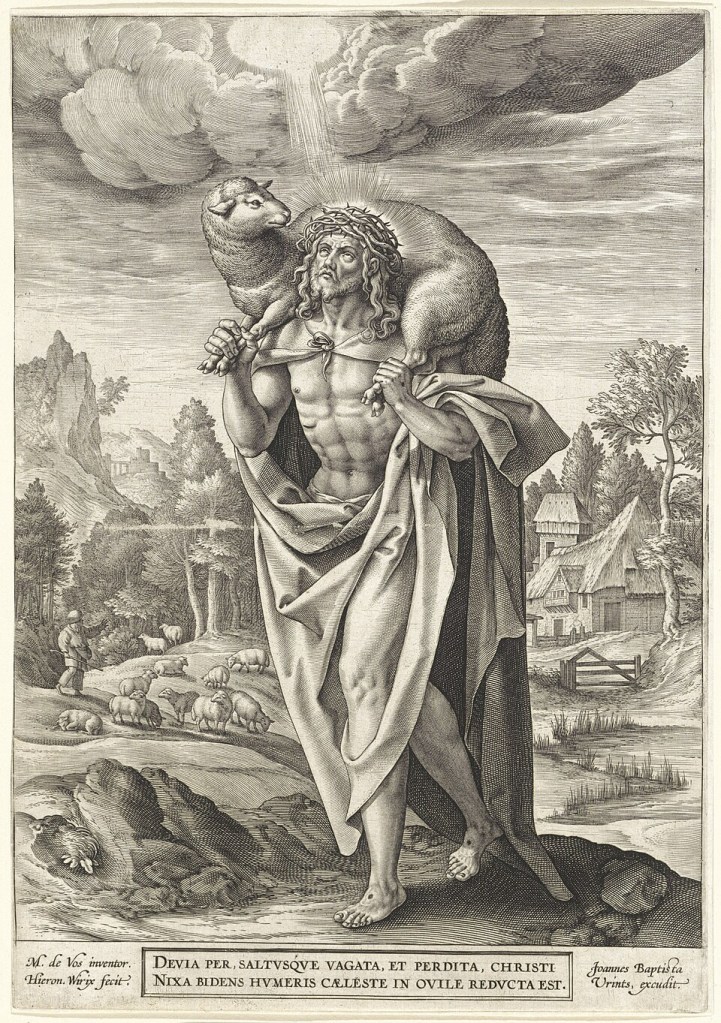
The engraving of Christ the King by Wierix captures this remarkable paradox. Here stands the King of the Universe, Jesus is not crowned with the traditional crown, but a crown of thorns. He carries a sheep upon His shoulders, while the wounds of His hands and feet remind us that His kingship was revealed through suffering and sacrifice. Our King is not distant from our suffering. He entered into it Himself.
In Matthew’s Gospel, Jesus reminds us that our love for Him is expressed through the way we care for others. Feeding the hungry, clothing the naked, visiting the sick and imprisoned, and welcoming the stranger are not simply good deeds. These works relating to the body are corporal works of mercy. They are encounters with Christ Himself in which our mission field becomes physically present and real. When the King returns in glory, all earthly rulers and kingdoms will pass away, and the sheep will be separated from the goats. What will matter is not the power we held, the pride or ego we nurtured, the wealth we accumulated, or the recognition we received, but whether we loved.
Paul’s letter to the Corinthians points us toward the promise of resurrection and the restoration of all things. Through Adam, sin and death entered the world, but through Christ, the firstfruits of the resurrection, death itself is conquered. The story of our salvation is ultimately the story of God’s enduring love for humanity. The Lamb who was offered for our salvation is also the King who reigns forever.
No longer do we need to offer burnt offerings or sacrificial lambs upon the altar. Christ has offered Himself once and for all. And yet, the paradox of our faith is that we too are called to sacrifice, not to earn God’s love, but in response to the love we have already received. To visit the sick and confined, feed the hungry, clothe the naked, and give of ourselves generously is to become a vessel of Christ’s love in a world that desperately longs for truth, goodness, and beauty. This is the life of a disciple.
As we close the liturgical year and prepare to enter Advent, a season of waiting, reflection, and conversion, perhaps we should ask ourselves a simple but uncomfortable question: Who truly reigns in my heart? Is Christ my King, or have I placed myself upon the throne? Are my hearts and hands open to His grace, or have they become hardened by pride, indifference, and the distractions of the world?
May the Lord soften our hearts of stone and give us hearts of flesh, receptive to His grace, mercy, and forgiveness. May we learn to recognize Christ in those whom the world overlooks, and may our lives reflect the love of the King who came not to be served, but to serve. For when we encounter the least among us, we encounter Him.

