1st Week of Advent: The King Is Coming, Be Awake
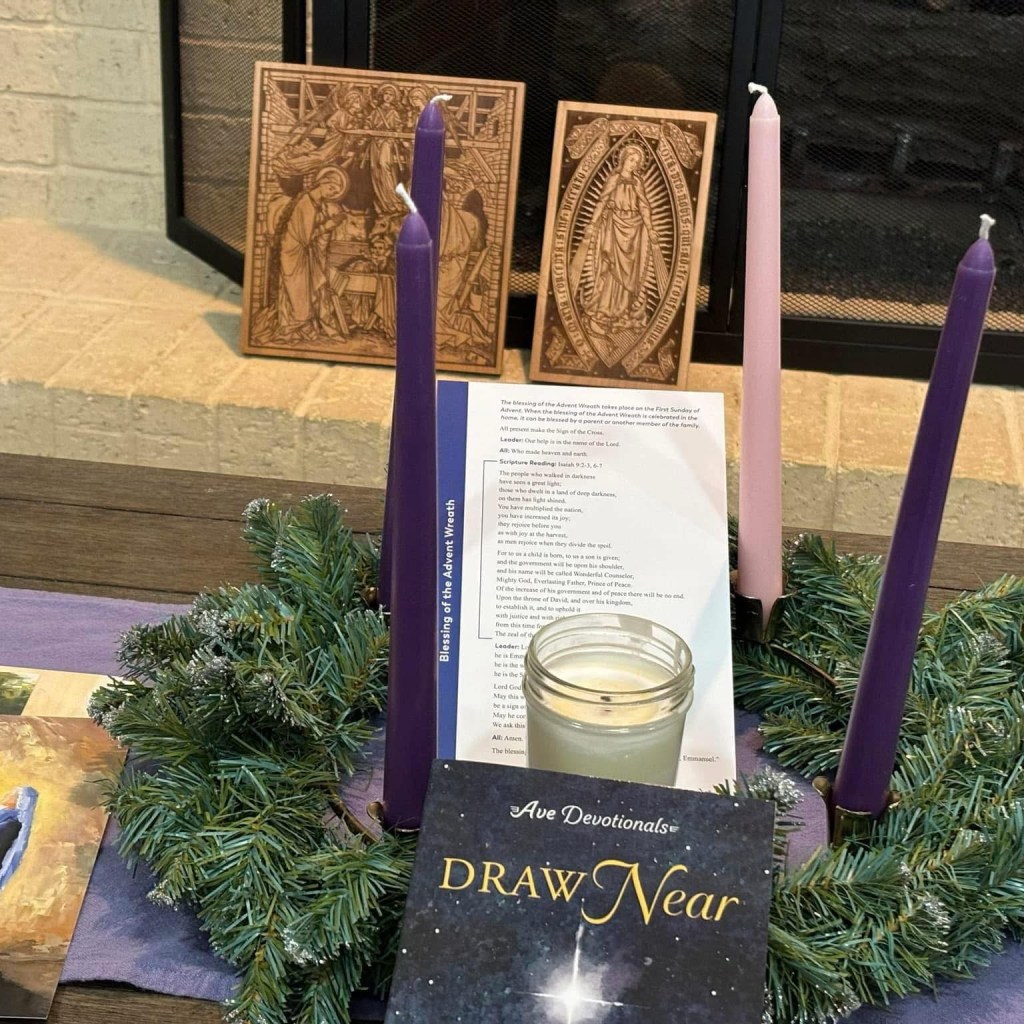
The second reading from Paul’s Epistle to the Romans for the beginning of the new Church year in Advent reminds us to stay awake. We are urged not to give in to the desires of the flesh but to remain ready, awake, and alert. At baptism, we put on the white garment that symbolizes our identity as adopted sons and daughters of God. We are called to put on the purity of Christ, emptying ourselves of what is sinful so that we may be filled with His grace.
Matthew’s Gospel echoes this same call to wakefulness, warning that at the final judgment some will be taken unexpectedly while awaiting the return of the Son of Man. Recalling the cleansing of the world in the time of the flood and Noah, and how this moment fits into the unfolding of salvation history leading to our Lord Christ Jesus, we are invited to reflect on the profound reality that everything prepares the way for His first coming. We must also be ready for His second coming, guided by this imagery of wakefulness.
The Jesse Tree is a wonderful Advent practice that helps us reflect on salvation history. Another meaningful practice is the lighting of the Advent wreath. The circle represents eternity, and the evergreen branches symbolize growth and life. The first candle represents hope, the second represents peace, the third pink candle represents joy, and the fourth represents love. Each candle reflects the light of Christ, the same guiding light symbolized by the star that shone in the night.
We are called to resist the lure and commercialization of the season and to begin with the true meaning of Advent, which means “to come.” When we prepare our hearts and minds in this way, we can joyfully echo the responsorial psalm on Christmas Day: “Let our hearts go rejoicing to the house of the Lord.”
Let us intentionally pause, slow down, and choose an Advent practice that prepares the way for the Christ Child to come. When we release our distractions and stop viewing the calendar as merely a countdown to Christmas, Advent becomes a season of emptying ourselves so that there is room in the inn of our hearts for the light of Christ to dwell. Only then will we be truly ready for His coming.
From the Collect or Entrance Prayer at Mass:
Grant your faithful, we pray, almighty God,
the resolve to run forth to meet your Christ
with righteous deeds at his coming,
so that, gathered at his right hand,
they may be worthy to possess the heavenly kingdom.
Through our Lord Jesus Christ, your Son,
who lives and reigns with you in the unity of the Holy Spirit,
God, for ever and ever.
An Attitude of Gratitude In The Christian Life
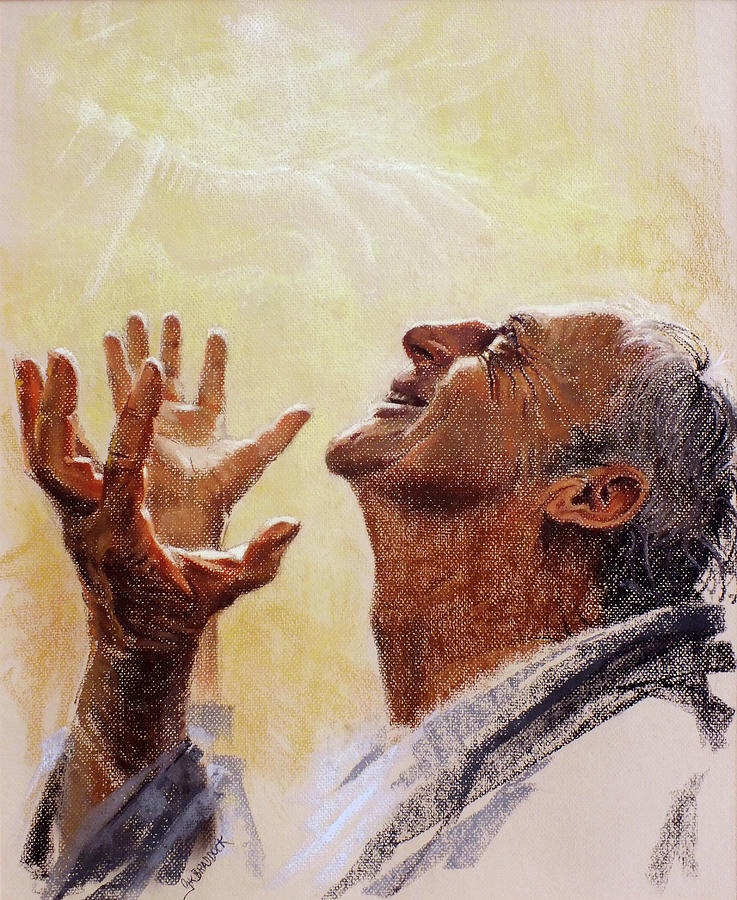
It’s that time of year again where many in the United States will prepare to gather around table with family & loved ones commemorating different traditions of displaying a day of thanksgiving. Such a day recalls the thankfulness from those early pilgrim people settlers for being blessed with the hospitality of the Wampanoag tribe for they knew all too well what it was like to be grateful for the bountiful rewards from mother earth. Such a tradition of giving thanks was done in many households with an agrarian society for those seasons of life where peoples were grateful for a bountiful harvest. It wasn’t until 1863 in which President Lincoln proclaimed the last Thursday of November as a national day of Thanksgiving and the day becoming a federal holiday under President Franklin Roosevelt.
Such a tradition of giving thanks and having an attitude of gratitude reminds us of our own calling as Christian disciples in which being grateful permeates our call to discipleship. President Lincoln, in issuing the proclamation in the midst of a civil war stated “To these bounties, which are so constantly enjoyed that we are prone to forget the source from which they come, others have been added, which are of so extraordinary a nature, that they cannot fail to penetrate and soften even the heart which is habitually insensible to the ever watchful providence of Almighty God” (https://www.abrahamlincolnonline.org/lincoln/speeches/thanks.htm). Lincoln put his trust in God’s providence and acknowledged that even the most hardest of hearts could be grateful. As Catholics, the Greek word for Eucharist is thanksgiving. Spanish colonists and explorers celebrated their arrival to the New World in America in 1565 by celebrating the Mass (https://www.ncregister.com/commentaries/america-s-first-thanksgiving-was-in-florida-seriously-it-was)
It’s so easy to be negative & curse our condition and the way our life turned out. We may complain that we weren’t gifted with certain possessions or a lifestyle we think we should have had compared to others. Perhaps, we are dealing with infirmities, financial distress, family issues or something we wish wouldn’t have occurred for us. Nevertheless, such a mindset does no good. We should take solace in knowing we were knitted in our mother’s womb and made in His image (Ps 139) as unique beings. We are ensouled beings on a mission to go out and be grateful while spreading the good news of Jesus to prepare others for His kingdom. Being grateful for that great prize awaiting us with the choirs of angels & saints with such a loving and wonderful paradise awaiting us should make any heart grateful.
Before Jesus asked for His Father’s help in the raising of his friend Lazarus, he reached out to Father God and proclaimed “Father, I thank you for hearing me” (Jn. 11:41) How often do we give thanks to God each morning we are blessed with another day? Is our daily prayer simply one of petitioning God to remove those crosses without being grateful for the graces He has bestowed on us? We can be like the Samaritan who trusted in God’s will and was healed. Being grateful for both the trials, hardships and blessings in life is a transformative mindset and spiritual journey we all must undertake. To be grateful for the life we received, baggage and all and give it all to an ever-loving, ever-merciful God is the challenge.
The Hymn of Thanksgiving for God’s Everlasting Love from Psalm 136 should remind us of the necessity for us living the Christian lifestyle to be grateful:
1 Give thanks to the Lord, for he is good.
His love endures forever.
2 Give thanks to the God of gods.
His love endures forever.
3 Give thanks to the Lord of lords:
His love endures forever.
To give God thanks is akin to recalling our most favorite Christmas present or birthday present received. God’s grace is a gift that we should all be thankful for because it is a gift multiplied to a magnitude that is beyond reason for God’s love, God’s mercy and God’s grace for His creation endures forever.
We give thanks each and every time within the holy liturgy in which the Spirit turns the bread and wine into the body and blood of our Lord Jesus. We give thanks for those gifts we receive from the Holy Spirit in the sacramental life.
Being able to be thankful for not only the thorns in life, but the beautiful flowers that God gives us epitomizes the Christian life. Turn to the Lord God this day and give thanks. Being grateful not only changes our mindset, but gives us a spiritual demeanor that transforms others around us despite any crosses that might come our way.
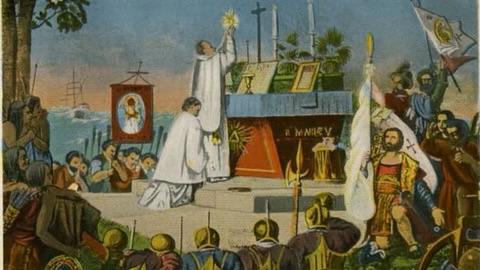
First Thanksgiving – St. Augustine, Florida
September 8,1565 – Nativity of Our Lady
by The Apostolate of Our Lady of Good Success
Today, let our attitude be one of gratitude for God’s love endures forever.
Our Lord Jesus Christ, King of the Universe

Who is the ruler and king of your life? Is it God, through the second person of the Trinity, King Jesus? Or is something in this earthly life separating you from your true identity as an adopted son or daughter of God (Romans 8:15, Galatians 3:26)?
Remember, when Jesus was asked by the teachers of the law what the greatest commandment was, He responded with a simple yet profound truth: “Love the Lord your God with all your heart, with all your soul, with all your mind, and with all your strength, and love your neighbor as yourself” (Mark 12:30-31). This commandment beautifully sums up the totality of God’s law written upon our hearts, and it should remind us of the wisdom and mercy of our King.
In today’s Gospel, we are reminded that our ultimate goal is to be with our King in paradise. Like the penitent sinner who turns to Jesus for mercy, we too must recognize our dependence on our heavenly King as we hang upon the crosses of our own struggles and weaknesses. As we look to Jesus, the source of our salvation, we ask for His mercy and grace, trusting that He is the ruler who leads us to eternal life.
In Matthew’s Gospel, Jesus presents the corporal works of mercy, showing us how we are called to attend to the bodily needs of our brothers and sisters. By caring for others—feeding the hungry, giving drink to the thirsty, clothing the naked, visiting the imprisoned, comforting the sick, and welcoming the stranger—we embody His love and mercy. We cannot enter the Kingdom of God, both here and in the life to come, if we ignore those in need around us.
Jesus, our King, rules over heaven, earth, and the entire universe. If we are to follow Him into the Kingdom and avoid eternal separation from God, we must actively care for others, providing for their basic needs and showing compassion. These acts of mercy may not always be easy, but they are essential.
For instance, as we prepare for the season of Advent, we might consider going through our closets and donating our gently used clothes to charity—not just the things we no longer want, but items that could truly benefit others. We could also donate to a local food pantry or help with a food drive in our community. While we may not personally know anyone in prison, there may be local jail ministries or outreach programs we can support.
Perhaps the hardest work is welcoming the stranger—the outcast, the one on the margins. Jesus calls us to open our hearts and our homes, making room for others in the “inn” of our hearts. If we are to enter His Kingdom, we must practice this kind of radical hospitality and love.
Jesus was born into this world, God incarnate, to walk among us and offer Himself as a living sacrifice for our sins. The question we must ask ourselves is: If Jesus came to earth today, would we recognize Him? Or would we dismiss Him as just another radical or outcast? The challenge is to see His presence in those around us and respond with love and mercy, as He has shown us.
Today the Catholic Church celebrates Jesus Christ as the Lord and King of the Universe—over both heaven and earth. This feast was first established by Pope Pius XI in 1925 to be observed in late October, as a reminder to the world of Christ’s sovereignty amid rising secularism. Later, Pope St. Paul VI moved the celebration to the final Sunday of the liturgical year, immediately before the start of Advent. This placement is fitting, as it highlights the salvific gift our King offers through the incarnation of His Son and prepares our hearts to welcome Christ anew in the Advent season.
It is easy to become absorbed in the limited vision of life on earth and forget our true calling as disciples of Jesus. Life is often messy, filled with strife, anxiety, sin, and the imperfections of a broken world. As we prepare for the upcoming liturgical season of Advent—a penitential time of waiting and hope—we are invited to ready our hearts for the light and majesty that come with the birth of our King, Christ the Lord. This preparation helps us grasp the deeper meaning of today’s solemnity.
Reflecting on the first coming of Jesus as a humble baby born in a manger offers a striking contrast to our typical image of earthly kings. Jesus was not born in a palace or into wealth, but into the humble home of a carpenter from Nazareth and a young woman named Mary. Mary, full of grace and chosen to be the new Ark of the Covenant, was preserved from the stain of sin and honored as the Theotokos—the God-bearer. Her “yes” made room for the King of the Universe to enter the world in simplicity and humility.
This same King faced resistance from the very beginning. Earthly King Herod sought to destroy the infant Jesus in a desperate attempt to preserve his own fragile power—power rooted in fear rather than in the promise of eternal life offered to all in the Kingdom of Heaven. And unlike earthly rulers crowned with gold, our King would one day wear a crown of thorns pressed upon His head. His royal rings were the nails driven into His hands and feet. The ultimate price paid by our King was His own precious blood, poured out for the salvation of all creation. His love is infinite—far beyond any earthly measure or limitation.
Jesus will come again—and the question we must ask ourselves is this: Will we be ready? We are called to prepare our hearts, staying spiritually awake and attentive, so that we may welcome our King when He comes in glory.
On this day, let us humbly and prayerfully reflect on how we can invite Jesus more fully into our lives, allowing Him to be the ruler of our hearts and the very center of our souls. Such reflection may lead us to concrete action—letting go of earthly attachments, possessions, or desires that hinder us from caring for the needs of others in our homes and communities. May we be transformed by the benevolent and loving reign of our King, who desires to bring peace and joy to His chosen people.
As the composer Father Martin B. Hellriegel expressed in his hymn To Jesus Christ, Our Sovereign King, written on the eve of rising darkness in pre–World War II Germany, we are reminded of Christ’s unshakable sovereignty and our call to faithful allegiance to Him alone.
Christ Jesus Victor!
Christ Jesus Ruler!
Christ Jesus, Lord and Redeemer!
When the King Draws Near: Pondering the Closing of the Liturgical Year (33rd Sunday in Ordinary Time)

Four Horsemen of Apocalypse (1887) Glinka National Museum Consortium of Music Culture, Moscow by Viktor Vasnetsov from the public domain
The Church stands again at the threshold of endings and beginnings. A quiet hush settles over the liturgical year, as if creation itself pauses, listening for the footfall of the coming King. The readings echo like distant thunder, not to frighten us, but to remind us that all of history bends toward a radiant dawn.
The Lord is near.
The King is coming.
Lift your eyes.
Malachi speaks of heat and light, of a day blazing like an oven, yet also of a sun of justice rising with healing in its rays. The fire of God does not come to consume the faithful but to cleanse, to illuminate, and to make whole. Each of us carries corners where shadows linger, yet Christ comes not with condemnation but with sunrise. As the year fades, we are invited to let the old be burned away so that new life in Him can break forth like morning after a long night.
The psalmist imagines rivers clapping their hands, mountains lifting their voices, and seas roaring with joy. Creation longs for the God who judges with justice and heals what sin has wounded. The world aches, but its ache is a longing for the King.
Saint Paul draws this cosmic vision down into the soil of ordinary days. He tells us to work quietly, live faithfully, avoid idleness, and remain humble and ready. Holiness grows in the steady rhythm of daily obedience.
In the Gospel, Jesus speaks of temples falling and kingdoms shaking. Earthquakes, famines, and plagues remind us that earthly things are fragile. Yet into this swirl of uncertainty He whispers peace. “Do not be terrified. I will give you wisdom. Not a hair on your head will be destroyed. By your perseverance you will secure your lives.” The unraveling of the world is not the unraveling of His love. His throne stands firm.
As we draw near to the Solemnity of Christ the King, we hear the Alleluia verse like a trumpet call:
“Stand erect and raise your heads, because your redemption is at hand.”
This week, we prepare our hearts for the One who reigns with mercy and truth. Do not be distressed by the chaos of the world. Christ the King comes to lead us into wisdom, peace, and purity, into a Kingdom that cannot be shaken.
The Stillness That Speaks
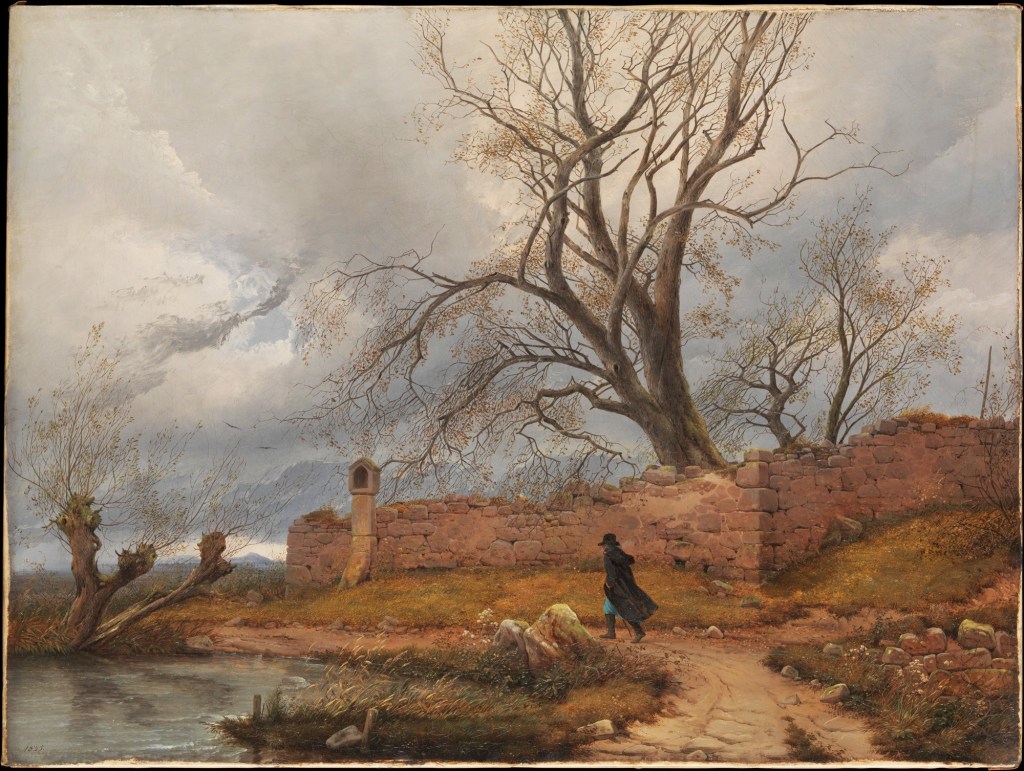
Our world and modern society are always on the go. Stillness is often mistaken for complacency, and silence can feel uncomfortable in an age of constant motion. My own tendency toward restlessness has, through the years, been tempered by grace. God continues to teach me to stop and smell the roses, to recognize that His presence is not found in frantic activity but in peaceful surrender
We live in a culture of instant gratification and seamless delivery, always connected and always consuming. Yet Holy Scripture reminds us of something different. When the prophet Elijah sought the Lord, he did not find Him in the wind, the earthquake, or the fire, but in a still small voice (1 Kings 19:11–12). Likewise, Jesus often withdrew to lonely places to pray (Luke 5:16), retreating to the wilderness to commune with His Father and to rest from the crowds.
If the Son of God needed silence and solitude, how much more do we?
We must learn to look to the stillness and quiet of our hearts. It is there, in the sacred silence, that the Holy Spirit speaks. Modern distractions such as smartphones, social media, and endless notifications tempt us to fill every moment with noise. We scroll, post, and capture memories through a dozen photos, yet rarely dwell in the moment itself. This noise is not the voice of God. More often, it is the roaring lion of distraction (1 Peter 5:8), seeking to pull us away from the gentle whisper that brings peace.
As we recently celebrated the Solemnities of All Saints and All Souls, we are reminded of those who have gone before us. Men and women who, through prayer and humility, learned the value of silence. Saints like Teresa of Avila, who said, “The Lord walks among the pots and pans,” and Thérèse of Lisieux, who found holiness in the hidden simplicity of daily life, teach us that sanctity grows in quiet trust.
How can we silence the anxiety of our busy world and allow Jesus to enter deeply into our hearts? Perhaps by reclaiming small moments of silence before meals, at the end of the day, or during a morning commute to whisper like Samuel, “Speak, Lord, for your servant is listening” (1 Samuel 3:10).
When we make room for stillness, we make room for Christ. And when Christ dwells within us, our homes, workplaces, schools, and communities can glimpse His light shining through us.
Moments Of Reflection:
When was the last time I paused long enough to listen for the gentle whisper of the Lord?
What moments in my day could I offer back to God in silence rather than distraction?
How can I help create a peaceful space in my home, workplace, or parish that allows others to encounter Christ’s presence?
Prayer:
Lord Jesus, You withdrew from the crowds to speak with Your Father in silence and peace. Teach me to find that same stillness in my own heart. Quiet the noise of the world around me, calm my anxieties, and help me to listen for Your voice. May Your Spirit guide my thoughts, my words, and my actions so that others may see Your love shining through me. Amen.
All Saints & All Souls
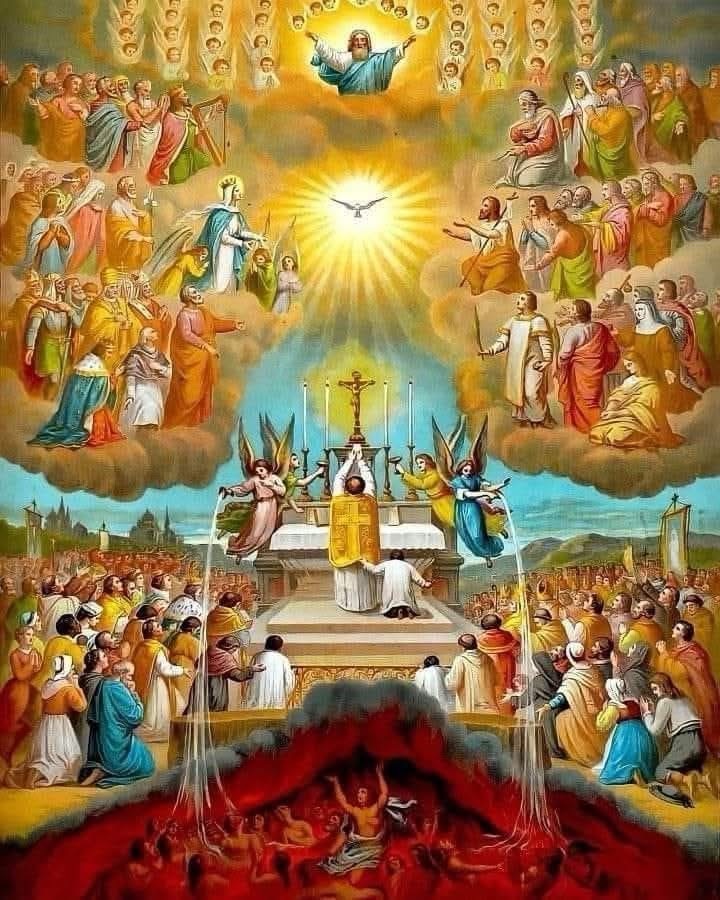
All Saints
Dear holy saints of God,
we join our prayers of praise to yours this day.
With you, we sing of God’s goodness,
rejoice in God’s mercy,
and celebrate God’s incredible love.
Teach us to live as you lived –
always thinking of others,
always recognizing your weaknesses,
always rejoicing in God’s gifts,
always following Jesus.
Blessed are you, happy are you,
all holy saints of God.
Pray for us that we, too,
may someday be among God’s holy ones.
All Souls
The Prayer of St. Gertrude
Eternal Father, I offer Thee the Most Precious Blood of Thy Divine Son, Jesus, in union with the masses said throughout the world today, for all the holy souls in purgatory, for sinners everywhere, for sinners in the universal church, those in my own home and within my family.
Amen.
Our Lady of The Rosary
Have you prayed the rosary lately? Perhaps you need a refresher and here are a few links from the US Conference of Catholic Bishops https://www.usccb.org/how-to-pray-the-rosary & Rosary Center https://rosarycenter.org/how-to-pray-the-rosary to get you started.
Such a strong devotion within the Catholic faith has her roots from the biblical accounts from scripture in which we meditate upon such mysteries as the Resurrection of Christ Jesus, or His Ascension and of Mary’s role in salvation history with the announcement of the birth of Jesus by the angel with the joyful mysteries. We may meditate upon other mysteries of sorrow that remind us to stay awake with Jesus in the Garden of Gethsemane as he takes up the cross on our own roads of life to Calvary with Jesus. For many including myself, the recitation of the rosary may seem mundane and filled with repetitive prayers that aren’t fruitful. However this assumption does not bear weight for the simple repetitive prayers help us clear our mind of the daily distractions of life to contemplate more fully the life of Mary as being full of grace and of the life of our Lord, Jesus. As Pope Paul VI states in Marialis Cultus 46 the rosary is “a Gospel prayer, centred on the mystery of the redemptive Incarnation, the Rosary is a prayer with a clearly Christological orientation. Its most characteristic element, in fact, the litany- like succession of Hail Marys, becomes in itself an unceasing praise of Christ…” (https://www.vatican.va/content/paul-vi/en/apost_exhortations/documents/hf_p-vi_exh_19740202_marialis-cultus.html).
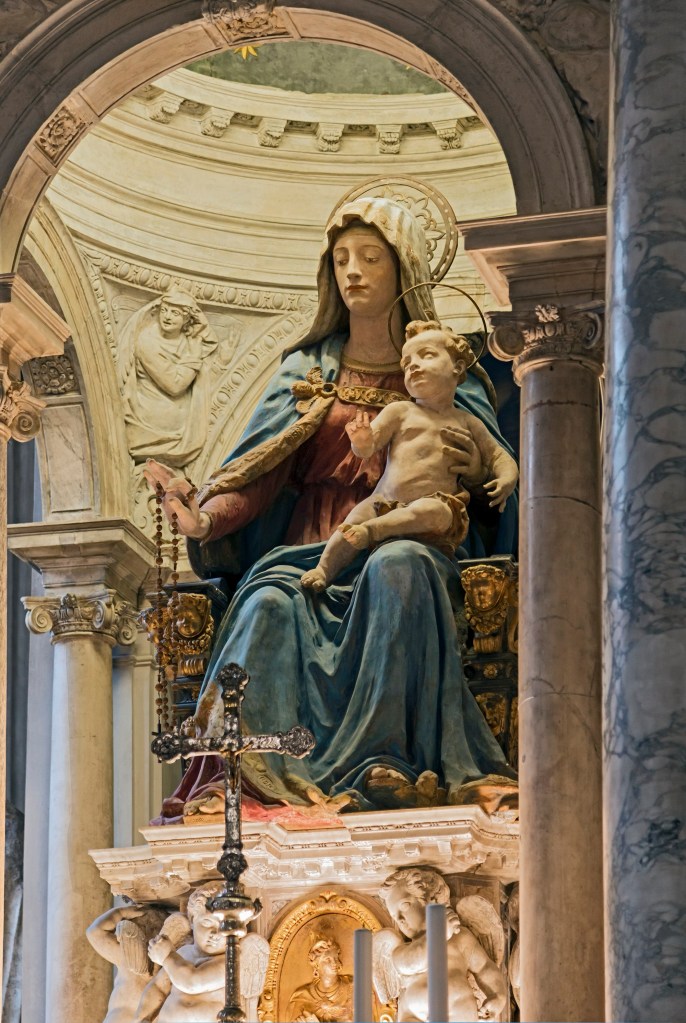
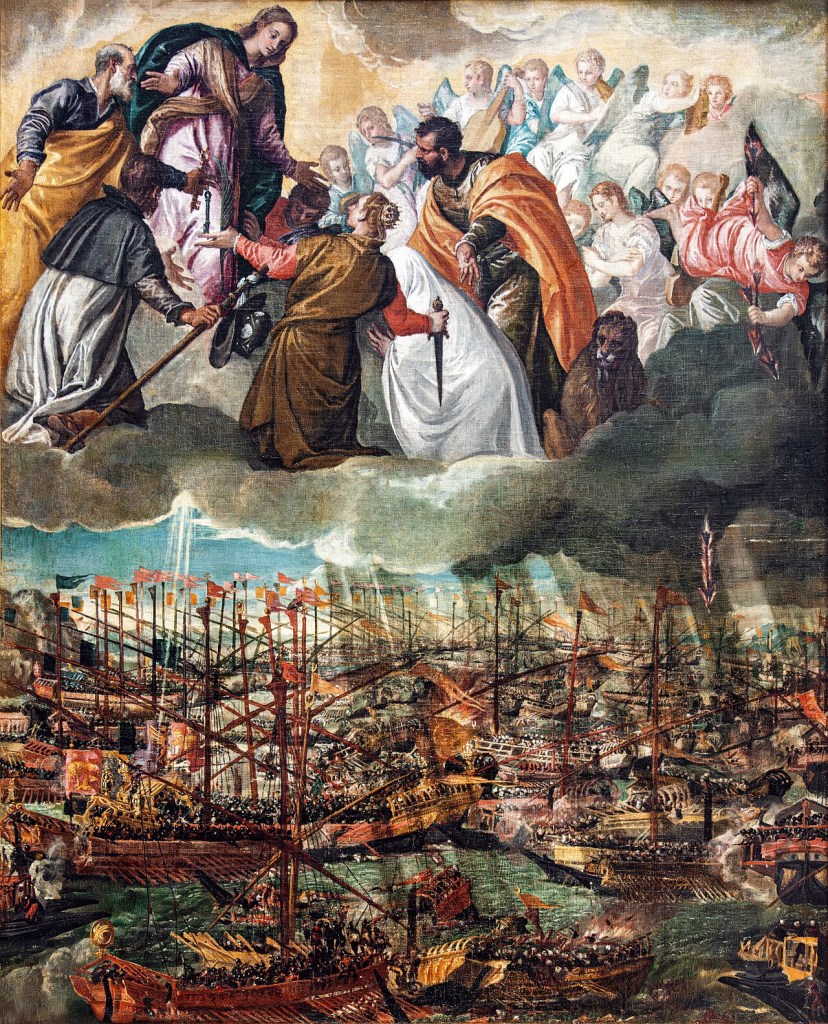
On October 7, 1571 the fleet of the Ottoman Turks was defeated by the Christian fleet at the naval battle of Lepanto. St. Pius V declared such a day as “Our Lady of Victory” recalling the powerful prayer of the rosary and of asking those holy saints, Mary as Queen of all Saints, for their intercession in seeking God’s favor which was granted by the Christian people not being annihilated on this day. Pope St. Pius X commemorated this day in 1913 known as Our Lady of the Rosary (https://www.franciscanmedia.org/saint-of-the-day/our-lady-of-the-rosary/)
As Fr. Patrick Peyton, C.S.C. reminds us of in this vintage video, “the family that prays together, stays together” when reciting such a beautiful prayer. https://m.youtube.com/watch?v=LXFlEJIpkqQ
Such a reminder allowed our family to create our own video reflection of the rosary of my daughter’s desire to be on YouTube & her voice is on some of these slides. https://m.youtube.com/channel/UC8v7hPc94IJOOrHZf1a-OMg?guided_help_flow=5
Our family and myself included have benefitted from this strong contemplative devotion. I highly encourage you to take up the prayer of the rosary as a devotion in your life.
God bless, Eric.
Memorial of the Guardian Angels

Angel of God, my guardian dear, to whom God’s love commits me here, ever this day be at my side to light and guard, to rule and guide. Amen.
Feast of Saints Michael, Gabriel, and Raphael, archangels


A Sermon by Pope St Gregory the Great
You should be aware that the word “angel” denotes a function rather than a nature. Those holy spirits of heaven have indeed always been spirits. They can only be called angels when they deliver some message.
You should be aware that the word “angel” denotes a function rather than a nature. Those holy spirits of heaven have indeed always been spirits. They can only be called angels when they deliver some message. Moreover, those who deliver messages of lesser importance are called angels; and those who proclaim messages of supreme importance are called archangels. And so it was that not merely an angel but the archangel Gabriel was sent to the Virgin Mary. It was only fitting that the highest angel should come to announce the greatest of all messages.
Some angels are given proper names to denote the service they are empowered to perform. In that holy city, where perfect knowledge flows from the vision of almighty God, those who have no names may easily be known. But personal names are assigned to some, not because they could not be known without them, but rather to denote their ministry when they came among us. Thus, Michael means “Who is like God”; Gabriel is “The Strength of God”; and Raphael is “God’s Remedy.”
Whenever some act of wondrous power must be performed, Michael is sent, so that his action and his name may make it clear that no one can do what God does by his superior power. So also our ancient foe desired in his pride to be like God, saying: I will ascend into heaven; I will exalt my throne above the stars of heaven; I will be like the Most High. He will be allowed to remain in power until the end of the world when he will be destroyed in the final punishment. Then, he will fight with the archangel Michael, as we are told by John: A battle was fought with Michael the archangel.
So too Gabriel, who is called God’s strength, was sent to Mary. He came to announce the One who appeared as a humble man to quell the cosmic powers. Thus God’s strength announced the coming of the Lord of the heavenly powers, mighty in battle. Raphael means, as I have said, God’s remedy, for when he touched Tobit’s eyes in order to cure him, he banished the darkness of his blindness. Thus, since he is to heal, he is rightly called God’s remedy.
Prayer:
St. Michael the Archangel, defend us in battle, be our protection against the wickedness and snares of the devil. May God rebuke him we humbly pray; and do thou, O Prince of the Heavenly host, by the power of God, cast into hell Satan and all the evil spirits who prowl about the world seeking the ruin of souls.
Amen.
St. Pio of Pietrelcina O.F.M. Cap., Pray for Us

About Padre Pio: https://www.ewtn.com/catholicism/library/padre-pio-his-biography-13815
Letter from Padre Pio To Raffaelina Cerase, May 19, 1914
Stones of the eternal dwelling
The divine craftsman gets ready to prepare stones to build an eternal temple; he cuts these stones by repeated blows of his hammer and carefully polishes them by removing any excess.
This is what the holy Catholic church, our tender Mother sings, as the hymn of the Office of the Dedication of a Church. And it can be seen to be true in this way. Each heart intended for eternal glory can be very well considered as one of these stones created for the eternal temple. When a contractor wants to build a house, he must first cut the stones, which will be used for construction; this he does with blows of hammer and chisel. Thus our heavenly Father acts on the heart which he chooses and desires from all eternity, in his great wisdom and Providence, to build as an eternal dwelling place.
To reign with Christ in eternal glory, the heart must thus be cut with large blows of hammer and chisel; in this way, as with stones, the divine architect prepares the hearts that it chooses. What are these blows of hammer and chisel? They are the shadows, my sister: the fears, temptations, afflictions, spiritual anxieties, and also the physical maladies.
Therefore, give thanks for the infinite tenderness of our Heavenly Father, who deals thus with your heart to save it. Why will mature people not praise these kind gestures that every father does? Open your heart to this celestial doctor of hearts and surrender yourself in all confidence to his very sacred hands for he treats you as someone whom he has chosen to follow Jesus closely, until the summit of martyrdom. As for me, I believe, that his grace will make itself manifest in you through the joy and wise movement of your heart. Thus, do not doubt that all that happens to your soul has been willed by the Lord. Thus, do not fear that God makes you fall into some evil or ruin! It should be enough for you to know that in all your life, you never offended the Lord whom you should approach more and more.
If this most benevolent Spouse hides himself in your heart, he does so, not as a punishment for your sin as you believe, but to further test your fidelity and your constancy; and moreover, to cure some weakness that your eyes of feeble, failing flesh, do not see, of which no one is simply free. As we know from the Holy Scripture: the righteous man falls seven times a day. (Pr 24,16).
And believe me, if I did not learn that you are also afflicted, I would be less happy, since I would think that the Lord decides to give you less pearls… Drive out like temptations doubts to the contrary… Drive out also the doubts that refer to your manner of living, namely, that you did not heed the divine calls and that you opposed the gentle invitations of your Husband. All that does not come from the good spirit, but from the bad. They are diabolic tricks that aim to bring you away from perfection, or at least to delay you along his way. Do not lose courage!
When Jesus shows himself to you, thank him; should he hide from you, thank him still. To love, everything is a joy. I wish that you deliver your spirit with Jesus on the cross and that you be able to say with him: All is accomplished! (Jn 19,30)
(retrieved from the Divine Office of Readings)
St. Matthew, Apostle, & Gospel Writer

Mt. 9:9-13 As Jesus passed by, he saw a man named Matthew sitting at the customs post. He said to him, “Follow me.” And he got up and followed him. While he was at table in his house, many tax collectors and sinners came and sat with Jesus and his disciples. The Pharisees saw this and said to his disciples, “Why does your teacher eat with tax collectors and sinners?” He heard this and said, “Those who are well do not need a physician, but the sick do. Go and learn the meaning of the words, I desire mercy, not sacrifice. I did not come to call the righteous but sinners.”
It is remarkable that the apostle and gospel writer, St. Matthew, would mention his profession & humble call to follow our Lord. The synoptic gospel writers St. Mark & St. Luke also mention the call of Levi or Matthew in their accounts. St. Luke adds a further detail noting that a banquet in St. Mathew’s home was given:
Lk 5:29 Then Levi gave a great banquet for him in his house, and a large crowd of tax collectors and others were at table with them.
As St. Bede mentions regarding the banquet that St. Matthew held, “he not only gave a banquet for the Lord at his earthly residence, but far more pleasing was the banquet set in his own heart which he provided through faith and love” (Bede, the Venerable, Hom. 21: CCL 122, 149-151, excerpt from Office of Readings of the Divine Office).
In many respects, the taking & giving of earthly wealth and the occupation of a tax collector were not professions of prestige. St. Matthew knew from the invitation to follow Jesus that he had to act. How do we act and respond to God’s call in our life? Is there some earthly fear holding us back? The lure and temptation to allow mammon to become our “god” by accumulating power and wealth is a real temptation to those of us who are sinners & sick among us in need of healing. As our Lord reminds us in another account, when responding to the Pharisees in paying the census tax we should “repay to Caesar what belongs to Caesar and to God what belongs to God” (Mt. 22:21). The gospel also reminds us of the insurmountable and eternal truth of God where heaven and earth may pass away, but the words of Jesus shall never pass as a reminder to all of us (Mt. 24:35). Matthew heeded the words of Jesus to come & follow him.
While we may stray from the path and allow temptation & other worldly concerns to separate us from God’s invitation to follow Him, let our hearts be ready for the banquet for the Lord to enter where our faith & love are present.
St. Matthew, pray for us.
St John Chrysostom – Whom Shall I Fear?
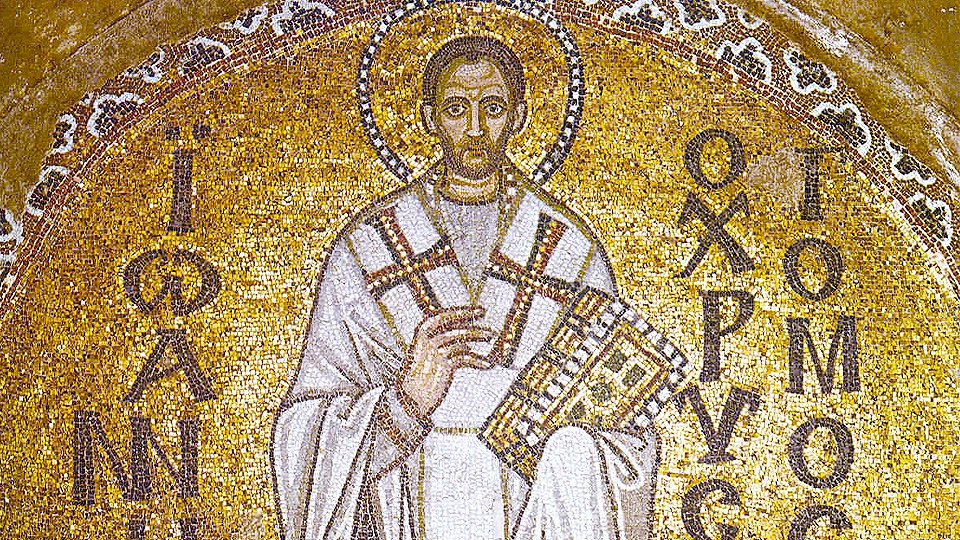
A Byzantine mosaic of John Chrysostom from the Hagia Sophia
From the office of daily readings for September 13, Memorial of St. John Chrysostom, Bishop and Doctor. An excerpt of a homily by St John Chrysostom:
The waters have risen and severe storms are upon us, but we do not fear of drowning, for we stand firmly upon a rock. Let the sea rage, it cannot break the rock. Let the waves rise, they cannot sink the boat of Jesus.What are we to fear? Death? Life to me means Christ, and death is gain. Exile? ‘The earth and its fullness belong to the Lord. The confiscation of goods? We brought nothing into this world, and we shall surely take nothing from it. I have only contempt for the world’s threats, I find its blessings laughable.I have no fear of poverty, no desire for wealth. I am not afraid of death nor do I long to live, except for your good. I concentrate therefore on the present situation, and I urge you, my friends, to have confidence.Do you not hear the Lord saying: Where two or three are gathered in my name, there am I in their midst? Will he be absent, then, when so many people united in love are gathered together? I have his promise; I am surely not going to rely on my own strength!I have what he has written; that is my staff, my security, my peaceful harbor. Let the world be in upheaval. I hold to his promise and read his message; that is my protecting wall and garrison. What message? Know that I am with you always, until the end of the world!
If Christ is with me, whom shall I fear?
Though the waves and the sea and the anger of princes are roused against me, they are less to me than a spider’s web. Indeed, unless you, my brothers, had detained me, I would have left this very day. For I always say “Lord, your will be done”; not what this fellow or that would have me do, but what you want me to do. That is my strong tower, my immovable rock, my staff that never gives way. If God wants something, let it be done! If he wants me to stay here, I am grateful. But wherever he wants me to be, I am no less grateful.Yet where I am, there you are too, and where you are, I am. For we are a single body, and the body cannot be separated from the head nor the head from the body.Distance separates us, but love unites us, and death itself cannot divide us.For though my body die, my soul will live and be mindful of my people.You are my fellow citizens, my fathers, my brothers, my sons, my limbs, my body. You are my light, sweeter to me than the visible light. For what can the rays of the sun bestow on me that is comparable to your love? The sun’s light is useful in my earthly life, but your love is fashioning a crown for me in the life to come.
More about the biography of St. John Chrysostom, Bishop & Doctor:
23rd Sunday In Ordinary Time Reflection – Take Up Your Cross To Be A Disciple

“Whoever does not carry his own cross and come after me cannot be my disciple (Lk. 14:27).
I saw a quote awhile back – “anyone can wear one, but who can bear one” as it relates to the cross. We wear crosses as jewelry and as a symbol of our faith, but how often do we bear them as a condition of Christian discipleship?
The Gospel of Luke challenges us once again as we approach the Solemnity and Exaltation of the Holy Cross on September 14. It reminds us that discipleship involves sacrifice and the act of surrendering everything to Jesus. Luke’s words, particularly when he tells us to “hate our own brother, sister, mother, father, wife, and children…” can be difficult to hear. But at its core, this passage calls us to reflect on where we place our ultimate dependence—on earthly relationships or on the will of God.
As the first reading from Wisdom 9:15 reminds us, “the corruptible body burdens the soul, and the earthly tent weighs down the mind with its many concerns.” It’s easy for the demands of this earthly life and our obligations to family, friends, neighbors, work, society to weigh us down. In doing so, we can lose sight of the greater journey—the call to follow Jesus’s invitation to take up our cross. Sometimes, this means carrying not only our own burdens, but also the struggles of those we love, all in pursuit of something greater as a core part of discipleship.
As the responsorial psalm reminds us, In every age, O Lord, you have been our refuge.”
To truly be disciples, we must carve out moments each day to give God His due. God, and not anyone or anything in this life, is our true refuge. How deeply do you trust in this? We must not let anxiety or worry weigh us down, for we are meant for greater things—a future with a loving and merciful Father in heaven!
This week, ask yourself the following:
1. How can I more fully trust in God as my refuge, especially when life’s burdens and worries threaten to overwhelm me?
2. What steps can I take each day to set aside time to honor God and align my heart with His purpose?
3. How can I bear my daily cross in order to surrender everything to Jesus to make Him the Lord and ruler of my life?
Try praying the morning offering to acknowledge the sacrifice of discipleship:
O Jesus, through the Immaculate Heart of Mary, I offer you my prayers, works, joys, and sufferings of this day for all the intentions of your Sacred Heart in union with the Holy Sacrifice of the Mass throughout the world, for the salvation of souls, the reparation of sins, the reunion of all Christians, and in particular for the intentions of the Holy Father this month. Amen.
Faith & Trust in God’s Will
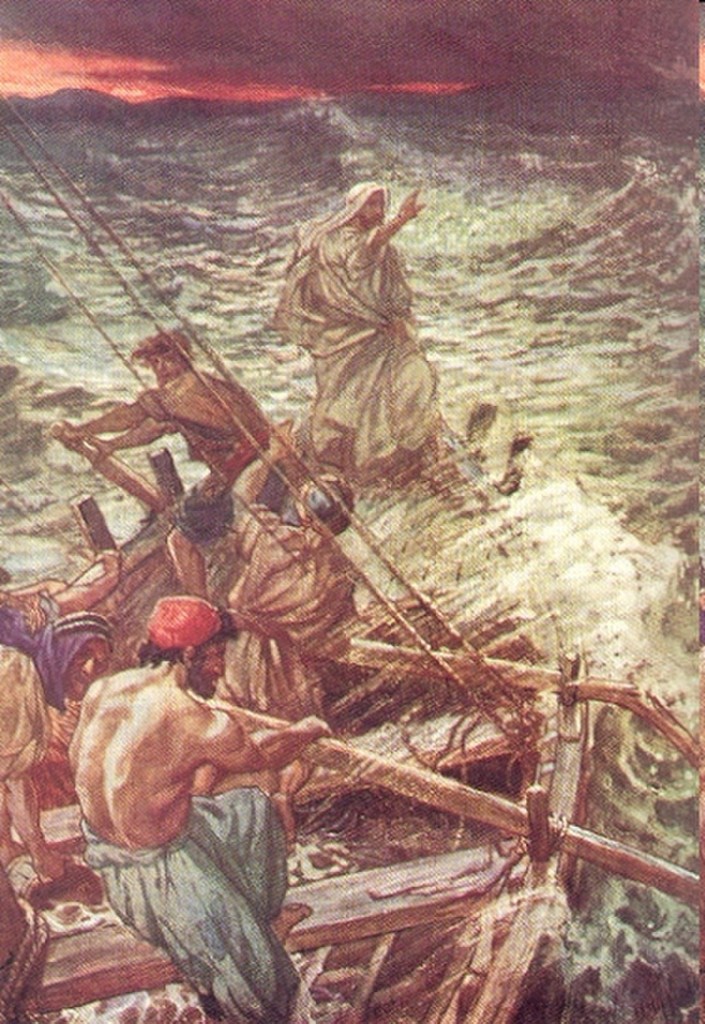
According to the Catechism of the Catholic Church, faith is defined as the following: 1814 Faith is the theological virtue by which we believe in God and believe all that he has said and revealed to us, and that Holy Church proposes for our belief, because he is truth itself. By faith “man freely commits his entire self to God.
Every time our family prays the rosary and asks for the grace to receive an increase in not only hope & charity; we also ask for an increase in faith. By God’s design as with Job in the Old Testament, is faith in God’s will present during those turbulent times.
Consider the human virtue of trust which we learn over time. As babies, we trust our parents to provide food, shelter & security. When we marry or are in a relationship, we pledge our promise of trust to the other person. However, one thing that is lacking in our present day society is trusting in God’s will & plan.
We value our human dependence & have the tendency to sweep God’s will & time for God in our prayer life under the proverbial rug. Only when we need something do we ask for God’s divine guidance only to realize that trust & faith are a two way street. Asking for God’s assistance to get through the difficult times is a momentous task when we don’t have a relationship with God to begin with.
Perhaps we place idols of entertainment, food, money or items that provide a false sense of comfort & trust before trusting & having faith in that we don’t see.
As Paul’s Epistle to the Ephesians reminds us, “hold onto the shield of faith with which one can extinguish all the arrows of the evil one” (Eph 6:16).
As doubting Thomas reminds us when casting his hands upon the wounds of the risen Jesus, “my Lord & my God!” (Jn. 20:28).
Reach out & take God’s hand found in Jesus our brother, friend, teacher & Savior. Let us ask for an increase in the virtue of faith & place our trust in God.
Do Not Let Your Hearts Be Troubled

Jn. 14:1-12 “Do not let your hearts be troubled. You have faith in God; have faith also in me. In my Father’s house there are many dwelling places. If there were not, would I have told you that I am going to prepare a place for you? And if I go and prepare a place for you, I will come back again and take you to myself, so that where I am you also may be. Where I am going you know the way.” Thomas said to him, “Master, we do not know where you are going; how can we know the way?” Jesus said to him, “I am the way and the truth and the life. No one comes to the Father except through me. If you know me, then you will also know my Father. From now on you do know him and have seen him.” Philip said to him, “Master, show us the Father, and that will be enough for us.” Jesus said to him, “Have I been with you for so long a time and you still do not know me, Philip? Whoever has seen me has seen the Father. How can you say, ‘Show us the Father’? Do you not believe that I am in the Father and the Father is in me? The words that I speak to you I do not speak on my own. The Father who dwells in me is doing his works. Believe me that I am in the Father and the Father is in me, or else, believe because of the works themselves. Amen, amen, I say to you, whoever believes in me will do the works that I do, and will do greater ones than these, because I am going to the Father.”
It is easy to think that God is absent in our life when tragedy occurs in our midst. Many claim that simply praying for someone or a family that is grieving is a passive affair. However, in John’s gospel of the farewell speech to his disciples, Jesus reminds us of his continued presence.
How can we do the works that Jesus did in a troubled world? When we have a solid relationship with Jesus who was sent by the Father to be the “way, the truth and the life” can we allow the Holy Spirit to enter our hearts to bring about change and action. Prayer leads us to action because it is an act of transformation rather than a passive affair.
Having the faith to get back up when we fall down or something tragic occurs is what is expected of us in the Christian life. The promise that we too will have a dwelling place prepared for us according to Jesus is something to recall on our earthly journey to prepare the way for His return. This dwelling place is not some far off distant heavenly paradise, but is our soul yearning for the Holy Spirit to make a home for us. We are a pilgrim people always on a journey seeking Christ Jesus in our midst to go out and be a disciple to those that need His love. Our duty to become saints by asking God to give us the grace to be a person that has lived a life of heroic virtue is our call.
What does an active prayer life look like? St. Mother Teresa of Calcutta said it best: “My vocation is to belong to Jesus, to cleave to Jesus. The work is the fruit of my love and my love is expressed in my work. . . . Prayer in action is love in action.” (https://www.franciscanmedia.org/franciscan-spirit-blog/mother-teresa-love-in-action/#:~:text=Prayer%20in%20action%20is%20love,in%20every%20person%20they%20encountered.).

Prayer in action is love in action. A powerful statement that allowed the Holy Spirit to move Mother Teresa to do great acts of service. We too are called to be “missionaries of charity” heeding the call to go out and be a compassionate and gentle hand as a reminder to those that need us to be instruments of God’s love in the world.
St Teresa of Avila reminds us of our Christian mission with the following:
Christ has no body but yours,
No hands, no feet on earth but yours,
Yours are the eyes with which he looks compassion on this world,
Yours are the feet with which he walks to do good,
Yours are the hands, with which he blesses all the world.
Yours are the hands, yours are the feet, yours are the eyes, you are his body.
Christ has no body now on earth but yours
Let our hearts not be troubled this day. Go out, empowered by the Holy Spirit, to be a light to others and remind them that Jesus is the way, the truth, and the life.
Memorial of the Immaculate Heart of Mary

Growing up as a child, I recall having a special fondness for Mary. Mary is known by many titles such as: the Queen of Saints, the Blessed Mother, the Theotokos (God-bearer), Queen of Heaven, Virgin most renowned, Mystical Rose, the New Eve, etc. Such titles can be found in the Litany to Mary (https://www.ewtn.com/catholicism/devotions/litany-of-loreto-246).
I recall both my grandmothers and mother having a devotion to Mary from memories of praying the rosary in reflecting on the scriptural accounts of our Lord’s life. In having lost a beloved maternal grandmother, Thecia (Mema) at an early age I turned to Mary for consolation. After all, what better way to seek the love of God in the Father & Son than through His mother who is full of grace (Lk. 1:28). My paternal grandmother, Evelyn (Grandma), prayed the rosary daily and fondly recall her cassette tapes with the rosary songs and meditations playing when I visited her house. My mother’s (Linda) pendant necklace she received from her mom after her passing is an image of Mary I fondly recall as she would wear it for special occasions at mass. Such moments where I saw the heart of the matriarchs of my family and their love for Mary deepened my faith life. It is Mary’s Immaculate Heart working through us that led this adopted son closer to wanting to seek God’s great love.
When my wife Angela & I pray the rosary together with our precious daughter, Abigail, it is a bond like no other. While our daughter is young and sometimes can’t meditate on the mysteries like adults, it is good practice for her learning the prayers as she knows something special is taking place. The family that prays together stays together.
The memorial of Mary’s Immaculate Heart after the feast of the Sacred Heart of Jesus is one in which we unite behind our blessed Mother in seeing her sorrow for our Lord Jesus’s great love in that her heart was also pierced by a sword per Simeon’s prophecy at the presentation of Jesus in the temple. “Simeon blessed them and said to Mary his mother, “Behold, this child is destined for the fall and rise of many in Israel, and to be a sign that will be contradicted and you yourself a sword will pierce so that the thoughts of many hearts may be revealed.” (Lk. 2:34-35). The white roses surrounding her heart symbolize her Immaculate Conception in which she knew no sin as affirmed by church dogma in 1854 with Pope Pius IX’s Infallibus Deus (https://www.papalencyclicals.net/pius09/p9ineff.htm). Mary is the New Eve to which our hearts may unite to hers in doing God’s will. The fire surrounding her heart represent her deep love for humanity and of God in His Son, Jesus. Lastly, the glorious and illuminated rays of light symbolize a woman clothed by the sun as written in Revelation “A great sign appeared in the sky, a woman clothed with the sun, with the moon under her feet, and on her head a crown of twelve stars.” (Rev. 12:1).
Let us consecrate ourselves to Mary’s Immaculate Heart, forever united in the redemptive and loving heart of our Lord Jesus.

Here is a helpful prayer for today’s memorial:
Act of Consecration to the Sorrowful and Immaculate Heart of Mary
O Lord Jesus, Who on Calvary and in the Holy Eucharist hast shown Thyself to us as the God of love and mercy, kneeling humbly at Thy feet, we adore Thee and beg once more for Thy forgiveness and for Thy divine pity.
And, remembering that by Thine own act on Calvary, the human race, represented by Thy beloved disciple John, gained a Mother in the Virgin of Sorrows, we desire to honour the sufferings and woes of our Mother’s Heart by devoting ourselves to it in solemn consecration.
It is but just, O Mary, that our souls should strive henceforth to venerate thee with special homage under the title of thy Sorrowful Heart, a title won by sharing in the whole Passion of thy divine Son and thus co-operating in the work of our redemption, a title due to thee in justice, and dear, we believe, to Jesus and to thine own Heart wounded by the wound in His.
We consecrate, therefore, O Mary, to thy Sorrowful and Immaculate Heart, ourselves, our families, and our country. Have pity upon us. See our tribulations and the anguish of our hearts in the midst of the mourning and calamities that lay waste the world. Deign, O Mother of God, to obtain mercy for us that, being converted and purified by sorrow and made strong in faith, we may henceforth be devoted servants of Jesus Christ and of His Church, for whose triumph we pray. O Mary Immaculate, we promise to be faithful clients of thy Sorrowful Heart. Intercede for us, we beseech thee, with thy Son that, at the very cry of thy Sorrowful and Immaculate Heart, His divine Power may speedily bring to pass the triumph of right and justice. Amen.
Sacred Heart of Jesus, have pity upon us.
Sorrowful and Immaculate Heart of Mary, pray for us and save us. (Prayer retrieved from https://traditionalcatholicprayers.com/2019/10/06/prayers-of-consecration-to-the-immaculate-heart-of-mary/).
Solemnity of Corpus Christi
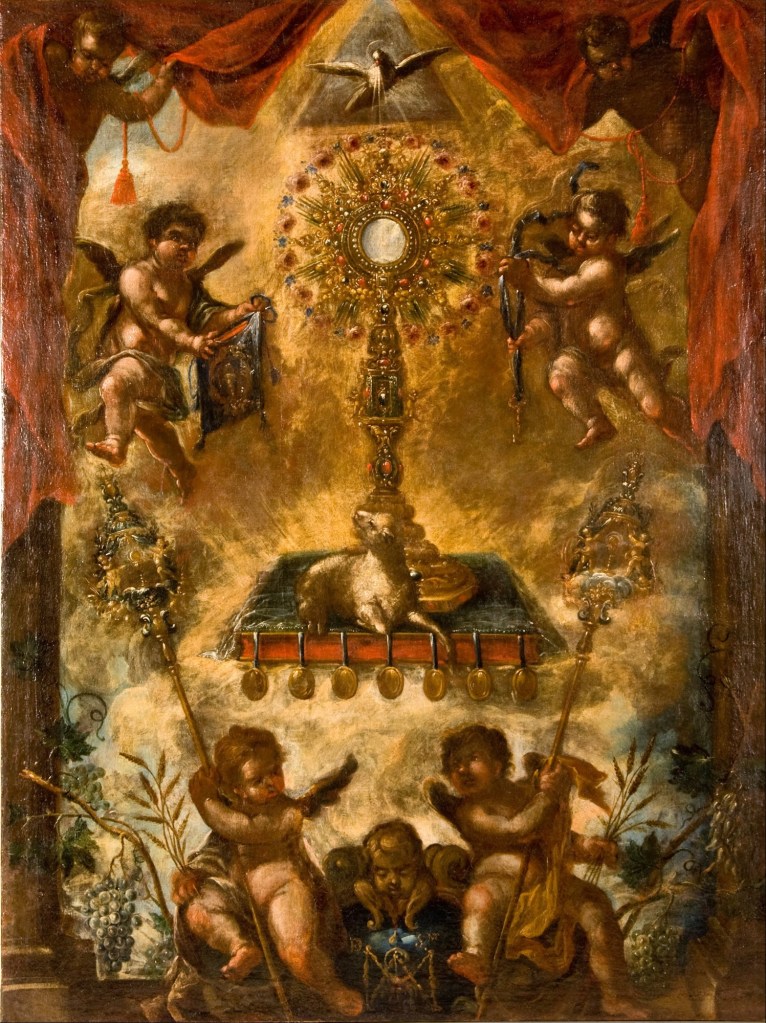
I am the living bread that came down from heaven, says the Lord; whoever eats this bread will live forever. (Jn. 6:51).
Today’s Solemnity of the Body of Christ reminds us that we are never alone. Through the Eucharist, Jesus offers Himself as nourishment for our earthly journey, inviting us to receive Him with faith and reverence. In the Gospel of Luke, when five loaves and two fish fed five thousand souls, we are reminded that Jesus provides for all our needs—just as He has always done. The beloved Archbishop Fulton Sheen once said, “the greatest love story of all time is contained in a tiny white host.”
Today’s feast reminds us of the Supper of the Lamb, offering a glimpse of our heavenly home with every return of Jesus to earth. In these sacred moments, He makes His dwelling among us in the sacramental forms of bread and wine (cf. Jn. 1:14). Through the mystery and power of the Holy Spirit, bread and wine are transformed into the most precious Body and Blood of Christ, at each divine encounter where heaven meets earth.
Take a moment today to approach the Lord in prayer and gratitude, remembering that He has given us the living Bread from heaven. Spend some time reflecting on John 6, and really let yourself take in the gift of this Bread that sustains us. It’s not just food for the body, but for the soul—life-giving nourishment that transforms us into the hands and feet of Jesus. As we grow in Him, we’re shaped to carry His love into the world, preparing the way for our heavenly home, while we walk this earthly journey. Behold the Body and Blood of Christ, the living bread come down from heaven. Let us reflect on this mystery, echoing the words of Saint Thomas Aquinas “Sing, my tongue, the Savior’s glory.”
Feast of Pentecost

Veni Sancte Spiritus!
As the Gospel of John reminds us today, at the beginning of the Church’s foundation, Jesus assures us that we are not alone. We are sustained by grace and consoled by the Advocate, the Holy Spirit
The Holy Spirit is present in our participation in the sacraments, instilling in us the courage to go out into the world and live as faithful disciples
Let us ask the Holy Spirit to guide our hearts on this Solemnity of Pentecost.
PRAYER TO THE HOLY SPIRIT by St Augustine:
‘Breathe into me, Holy Spirit, that my thoughts may all be holy.
Move in me, Holy Spirit, that my work, too, may be holy.
Attract my heart, Holy Spirit, that I may love only what is holy.
Strengthen me, Holy Spirit, that I may defend all that is holy.
Protect me, Holy Spirit, that I may always be holy.
Amen.’
Ascension Of Our Lord
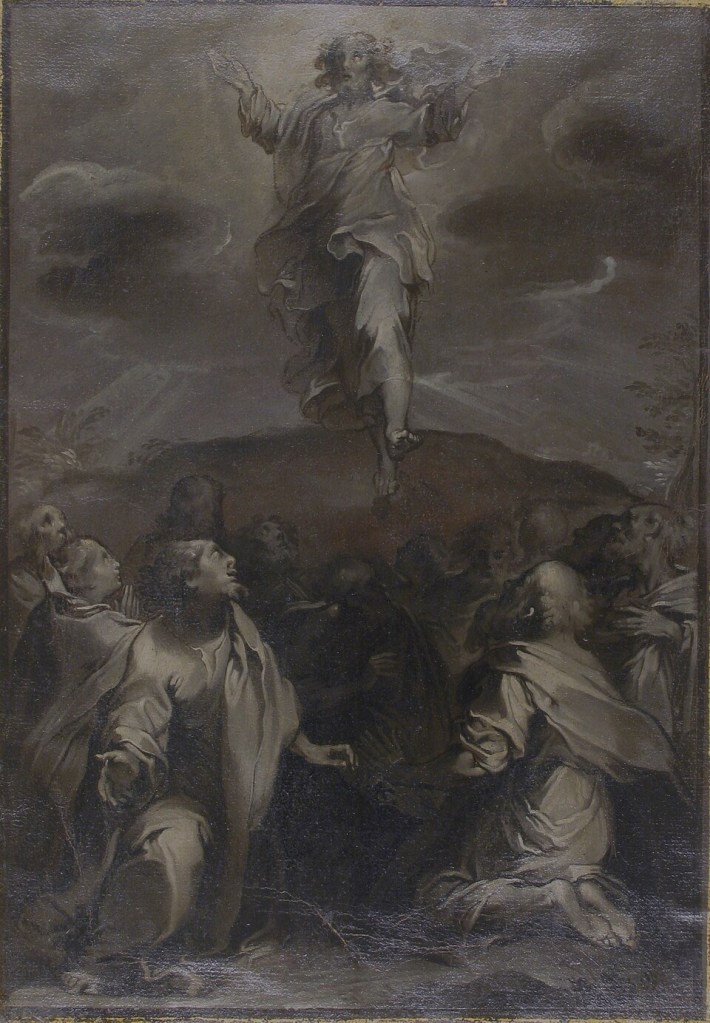
From a Sermon by Saint Leo the Great, Pope
And so our Redeemer’s visible presence has passed into the sacraments. Our faith is nobler and stronger because sight has been replaced by a doctrine whose authority is accepted by believing hearts, enlightened from on high. This faith was increased by the Lord’s ascension and strengthened by the gift of the Spirit; it would remain unshaken by fetters and imprisonment, exile and hunger, fire and ravening beasts, and the most refined tortures ever devised by brutal persecutors. Throughout the world women no less than men, tender girls as well as boys, have given their life’s blood in the struggle for this faith. It is a faith that has driven out devils, healed the sick and raised the dead.
Even the blessed apostles, though they had been strengthened by so many miracles and instructed by so much teaching, took fright at the cruel suffering of the Lord’s passion and could not accept his resurrection without hesitation. Yet they made such progress through his ascension that they now found joy in what had terrified them before. They were able to fix their minds on Christ’s divinity as he sat at the right hand of his Father, since what was presented to their bodily eyes no longer hindered them from turning all their attention to the realisation that he had not left his Father when he came down to earth, nor had he abandoned his disciples when he ascended into heaven.
The truth is that the Son of Man was revealed as Son of God in a more perfect and transcendent way once he had entered into his Father’s glory; he now began to be indescribably more present in his divinity to those from whom he was further removed in his humanity. A more mature faith enabled their minds to stretch upward to the Son in his equality with the Father; it no longer needed contact with Christ’s tangible body, in which as man he is inferior to the Father. For while his glorified body retained the same nature, the faith of those who believed in him was now summoned to heights where, as the Father’s equal, the only-begotten Son is reached not by physical handling but by spiritual discernment.
Divine Mercy Sunday

Mercy is one of those words that carries a deep sense of reverence. According to Merriam-Webster, its definition reflects a sacred complexity. The third definition, in particular, stands out: “compassionate treatment of those in distress.” How often do we truly embody this? Let us take time this week to reflect on the definition and the sacred nature of Mercy as Christians.

A while back, a homilist reflected on four essential truths of our existence as God’s creations, framed within the context of our Christian faith:
- We will die.
- There will be judgment.
- We may go to heaven.
- We may go to hell.
The homilist then emphasized that the choices we make—whether to follow God and carry our crosses with Him—form the foundation of the Christian life. The Catholic Church teaches that the graces we receive from God, along with the faith we hold, should naturally lead us to good works. As St. James writes in his epistle (James 2:14-26), “faith without works is dead,” underscoring the idea that Christianity is not a passive pursuit.
Philippians 4:13 further underscores this divine plan by reminding us that it is God who strengthens us in our endeavors. And as Paul beautifully puts it in Romans 8:14-17, we are all spiritually adopted as sons and daughters of God.
In light of this, I propose a fifth truth for reflection: as spiritually adopted children of God, we must also consider the essential quality of mercy. Mercy is not only a gift we receive but a virtue we are called to practice, following the example set by our Heavenly Father.
In the 1930s, a humble Polish nun, Sister Faustina Kowalska, who belonged to the Congregation of Divine Mercy, reported experiencing various visions and encounters with God’s mercy, as recorded in her Diary of Saint Maria Faustina Kowalska. In the year 2000, Pope Saint John Paul II canonized Sister Faustina as a saint and established the second Sunday of Easter as the feast of Divine Mercy.
The Gospel reading from John 20:19-31 recounts the story of Thomas, also called Didymus, who doubted the resurrection of Jesus. The apostles, along with Thomas, are discussing the Lord’s appearance after His resurrection. Thomas, unwilling to believe without tangible evidence, insists that he must not only see the nail marks in Jesus’ hands and the wound in His side but must touch them to believe. When Jesus appears to him, He invites Thomas to do just that. In that profound moment, Thomas exclaims, “My Lord and my God!” This powerful encounter demonstrates the boundless mercy of Jesus. His willingness to appear to Thomas and invite him to touch His wounds exemplifies a deeper message: as Christians, we are called to reach out to those who lack faith, hope, or belief.
Today, Divine Mercy calls us to reflect on five key truths: death, judgment, heaven, hell, and mercy. Carrying our crosses and avoiding sin would mean little without the transforming power of mercy. It’s not enough to attend church more frequently, pray more diligently, or seek to act more influentially than others if we lack the essential quality of mercy. The divine healer, our Lord Jesus, who cared for the outcasts, healed the sick, and bore the weight of sin for all humanity, shows us the true meaning of mercy. He offers this mercy even to doubting Thomas, illustrating that mercy is for all, especially those who struggle to believe.
Of course, even for those who may not adhere to the tradition of the Divine Mercy devotion—a reflection on the Sacred Heart of Jesus remains a fitting and meaningful alternative.

The Acts of the Apostles offers a powerful account of what life was like for the early Christian community. The early Christians claimed no personal possessions and shared everything in common. One might be tempted to view this as a form of communism. However, such an assumption would be mistaken. Under communism, societal class warfare often arises, creating sharp divisions between the ruling oligarchy and the general citizenry. This system is not merciful.
In contrast, the writer of Acts describes a community where “no one was in need.” Those who owned houses or land sold them and brought the proceeds to the apostles, who distributed the funds according to the needs of the community. This was not about creating a classless society through force or coercion, but about mercy and charity—voluntarily shared among believers out of love.
We also learn from the story of Thomas that God will come to us, offering comfort and removing our spiritual blindfolds. It is not about seeing life through our own limited perspective, but about seeing our existence through God’s eyes—through His lens of mercy. Mercy, at its core, is the experience of God’s great agape love.
Our choice of heaven and its promises is within our reach, but we must first allow God’s mercy to enter our hearts. It is a radical choice to let the blood of Christ’s wounds wash over us, not only cleansing us but also moving us to share that same mercy with others. This is the transformative power of grace.
Saint Maria Faustina, God’s “Apostle of Divine Mercy,” who lived during a time just before the rise of fascism, communism, and the onset of World War II, serves as a powerful example of how God blesses us with gentle reminders to make the most of the graces we receive. Jesus’ words in Matthew’s Gospel—reminding us not to hide our light under a bushel basket but to let it shine for all to see (Matthew 5:15)—are a fitting reflection of this call to mercy.
Today, let us reflect and pray for God’s mercy to enter us and transform us as we minister to our fellow man/woman on this Divine Mercy Sunday. Jesus I trust in you to come fill my heart and soul this day with your mercy. Transform me and lead me to bring that mercy to others. For the sake of His sorrowful passion, have mercy on us and on the whole world. Amen.
Prayers for The Repose of the Soul of Pope Francis & Holy Mother Church
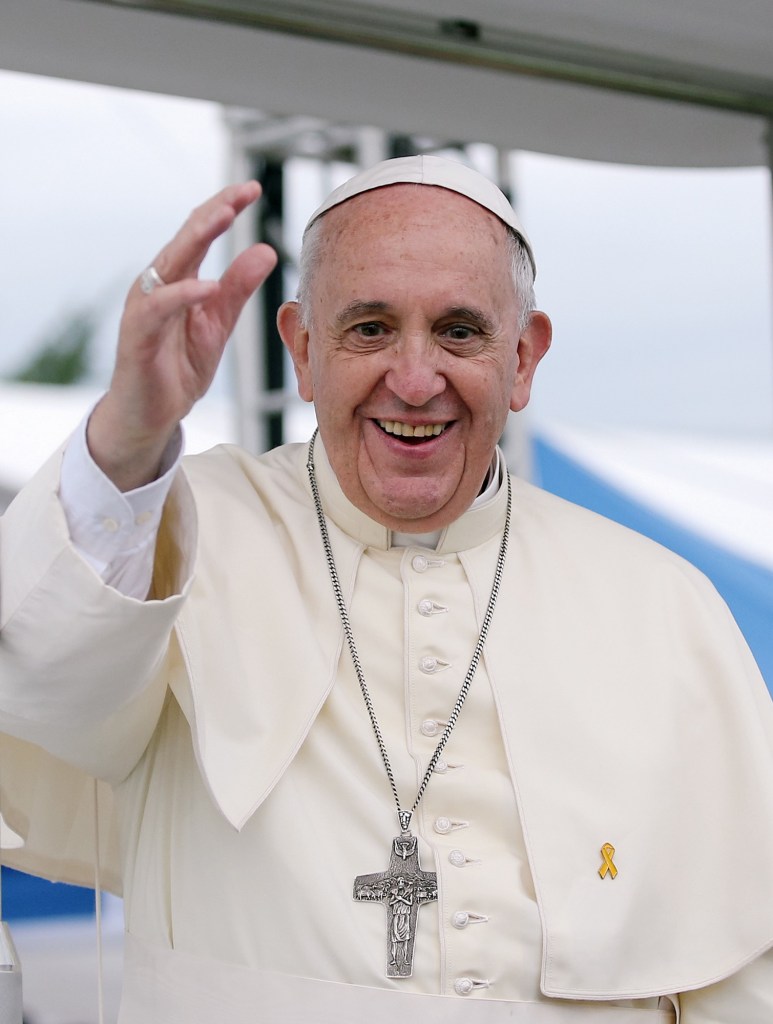
Eternal rest grant unto them, O Lord, and let perpetual light shine upon them. May their souls and the souls of all the faithful departed, through the mercy of God, rest in peace. Amen.
Quotes attributed to our beloved Holy Father, Pope Francis: https://www.catholicnewsagency.com/news/263537/pope-francis-in-his-own-words-12-key-quotes-that-defined-his-12-year-pontificate
Godspeed good and faithful servant. May the Holy Spirit empower the conclave to choose the next Pope and vicar of Christ!
Jesus Christ is Risen Today – Alleluia!

Today, we celebrate the fullness of the Paschal Mystery, remembering that Jesus, Our Lord and Savior, is the conqueror of death. Sin and its consequences, which arise from our turning away from God’s love and mercy, hold no power over us. Jesus desires to roll away the stone of our own tombs, if only we seek the risen Christ.
We also reflect on the mystery of the Paschal Candle — the same candle lit during our baptism, marking our rebirth as new creations in Christ Jesus. Our original sin was washed away, and we are called to live as children of the light. Today, we remember that we are an Easter people!
Jesus Christ is Risen Today – Rejoice and be Glad!
Annunciation

“Behold, the Lord’s handmaiden; may it be done to me according to your word.”
My soul proclaims the greatness of the Lord; my spirit rejoices in God my savior. For he has looked upon his handmaid’s lowliness; behold, from now on will all ages call me blessed. The Mighty One has done great things for me, and holy is his name.
Saint Joseph, Pray for Us
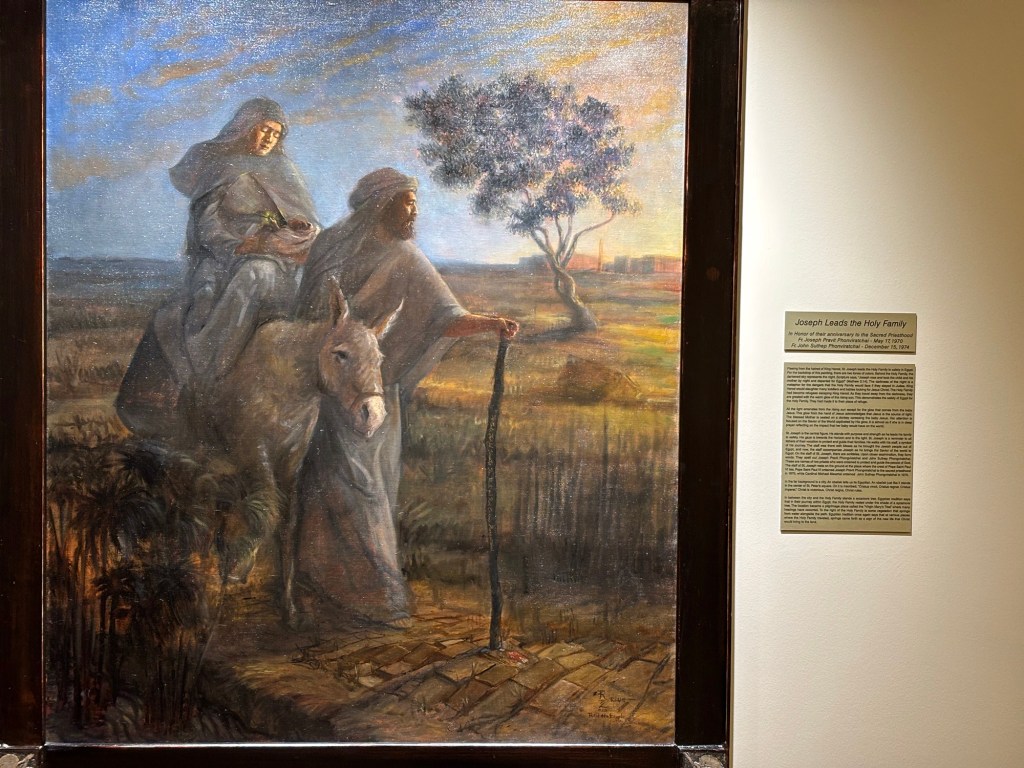
What can Saint Joseph teach us as we commemorate this worthy and humble saint? Today, the Church honors Joseph, the husband of Mary. First and foremost, Saint Joseph serves as a role model for husbands everywhere. He took Mary as his wife without hesitation, trusting the message delivered to him in a dream.
We also know that Joseph protected his family when he fled with them to Egypt, exemplifying the courage and commitment of a father. His trust in God and his humility are evident in his actions—he did not question, but faithfully followed God’s will. Joseph’s love for his family shone through in his quiet but steadfast obedience, ensuring their safety and well-being.
Although not much is said about Saint Joseph in scripture, we recognize him as a vital member of the Holy Family—a man of action who answered God’s call to care for those entrusted to him. Today, let us ask for Saint Joseph’s intercession, seeking the same fidelity to God’s will in our own lives.
Memorare to St. Joseph
Remember, O most chaste spouse of the Virgin Mary, that never was it known that anyone who implored your help and sought your intercession were left unassisted.
Full of confidence in your power I fly unto you and beg your protection.
Despise not O Guardian of the Redeemer my humble supplication, but in your bounty, hear and answer me.
Amen.
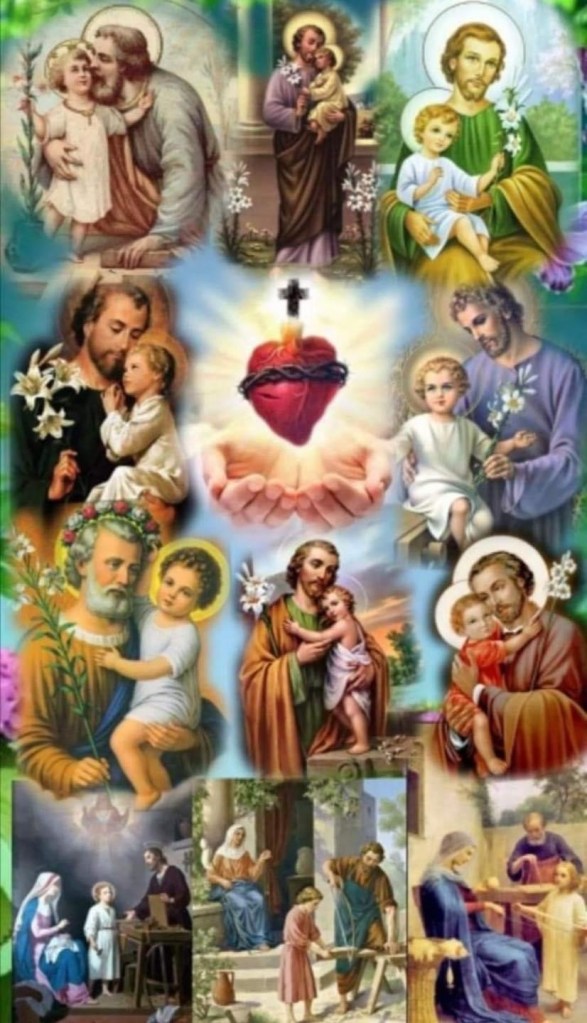
2nd Sunday Of Lent Reflection

The 2nd Sunday of Lent offers an opportunity to reflect on our spiritual journey. We are invited to deepen our relationship with God through prayer, fasting, and almsgiving, aligning ourselves with the sacrifices of Christ as He made His way toward the Cross. We, too, are called to journey with our Lord along the Way of the Cross, where we must be transformed by selfless and loving sacrifice. In emptying ourselves and letting go of the distractions and roadblocks that blind our view, we begin to see Christ glorified by the great love God has for us. It is in this process that we come to share in His glory.
The Gospel reading for this Sunday asks us to contemplate the mystery of the Transfiguration of Jesus (Luke 9:28b–36). Jesus takes Peter, James, and John up a mountain. There, they witness Him in His divine glory, His face shining like the sun, and His clothes dazzling white. Moses and Elijah appear with Him, symbolizing the Law and the Prophets, affirming that Jesus is the fulfillment of all God’s promises. The voice of God declares, “This is my Son, the Beloved; listen to Him.”
This moment is a glimpse of the glory that will follow Jesus’ suffering and death on the cross. It offers hope and encouragement, especially for those of us journeying through the Lenten season. Just as the disciples were encouraged by this revelation of Jesus’ divinity, we are reminded that our Lenten sacrifices, while difficult, are not empty. There is a promise of transformation and glory on the other side of our suffering.
This Sunday invites us to listen to Jesus more intently, to follow Him in His path of humility, and to trust that our own struggles, when offered in faith, can lead to deeper communion with Him. The Transfiguration reminds us that we are not alone in our journey. God has revealed His love and glory to us, and as we continue through Lent, we are called to keep our eyes fixed on the promise of the Resurrection that lies ahead.
A key takeaway this Sunday could be the importance of listening to God amidst the distractions of our daily lives. Just as the voice of God spoke to the disciples, we are called to listen deeply to God’s word and allow it to transform our hearts during this Lenten season. Recall the words from the prophet Joel at the start of this Lent, “rend your hearts, not your garments.” We must shed the facades and distractions of worldly affairs that prevent us from seeing Christ and ourselves in the radiant light of His glory.
As the Collect at today’s mass reminds us, may our spiritual sight be pure and our hearing attentive to listening to God’s voice.
Collect:
O God, who have commanded us to listen to your beloved Son, be pleased, we pray, to nourish us inwardly by your word, that, with spiritual sight made pure, we may rejoice to behold your glory. Through our Lord Jesus Christ, your Son, who lives and reigns with you in the unity of the Holy Spirit, God, for ever and ever.
1st Sunday of Lent

The first Sunday of Lent, marked by Jesus’s journey into the wilderness to fast for 40 days, reminds us that there is more to life than earthly desires. Following the Baptism of our Lord in Luke’s Gospel, we see that Jesus was led by the Spirit. In the same way, we too must seek moments throughout this Lenten season where we can be empowered by the Holy Spirit. These moments invite us to undergo our own fasts and embark on spiritual journeys to our own deserts of solitude and peace, where we can commune with our Lord Jesus.
Through prayer, we are empowered on our journey to receive the Holy Spirit in our lives. As the reading from Deuteronomy reminds us, the priests offered the firstfruits of the harvest to the Lord as a holy sacrifice. Do we offer God the firstfruits of our time and our actions? Perhaps this Lent, we can make it our goal to enrich our prayer life by setting aside distractions that dim our hearts, allowing the light of the Holy Spirit to shine within us. We can also practice this through almsgiving, sharing the blessings God provides with others.
Jesus fasted during this time, and fasting calls us to empty ourselves so that we might be filled with something greater. As the responsorial verse before the Gospel reminds us, “One does not live by bread alone, but on every word that comes forth from the mouth of God” (Mt. 4:4). During this time, we see that Jesus was tempted by Satan. We, too, are tempted as adopted sons and daughters of God. Our only response must be one of “Be gone, Satan,” allowing the Holy Spirit to overcome the desires and temptations that separate us from drawing closer to God.
This Lenten season, we are called to enter our own spiritual desert and seek God’s grace to do His holy will. Along the way, we will feel hungry, tired, and enticed by distractions. Yet, God offers us a reward beyond comparison at the end of this pilgrimage. Have courage and trust that Jesus is guiding us on this journey.
One thing we can do is to offer a Morning Offering prayer to God each day so that we recall what our mission is:
O Jesus,
through the Immaculate Heart of Mary,
I offer You my prayers, works,
joys and sufferings
of this day for all the intentions
of Your Sacred Heart,
in union with the Holy Sacrifice of the Mass
throughout the world,
in reparation for my sins,
for the intentions of all my relatives and friends,
and in particular
for the intentions of the Holy Father.
Amen.
Removing the Log & Seeing Christ In Others – 8th Sunday of Ordinary Time Reflection
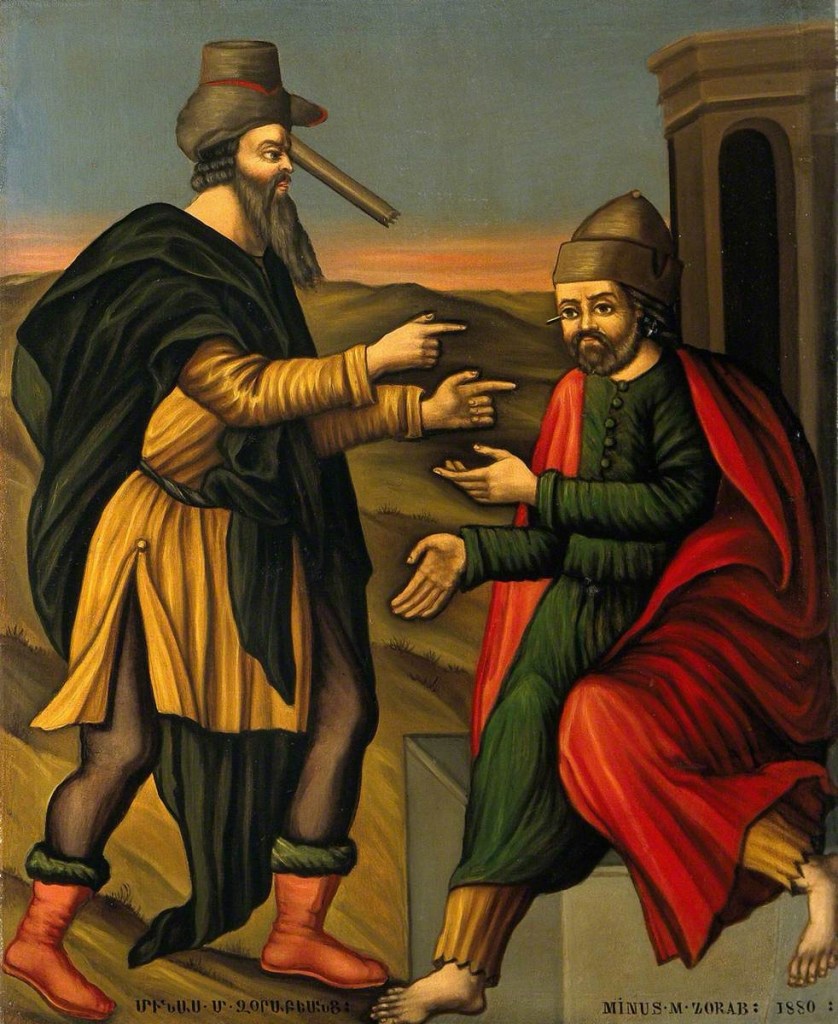
Sirach 27:4-7 Psalm 92 1st Corinthians 15:54-58 Gospel of Luke 6:39-45
When I was a fifth-grade teacher at a Catholic school, I had a poster in our classroom titled “The Many Faces of Jesus.” This artwork served as a reminder that we are all called to reflect Christ’s love to others, regardless of our cultural or historical backgrounds. It’s a fitting reminder in light of today’s readings—how do we see Christ in others, despite differences and even another’s failings as compared to our own limited view? What is the beam in our eye that impedes our ability to do God’s will?
Last Sunday’s gospel reminded us to show mercy to our neighbor and to offer pardon instead of condemnation. The readings today, especially from Luke’s gospel, invite us to undertake the important task of self-examination. We are called to remove the plank from our own eye before noticing the splinter in our brother’s eye (Luke 6:42). As a society, we are often quick to judge others and form opinions, yet we rarely acknowledge our own failings. The Book of Sirach reminds us that the Master Potter shapes us, urging us to be mindful of how we speak to others. It also cautions us to be careful with our words, as they can have a powerful impact.
This gospel, however, does not mean that we should refrain from making righteous and compassionate judgments of our neighbor. If we see someone in a difficult situation, we are called to offer our compassionate advice and support. The Catechism of the Catholic Church (CCC 2478) reminds us to guard against the negative aspect of rash judgment, which Jesus warns against—where we place ourselves in a position of superiority over others. In his letter to the Corinthians, Paul encourages us to remain firm and steadfast in our work for God, reminding us that the sting of death and sin no longer holds power over us when we turn to the victory that Jesus the Christ has shown us.
As we prepare for the holy season of Lent, beginning on Ash Wednesday, it is beneficial to pray the Litany of Humility as one of many devotions. Our Lenten journey invites us to examine the depths of our hearts, to seek the log in our eye, and to strive to more closely reflect the image of Christ to others.
Litany of Humility
O Jesus, meek and humble of heart,
Hear me.
From the desire of being esteemed,
Deliver me, O Jesus.
From the desire of being loved,
Deliver me, O Jesus.
From the desire of being extolled, etc.
From the desire of being honored,
From the desire of being praised,
From the desire of being preferred to others,
From the desire of being consulted,
From the desire of being approved,
From the fear of being humiliated,
From the fear of being despised,
From the fear of suffering rebukes,
From the fear of being calumniated,
From the fear of being forgotten,
From the fear of being ridiculed,
From the fear of being wronged,
From the fear of being suspected,
That others may be loved more than I,
Jesus, grant me the grace to desire it.
That others may be esteemed more than I,
Jesus, grant me the grace to desire it.
That, in the opinion of the world, others may increase
and I may decrease, etc.
That others may be chosen and I set aside,
That others may be praised and I go unnoticed,
That others may be preferred to me in everything,
That others may become holier than I,
provided that I may become as holy as I should.
By Cardinal Merry del Val (1880).
Saint Blaise, Pray For Us

About Saint Blaise:
O glorious St. Blaise, who by your martyrdom left to the Church a precious witness to the Faith, obtain for us the grace to preserve within ourselves this divine gift, and to defend — without concern for human respect — both by word and example, the truth of that same Faith, which is so wickedly attacked and slandered in these our times. You miraculously restored a little child who was at the point of death because of an affliction of the throat.
Grant us your mighty protection in similar misfortunes. And, above all, obtain for us the grace of Christian mortification, together with faithful observance of the precepts of the Church, which keep us from offending almighty God. Amen.
The Presentation of the Lord
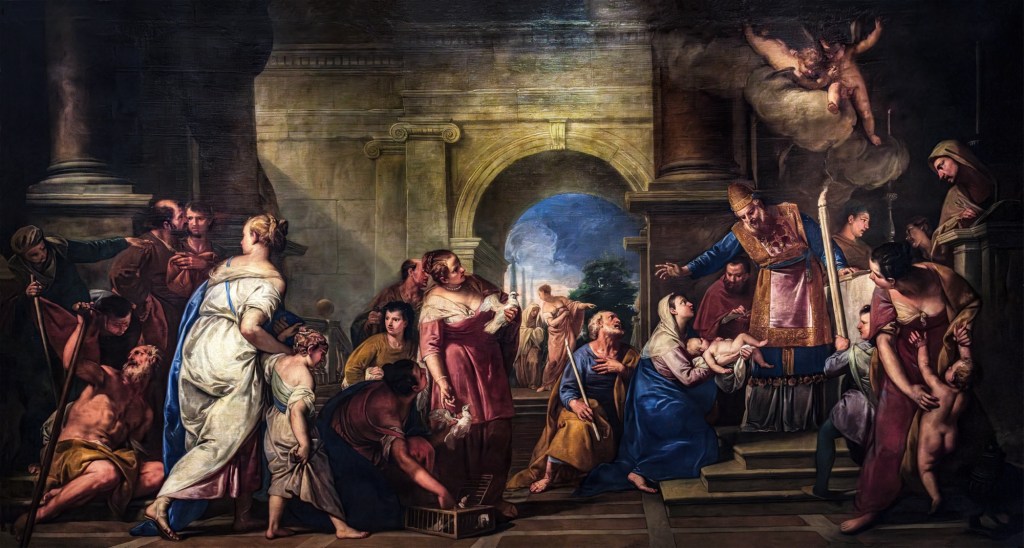
Simeon’s words from the Gospel today: (Lk. 2:22-40)
“Now, Master, you may let your servant go in peace, according to your word, for my eyes have seen your salvation, which you prepared in the sight of all the peoples: a light for revelation to the Gentiles, and glory for your people Israel.”
May we all seek to be like Simeon or Anna from Luke’s gospel in which we speak and proclaim about the Christ. May we be obedient to the Master’s plan and keep watch in which our eyes and hearts long to see His magnificent and radiant glory. May the light of Christ dwell with us today.
The Baptism of Christ Jesus

From a homily excerpt from St. Gregory Nazianzen:
Christ is bathed in light; let us also be bathed in light. Christ is baptized; let us also go down with him, and rise with him.
John is baptizing when Jesus draws near. Perhaps he comes to sanctify his baptizer; certainly he comes to bury sinful humanity in the waters. He comes to sanctify the Jordan for our sake and in readiness for us; he who is spirit and flesh comes to begin a new creation through the Spirit and water.
The Baptist protests; Jesus insists. Then John says: I ought to be baptized by you. He is the lamp in the presence of the sun, the voice in the presence of the Word, the friend in the presence of the Bridegroom, the greatest of all born of woman in the presence of the firstborn of all creation, the one who leapt in his mother’s womb in the presence of him who was adored in the womb, the forerunner and future forerunner in the presence of him who has already come and is to come again. I ought to be baptized by you: we should also add, “and for you,” for John is to be baptized in blood, washed clean like Peter, not only by the washing of his feet.
Jesus rises from the waters; the world rises with him. The heavens, like Paradise with its flaming sword, closed by Adam for himself and his descendants, are rent open. The Spirit comes to him as to an equal, bearing witness to his Godhead. A voice bears witness to him from heaven, his place of origin. The Spirit descends in bodily form like the dove that so long ago announced the ending of the flood and so gives honour to the body that is one with God.
Today let us do honour to Christ’s baptism and celebrate this feast in holiness. Be cleansed entirely and continue to be cleansed. Nothing gives such pleasure to God as the conversion and salvation of men, for whom his every word and every revelation exist. He wants you to become a living force for all mankind, lights shining in the world. You are to be radiant lights as you stand beside Christ, the great light, bathed in the glory of him who is the light of heaven. You are to enjoy more and more the pure and dazzling light of the Trinity, as now you have received – though not in its fullness – a ray of its splendour, proceeding from the one God, in Christ Jesus our Lord, to whom be glory and power for ever and ever. Amen.
Gospel from Lk. 3:22 And a voice came from the heavens, “You are my beloved Son; with you I am well pleased.”
Reference: Saint Gregory of Nazianzus (Oratio 39 in Sancta Lumina) from the Office of Readings for the Feast of Baptism of the Lord in the Roman breviary.
Reflection Questions:
Do you recall the date of your baptism in which you were made into a new creation and received sanctifying grace to cleanse you from the stain of original sin?
As baptized Christians we become adopted sons and daughters of the Holy Trinity. We put on the white garment symbolizing the purity of Christ Jesus as the lamb that was slain for our sin. We receive our baptismal candle, lit from the Easter paschal candle reminding us that we are made for the light, not the dark. No sin or transgression can separate us from God’s love. How do we live our call to continue to put to death our sin and those obstacles that separate us from God’s love? (See CCC, 2nd edition #s 1246-1284 for further reading & reflection of this great sacrament).
Many baptismal font designs now resemble a tomb that reminds us of this most crucial sacrament where sin is defeated and we rise to new life. The crucifix and carrying of our earthly crosses in the below image reflection from the baptismal font at a Catholic Church in North Texas reminds us of the ongoing effort to rid those roadblocks in our life and to put to death our sinful behavior so that we too might rise to new life in Christ Jesus.

Pax, Eric
The Epiphany of Our Lord
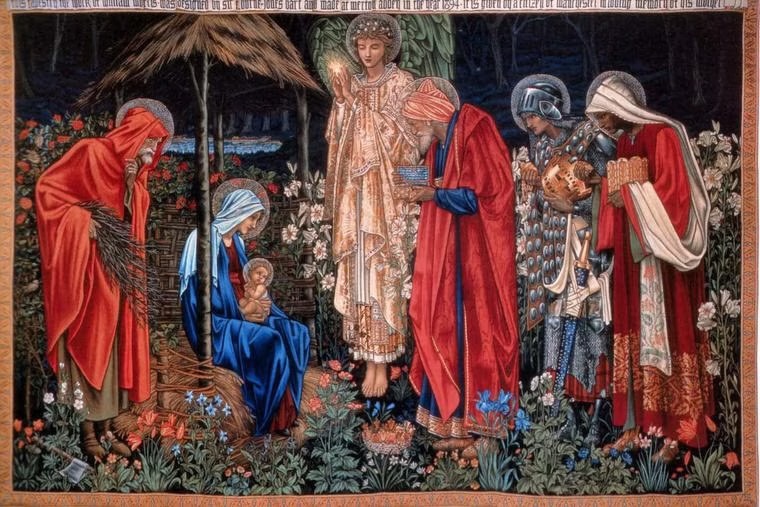
Edward Burne-Jones, “The Adoration of the Magi,” 1890
The 12th Day of Christmas, on which we celebrate the Magi bearing gifts to the infant Christ, is more than just a revelation that He is the chosen Light of the World. It serves as a reminder that we, too, are called to seek out this revelation, to search for the Christ child in our midst. In doing so, we are invited to radiate His light to others, especially to those within our own families.
It is customary to perform a house blessing on this day, inviting our Lord to bless our homes for the coming year. The Epiphany (Revelation) or Theophany (Revelation of God) reminds us that it is Emmanuel (Is. 7:14)—God with us—who has been revealed to save us from the darkness of sin and selfishness, transforming that darkness into a magnificent and holy light. Like the Magi, we are called to seek the bright and shining star that leads to Jesus, drawing out the good in ourselves and in others.
Will we, like the Magi, offer the Child Jesus the gift of ourselves and dedicate this year to our Lord, fully embracing God’s will and His plan of salvation for our journey? Will we cast aside those aspects of life that dim our vision, preventing us from following the guiding star that leads us to Jesus?
Here is a link to a House Blessing by the United States Conference of Catholic Bishops: https://www.usccb.org/prayers/blessing-home-and-household-epiphany
A household blessing with chalk: https://www.churchpop.com/blessing-your-home-on-epiphany-how-to-do-it-in-2025/
Take some time today & reflect on today’s Gospel from Matthew 2:1-12. How can you make this coming year one that leads you to the star that leads to Jesus?
Solemnity of Mary, Mother of God (Theotokos)
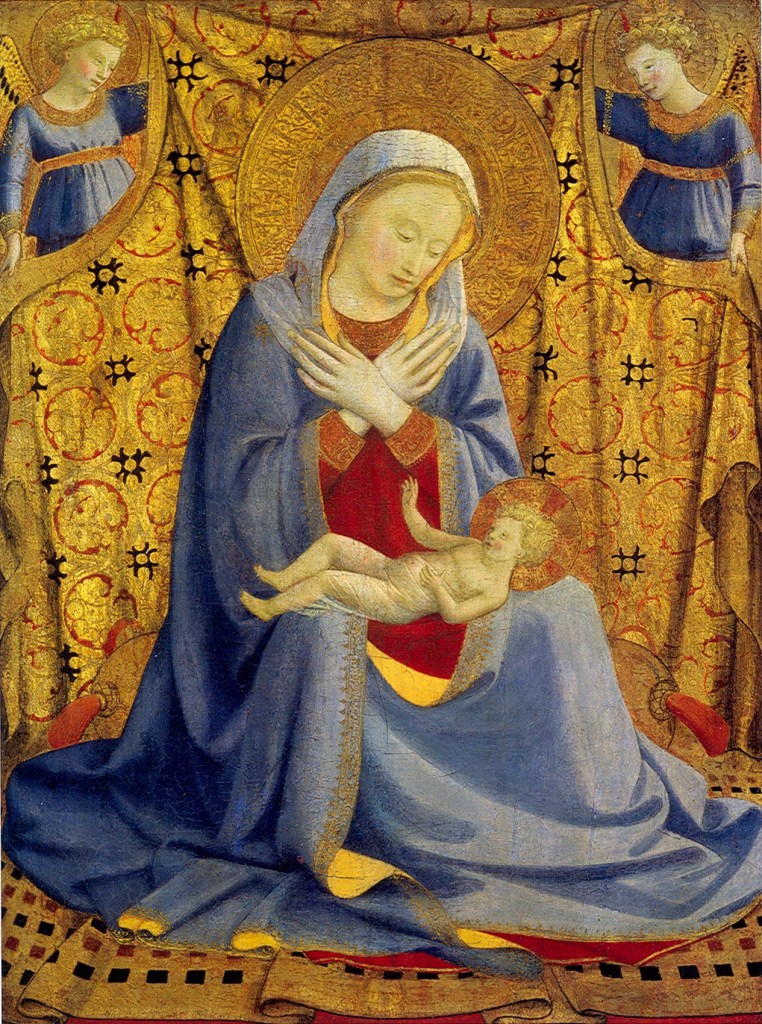
Today, we honor Mary as the Theotokos, or “God-Bearer.” The Council of Ephesus formally proclaimed her this title, recognizing her unique role in salvation history. Mary holds a special place as the mother of Jesus, God’s only begotten Son, conceived through the power of the Holy Spirit.
As adopted children of God, we share a filial connection with Mary, who intercedes for us as the Queen of Angels and Saints. No matter our station in life, we can turn to her for guidance and inspiration, helping us return to the path Jesus calls us to follow.
From a Letter from Saint Athanasius, Bishop of Alexandria, 4th Century Divine Office of Readings:
What was born of Mary was therefore human by nature, in accordance with the inspired Scriptures, and the body of the Lord was a true body: It was a true body because it was the same as ours. Mary, you see, is our sister, for we are all born from Adam.
The words of St John, the Word was made flesh, bear the same meaning, as we may see from a similar turn of phrase in St Paul: Christ was made a curse for our sake. Man’s body has acquired something great through its communion and union with the Word. From being mortal it has been made immortal; though it was a living body it has become a spiritual one; though it was made from the earth it has passed through the gates of heaven.
Even when the Word takes a body from Mary, the Trinity remains a Trinity, with neither increase nor decrease. It is for ever perfect. In the Trinity we acknowledge one Godhead, and thus one God, the Father of the Word, is proclaimed in the Church.
Lk. 2:16-21 (NABRE)
The shepherds went in haste to Bethlehem and found Mary and Joseph, and the infant lying in the manger. When they saw this, they made known the message that had been told them about this child. All who heard it were amazed by what had been told them by the shepherds. And Mary kept all these things, reflecting on them in her heart. Then the shepherds returned, glorifying and praising God for all they had heard and seen, just as it had been told to them. When eight days were completed for his circumcision, he was named Jesus, the name given him by the angel before he was conceived in the womb.
Let us reflect today on the great mystery of Mary being chosen as a holy vessel, one of a noble and powerful act in being a Mother to God’s Son Jesus.
It is Customary to Recite the Te Deum within the last day of the Octave of the Christmas Season:
Te Deum
You are God: we praise you;
You are God: we acclaim you;
You are the eternal Father:
All creation worships you.
To you all angels, all the powers of heaven,
Cherubim and Seraphim, sing in endless praise:
Holy, holy, holy, Lord, God of power and might,
Heaven and earth are full of your glory.
The glorious company of apostles praise you.
The noble fellowship of prophets praise you.
The white-robed army of martyrs praise you.
Throughout the world the holy Church acclaims you:
Father, of majesty unbounded,
Your true and only Son, worthy of all worship,
And the Holy Spirit, advocate and guide.
You, Christ, are the king of glory,
The eternal Son of the Father.
When you became man to set us free
You did not spurn the Virgin’s womb.
You overcame the sting of death,
And opened the kingdom of heaven to all believers.
You are seated at God’s right hand in glory.
We believe that you will come, and be our judge.
Come then, Lord, and help your people,
Bought with the price of your own blood,
And bring us with your saints
To glory everlasting.
Save your people, Lord, and bless your inheritance.
Govern and uphold them now and always.
Day by day we bless you.
We praise your name forever.
Keep us today, Lord, from all sin.
Have mercy on us, Lord, have mercy.
Lord, show us your love and mercy;
For we put our trust in you.
In you, Lord, is our hope:
And we shall never hope in vain
J+M+J: Holy Family, Pray For Us

Readings:
1 Samuel 1, or Sirach 3, Psalm 84, 1 John 3 or 3 Colossians, Luke 2:41–52
Today, within the Octave of Christmas, we reflect on the Holy Family. The initials J+M+J—Jesus, Mary, and Joseph—serve as a reminder of God’s plan of salvation. This simple yet profound model reveals how God’s love was made manifest through the humble calling of a family.
Think about your own family—or perhaps even your in-laws. There is often that one family member who tests our patience, challenging us to resist lashing out, suspend judgment, and instead show love and understanding. The Holy Family was holy not only because of their virtues but also because they remained faithful to their Jewish traditions. As today’s Gospel from Luke recounts, they journeyed to Jerusalem to celebrate Passover. During this pilgrimage, Mary and Joseph experienced a moment of worry and human frailty when they misplaced 12-year-old Jesus, who had stayed behind in the temple, astonishing the elders with His wisdom.
Even Mary, as a mother, had her moments. Yet, the key message in Jesus’s response when she found Him was profound: “Did you not know I must be in my Father’s house?” The Gospel writer Luke tells us that Jesus was obedient to Mary and Joseph throughout His life, while Mary treasured all these moments in her heart. We, too, can learn from the Holy Family’s example by honoring the third commandment: keeping the Sabbath holy. This includes going to the House of the Lord and celebrating His presence together. We should read our bibles and reflect upon God’s word within our families. Committing to being part of a church community can be challenging, but it is essential for grounding our family in an enduring love with God at its center.
The Holy Family faced many challenges, yet they were holy because they allowed God’s will to guide their decisions. When Joseph received the dream to take the Holy Family to Egypt to escape King Herod’s attempt to kill the infant Jesus, they fled in obedience. When Joseph took Mary as his wife & traveled to Bethlehem for the census to start the Holy Family’s life together, it was divine providence. Pious & holy Saint Joseph cast aside his doubt, fear & pride to humbly follow God’s will. Likewise, when the humble and pious Mary and Joseph celebrated Passover, they faithfully made the journey to Jerusalem. These profound events in the life of the Holy Family remind us of the importance of keeping God at the center of our lives.
The beloved priest Father Patrick Peyton reminds us, “The family that prays together stays together.” Learn more about his legacy at www.fatherpeyton.org.
Make prayer a cornerstone of your life, and never lose hope. God favors the family as His simple yet profound plan to reveal His love to the world today.
Holy Family, Pray for Us.
Merry Christmas!

Rejoice! Today in Bethlehem, a Savior is born—Christ the Lord. As I reflect on this glorious season of the Incarnation of Christ Jesus, I am reminded, as a history major, of the unfolding timeline of salvation history. God’s unconditional love for humanity is revealed through the generations of covenants—from Abraham to Noah, Moses, David, and ultimately, the New Covenant through Christ—where God dwells with us. As Saint Athanasius beautifully reminds us: God became man so that we might become, and resemble, God’s divinity through grace.
My late grandmother Doris used to sign her cards, In love & light. One of the Christmas Gospel readings from the Gospel of John beautifully reminds us: A light shines in the darkness, and the darkness shall not overcome it.
This light is Jesus the Lord. The Savior foretold by the prophet Isaiah has come to us, taking on human form. Though God’s Son was without sin, He chose to bear the weight of our sin, paying the ultimate sacrifice. God’s New Covenant is a profound sign of His love and light, revealed to us on this day. By taking the form of a vulnerable and dependent baby, Jesus exemplifies the kind of love we are called to reflect on this Christmas Day. Just as the infant Jesus relied on Mary and Joseph, God desires for us to depend on Him with the same trust and humility.
Let us turn to the Lord this day and reflect on the Season of Christmas, a time when God seeks to transform the dark corners of our lives and fill them with His radiant light of grace. “Come to me, take my hand, and rely on my grace.”Truly, today a Savior is born, and Jesus, the Light of the World, longs to shine upon us this day!
Did You Know These Facts About These Christmas Symbols?

Finding Holiday Cheer & Inner Peace
For many, the consumerism of the holiday season and the pressure to buy gifts can create stress. For others, this time of year is filled with grief and desolation. Not everyone experiences holiday cheer or finds inner peace during this season.
It’s worth reflecting on the true nature of the season—where the simple pleasures of seeing beautiful lights, sipping hot chocolate, and enjoying festive treats may bring a bit of cheer. If we look back to the first Christmas celebration, we remember that Joseph and Mary had no lodging for Mary, who was heavily pregnant. Mary is believed to have traveled about 90 miles from Nazareth to Bethlehem, enduring a long and difficult journey due to a census ordered by Caesar. Traveling while about to give birth, with only animal transport, was no easy task. The holiday cheer of Joseph and Mary likely wasn’t as clear as often depicted in paintings, but despite the hardships, something deep within their hearts and souls kept them going. Jesus, the Light of the World, and God’s grace moved them to face these challenges. Giving birth to Jesus in the humble surroundings of livestock was not easy, but Christians believe Jesus came into the world to uplift the lowest of the low and to offer God’s grace, love, and mercy to all who are impoverished and desolate.
Perhaps you’re not a Christian, and that’s okay. The “reason for the season” might make you think of the Grinch and how some might view you in a similar light. But at its core, the season is about finding peace—a pursuit that can be difficult, especially if you are grappling with the loss of a loved one, facing health challenges, or feeling overwhelmed. Think about those moments in life that brought you happiness. Reflect on the kindness a neighbor has shown you or a small act of goodwill you once did for someone else.
Seeking the love and peace of the season can feel like an arduous task. I encourage you to find peace in the silence. Contemplate the joyful memories and places that once brought you happiness—that is the heart of the season and a path toward inner peace.
To be cheerful is often a matter of changing your perspective—even if this time of year makes you feel like shutting the door and becoming an Ebenezer Scrooge or the Grinch. Finding peace requires escaping the distractions of the mind and the pains of the body, and following the heart toward those cherished moments of joy. It is not an easy task, but it is worth the effort to experience the true cheer of the season.
May the reason for the season bring you holiday cheer. May your quest for peace lead you to a moment of calm and joy.
In love & light.
Saint John of the Cross, Priest, Doctor

Bio: https://www.franciscanmedia.org/saint-of-the-day/saint-john-of-the-cross/
From a spiritual Canticle by John of the Cross: The knowledge of the mystery hidden in Christ Jesus
Though holy doctors have uncovered many mysteries and wonders, and devout souls have understood them in this earthly condition of ours, yet the greater part still remains to be unfolded by them, and even to be understood by them.
We must, then, dig deeply in Christ. He is like a rich mine with many pockets containing treasures. However deep we dig, we will never find their end or their limit. Indeed, in every pocket new seams of fresh riches are discovered on all sides.
For this reason the apostle Paul said of Christ: In him are hidden all the treasures of the wisdom and knowledge of God. The soul cannot enter into these treasures, nor attain them, unless it first crosses into and enters the thicket of suffering, enduring interior and exterior labors, and unless it first receives from God very many blessings in the intellect and in the senses, and has undergone long spiritual training.
All these are lesser things, disposing the soul for the lofty sanctuary of the knowledge of the mysteries of Christ: this is the highest wisdom attainable in this life. Would that men might come at last to see that is it is quite impossible to reach the thicket of the riches and wisdom of God except by first entering the thicket of much suffering, in such a way that the soul finds there its consolation and desire. The soul that longs for the divine wisdom chooses first, and in truth, to enter the thicket of the cross.
Saint Paul, therefore, urges the Ephesians not to grow weary in the midst of tribulations, but to be rooted and grounded in love, so that they may know with all the saints the breadth, the length, the height and the depth – to know what is beyond the knowledge – the love of Christ, so as to be filled with all the fullness of God.
The gate that gives entry into these riches of his wisdom is the cross; because it is a narrow gate. While many seek the joys that can be gained though it, it is given to few to desire to pass through it.
Quote: “Where there is no love, put love, and you will draw love out.”
Source: The Liturgy of the Hours, Office of Readings, December 14
Advent – Making Room Within The Inn of Our Hearts for the Christ child Jesus
As many Christians prepare to think about shopping for Christmas gifts, decorating with lights and the secular push to conform with society, it’s good to ponder the seasons of life. Let us await with gentle patience the coming of Jesus, the Christ child. Making room within the inn of our hearts during the penitential time of Advent is crucial for a spectacular incarnation to occur for us on this earthly pilgrimage. Such a season not only reminds us of the first coming of our Lord & King Jesus born in a manger, but of the time when He will return with the second coming.
This first week of Advent reminds us of the need to have hope. We are to be watchful and to be on guard. As Saint Luke’s reminds us there will be apocalyptic signs when Jesus returns again, but we should not fear if we place our trust and hope in the Lord.
Will we make this season of Advent one where we prepare the way for the Lord? We oftentimes think that Lent is the time for penance, but Advent is a penitential time of preparation as well. Such a season reminds us of the need to give alms, declutter, attend the sacrament of reconciliation and increase our prayer. Just as in Luke’s gospel describing that there was no room for Jesus and the holy family in the inn, will you make this advent season one where there is room in the inn of your heart?


Advent songs: https://catholicreview.org/advent-hymns-and-songs/
St. Andrew, Pray for Us
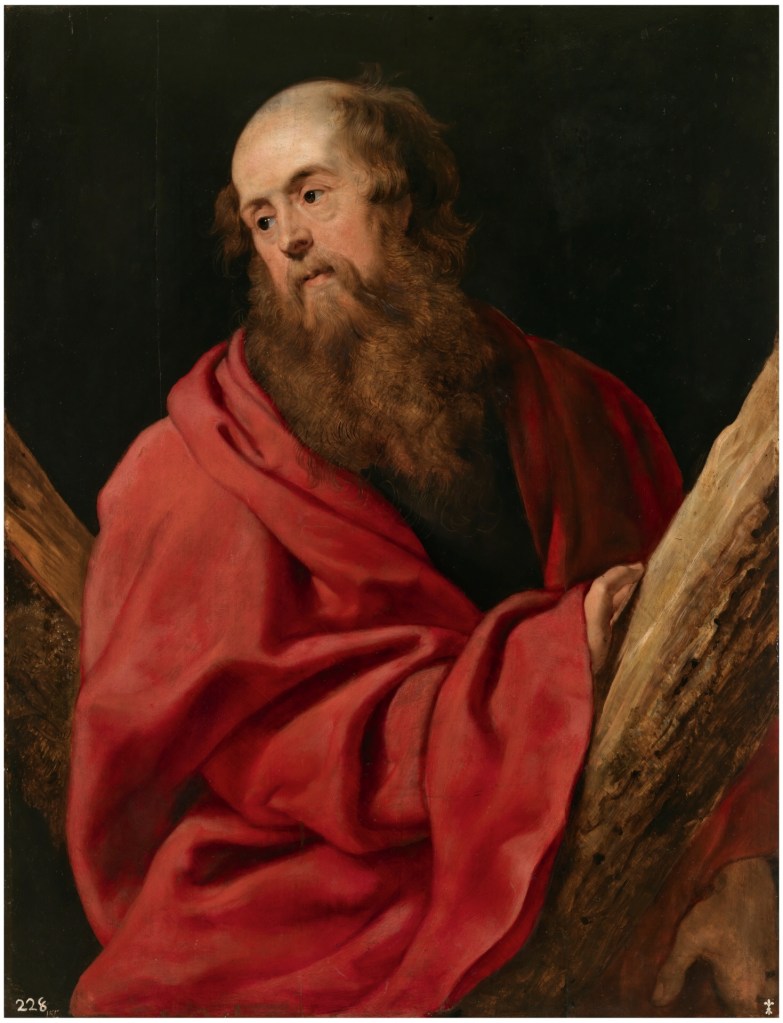
Today the church recalls St. Andrew, the first apostle and humble fisherman and brother of Simon Peter. St. Andrew, a follower of John the Baptist, led a bunch of followers to Christ Jesus as a strong witness of the Holy Spirit & ventured out to Greece and Asia Minor spreading the good news of the gospel.
St. Andrew was martyred for the faith on an x shaped cross or saltire cross in Greece and legend states he preached the faith from the cross for two days before his demise.
Gospel (Mt. 4:18-22)
As Jesus was walking by the Sea of Galilee, he saw two brothers,
Simon who is called Peter, and his brother Andrew, casting a net into the sea; they were fishermen. He said to them,
“Come after me, and I will make you fishers of men.” At once they left their nets and followed him. He walked along from there and saw two other brothers, James, the son of Zebedee, and his brother John. They were in a boat, with their father Zebedee, mending their nets. He called them, and immediately they left their boat and their father and followed him.
What is holding you back from leaving all of your concerns, worries and roadblocks of life to come follow Jesus? St. Andrew along with Simon Peter immediately left their nets, their livelihoods to follow Jesus. Can you say the same thing with where you are in your faith life?
A reflection from St John Chrysostom from the Breviary office of readings has an interesting reflection for us to ponder:
After Andrew had stayed with Jesus and had learned much from him, he did not keep this treasure to himself, but hastened to share it with his brother. Notice what Andrew said to him: We have found the Messiah, that is to say, the Christ. Notice how his words reveal what he has learned in so short a time. They show the power of the master who has convinced them of this truth. They reveal the zeal and concern of men preoccupied with this question from the very beginning. Andrew’s words reveal a soul waiting with the utmost longing for the coming of the Messiah, looking forward to his appearing from heaven, rejoicing when he does appear, and hastening to announce so great an event to others. To support one another in the things of the spirit is the true sign of good will between brothers, of loving kinship and sincere affection.
Notice, too, how, even from the beginning, Peter is docile and receptive in spirit. He hastens to Jesus without delay. He brought him to Jesus, says the evangelist. But Peter must not be condemned for his readiness to accept Andrew’s word without much weighing of it. It is probable that his brother had given him, and many others, a careful account of the event; the evangelists, in the interest of brevity, regularly summarise a lengthy narrative. Saint John does not say that Peter believed immediately, but that he brought him to Jesus. Andrew was to hand him over to Jesus, to learn everything for himself. There was also another disciple present, and he hastened with them for the same purpose.
When John the Baptist said: This is the Lamb, and he baptizes in the Spirit, he left the deeper understanding of these things to be received from Christ. All the more so would Andrew act in the same way, since he did not think himself able to give a complete explanation. He brought his brother to the very source of light, and Peter was so joyful and eager that he would not delay even for a moment.
Sources:
https://www.catholic.org/saints/saint.php?saint_id=109
Roman Office of Readings for the Feast of Saint Andrew from a homily excerpt from St John Chrysostom on St John’s gospel
Give Thanks To The Lord
Our very life and the source of all goodness and mercy come from the Lord God. As Psalm 107:1 reminds us, “Give thanks to the Lord, for He is good; His love endures forever.” Saint Paul also calls us to gratitude, urging us to offer thanksgiving for all that we have in Christ Jesus: “And let the peace of Christ rule in your hearts, to which indeed you were called in one body. And be thankful” (Colossians 3:15).
Every time we gather at the altar and receive Jesus in the Eucharist—whose very name, derived from the Greek eucharistia, means “thanksgiving”—we are called to something greater. While it’s easy to focus on complaints about our circumstances, or lament how the paycheck no longer stretches as far for our Thanksgiving meals, we must not allow these worries to overshadow the light of Christ that dwells in each of us. A grateful heart is a joyous heart. When we cultivate gratitude—whether for the gift of life, our family and friends, or even that one coworker, friend, or family member who challenges us—we open our hearts to something higher.
As we gather around the table today, let us take a moment to reflect on what we are thankful for. Let us lift up all our worries, concerns, and troubles to the Lord God.
From today’s Collect Prayer at Mass:
“Father all-powerful, Your gifts of love are countless and Your goodness infinite. As we come before You on Thanksgiving Day with gratitude for Your kindness, open our hearts to concern for every man, woman, and child, so that we may share Your gifts in loving service. Through our Lord Jesus Christ, Your Son, who lives and reigns with You in the unity of the Holy Spirit, God, forever and ever. Amen.”
The Solemnity of Jesus Christ the King of the Universe
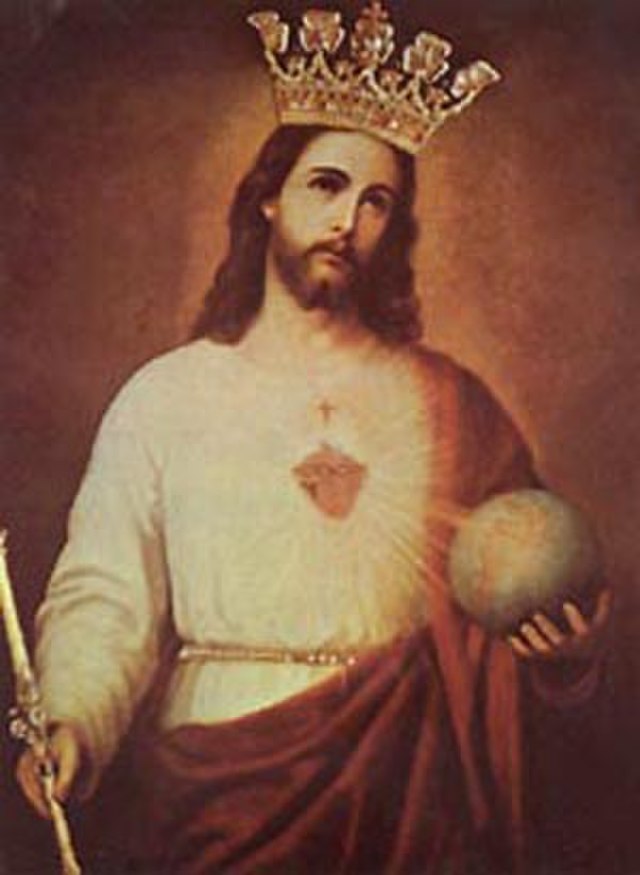
Book of Daniel 7:13-14 Psalm 93:1 Book of Revelation 1:5-8 Gospel of John 18:33b-37
Today, the Catholic Church honors Jesus Christ as the Lord and King of the Universe, reigning over both earth and heaven. This solemnity was first instituted by Pope Pius XI in 1925, originally celebrated in late October. Later, Pope St. Paul VI moved the commemoration to the Sunday before Advent, a fitting placement as we anticipate the incarnation of Christ and reflect on God’s plan of redemption through His Son, our King.
The Gospel of John proclaimed on this solemnity invites us to reflect on a central tenet of our faith: the search for truth as citizens longing for heaven.
“You say I am a king. For this I was born, and for this I came into the world, to testify to the truth. Everyone who belongs to the truth listens to my voice” (John 18:37). Pilate’s rhetorical question, “What is truth?” (Quid est veritas?) prompts us to explore the eternal nature of Christ’s Kingship. As the prophet Daniel reminds us, this Kingship is everlasting and will never be destroyed.
In today’s politicized world, we often find ourselves distracted by false truths, divided by partisan politics, and quick to cast judgment on those who do not share our values or beliefs. Yet, the truth our King Jesus testifies to is one of perfect, self-giving love. By surrendering His very life, Christ established a covenant of love, offering us the opportunity to become citizens of His perfect kingdom in heaven.
This kingdom is not a distant reality—it is here and now, present in the way we live our lives among the Church Militant. The Beatitudes and the commands to aid the stranger, nourish the poor, and uplift the downtrodden are not optional; they are the very fabric of Christ’s reign. To follow this King, crowned with thorns and pierced with nails, we must cast aside selfish and sinful behaviors, take up our cross, and embrace the sacrificial love He exemplifies.
The truth that Jesus reminds Pilate of cannot be found in the fleeting pleasures or luxuries of this world. Rather, it lies in the transformative love of the Holy Trinity. The love between the Father and the Son, poured out through the Holy Spirit, invites us into communion with God as citizens of His kingdom—both on earth and in heaven.
This week, let us reflect on these profound truths. Who is the ruler of our lives? Do we fully surrender ourselves to Christ, seeking the truth and beauty of His kingdom?
As the hymn often sung on this solemnity reminds us:
“To Jesus Christ, our Sovereign King,
Who is the world’s salvation,
All praise and homage do we bring,
And thanks and adoration.
Christ Jesus Victor, Christ Jesus Ruler!
Christ Jesus, Lord and Redeemer!”
Written by Fr. Martin Hellriegel during the rise of the Third Reich, this hymn calls us to turn away from worldly powers and submit ourselves to Christ, the King of all powers and principalities.
May Christ the King reign in our hearts and guide us to live as faithful citizens of His eternal kingdom.
The Presentation of The Theotokos, the Blessed Virgin Mary to the Temple
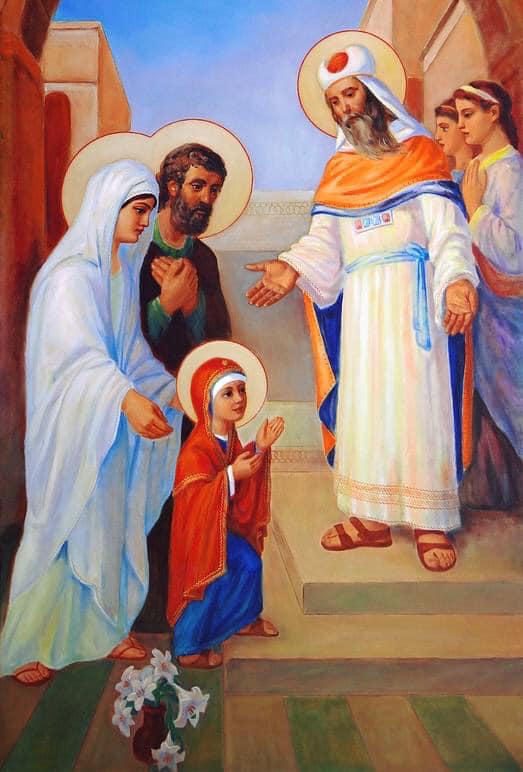
From a sermon by Saint Augustine
By faith she believed; by faith, conceived
Stretching out his hand over his disciples, the Lord Christ declared: Here are my mother and my brothers; anyone who does the will of my Father who sent me is my brother and sister and my mother. I would urge you to ponder these words. Did the Virgin Mary, who believed by faith and conceived by faith, who was the chosen one from whom our Saviour was born among men, who was created by Christ before Christ was created in her – did she not do the will of the Father? Indeed the blessed Mary certainly did the Father’s will, and so it was for her a greater thing to have been Christ’s disciple than to have been his mother, and she was more blessed in her discipleship than in her motherhood. Hers was the happiness of first bearing in her womb him whom she would obey as her master.
Now listen and see if the words of Scripture do not agree with what I have said. The Lord was passing by and crowds were following him. His miracles gave proof of divine power, and a woman cried out: Happy is the womb that bore you, blessed is that womb! But the Lord, not wishing people to seek happiness in a purely physical relationship, replied: More blessed are those who hear the word of God and keep it. Mary heard God’s word and kept it, and so she is blessed. She kept God’s truth in her mind, a nobler thing than carrying his body in her womb. The truth and the body were both Christ: he was kept in Mary’s mind insofar as he is truth, he was carried in her womb insofar as he is man; but what is kept in the mind is of a higher order than what is carried in the womb.
The Virgin Mary is both holy and blessed, and yet the Church is greater than she. Mary is a part of the Church, a member of the Church, a holy, an eminent – the most eminent – member, but still only a member of the entire body. The body undoubtedly is greater than she, one of its members. This body has the Lord for its head, and head and body together make up the whole Christ. In other words, our head is divine – our head is God.
Now, beloved, give me your whole attention, for you also are members of Christ; you also are the body of Christ. Consider how you yourselves can be among those of whom the Lord said: Here are my mother and my brothers. Do you wonder how you can be the mother of Christ? He himself said: Whoever hears and fulfils the will of my Father in heaven is my brother and my sister and my mother. As for our being the brothers and sisters of Christ, we can understand this because although there is only one inheritance and Christ is the only Son, his mercy would not allow him to remain alone. It was his wish that we too should be heirs of the Father, and co-heirs with himself.
Now having said that all of you are brothers of Christ, shall I not dare to call you his mother? Much less would I dare to deny his own words. Tell me how Mary became the mother of Christ, if it was not by giving birth to the members of Christ? You, to whom I am speaking, are the members of Christ. Of whom were you born? “Of Mother Church,” I hear the reply of your hearts. You became sons of this mother at your baptism, you came to birth then as members of Christ. Now you in your turn must draw to the font of baptism as many as you possibly can. You became sons when you were born there yourselves, and now by bringing others to birth in the same way, you have it in your power to become the mothers of Christ.
From Excerpts from the English translation of The Liturgy of the Hours (Four Volumes) © 1974, International Commission on English in the Liturgy Corporation. All rights reserved.
Blessed is the womb of the Virgin Mary, which bore the Son of the eternal Father. (From the communion antiphon at the mass today, cf. Lk 11:27).
Continuing To Live Out The Gospel Message Post Election Season

The Gospel from Matthew (22:15-22) reminds us of our call as Christians. The Pharisees wish to entrap Jesus along with the followers of Herod by asking Jesus if it is lawful to pay a tax with a pagan image of Cesar in which the Romans worshipped their emperor as a god/deity.
Jesus’s response reminds us that we should abide by the laws of the world and render unto Cesar’s what is Cesar’s while giving to God what is owed to God. It is easy for us to place labels and chastise individuals in our family and among our friends for how they cast their vote.
For those that are Christian, we must be mindful that we respect those duly appointed leaders and the laws of this nation by fulfilling our Christian call of discipleship. Of course, this does not mean we are not to petition and address our grievances for unjust laws that go against our faith.
A good guide to follow is how we live out the primary call of God’s commandment in loving God with our whole heart, mind, soul & strength. With the second commandment, Jesus reminds us to love our neighbor as ourself – (even if they voted for the other political opponent).
At the end of the day, letting trivial matters like politics divide us as Christians is not befitting of our baptismal call as new creations being wonderfully made in the light of Jesus. Many politicians of today’s time like to take sides and disparage the character of another. In doing so, they are not living up to the Christian Call of solidarity, charity, compassion, or loving others. We should take the high road for that is our call as Jesus’s disciples.
Blessed Miguel Pro, a martyr for the faith was executed in 1927 during the Cristeros War in Mexico. The Mexican government was opposed to the Catholic clerical influence. The chant of the Cristeros movement was ¡Viva Cristo Rey! or Long Live Christ the King!
If we as chosen disciples of Jesus truly want to honor Christ, our glorious king, we should practice loving our neighbor as ourselves regardless of who they voted for. There will be winners and losers after this election season is over. We must be mindful, that when we love God with our whole heart, mind, soul, and strength then it does not matter what is given to Cesar or the ruling class of the day. Our life is geared toward heavenly matters of citizenship. As Jesus reminds us, heaven and earth will pass away, but his words will not pass away (Mt. 24:35).
This earthly life is not our end goal. Being transformed and made perfect by God’s love is our goal. Jesus was crucified for the weight of the sin of all mankind is the only choice we should be concerned about. Getting caught up in the vitriol and mudslinging of which political party is in charge does not keep us on the path that Jesus wants for us as his chosen disciples.
Despite what outcome occurs at the ballot box, let love for God and love for our brother be our guide. When Christ our King is leading us, it does not matter who our neighbor voted for because God’s love is what should guide us.
All Hallow’s Eve & Recalling Our Christian Call to be Saints
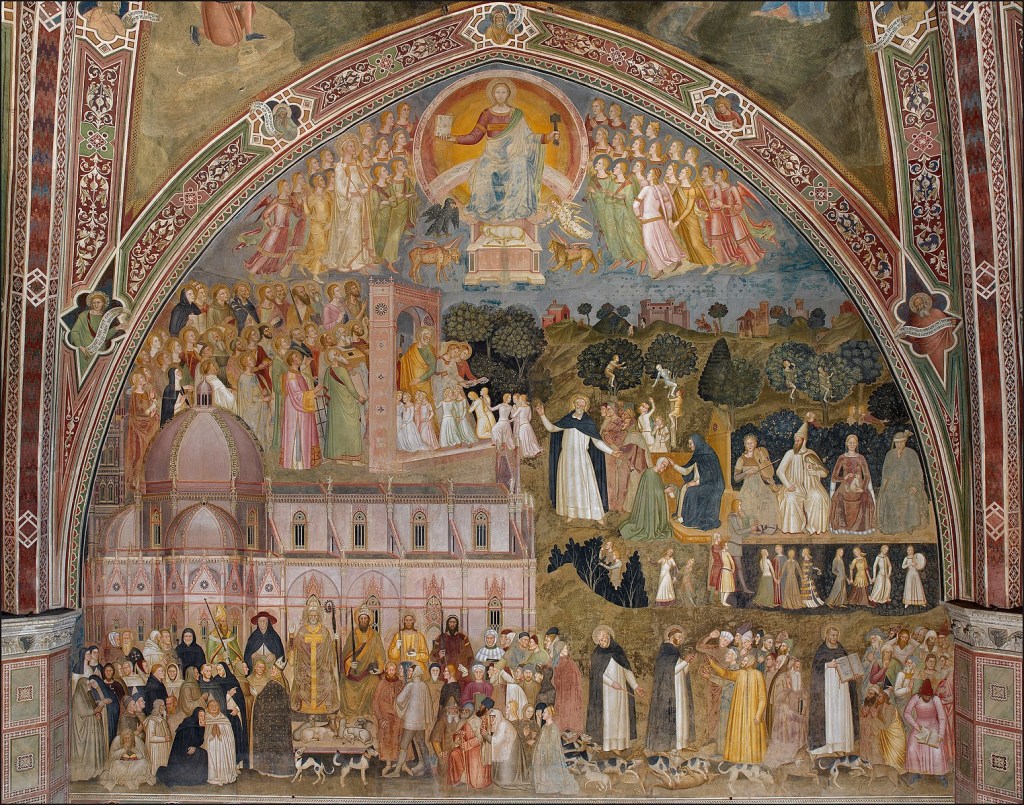
All Hallow’s Eve is a special day that has become secularized over the years in which we have lost the meaning and sacredness of the day. The day before All Saints asks us to contemplate the four last tenets of our eschatological and ontological journey. We will die. We will face judgment. There will be the prospect of heaven (or purgatory – a state of purification before a soul is ready to receive the merits of the beatific vision). Some may receive the possibility of hell or life without God’s love. This of course is a choice in which every human being is offered in how they conduct their affairs. We can respond to God’s continual call of grace and mercy or reject it by the way we live our life.
Our true ontological nature with our baptismal call as part of the Church militant is to be saints. We further reflect upon such a call from being new beings, born into the family of Christ, with our confirmation and choice of a Christian saintly name in which we wish to emulate. How we allow God’s will to become our Northern star is our why. How we respond to the grace and merits of the Holy Spirit on this earthly journey equips us toward becoming part of the church triumphant in heaven.
What then is a Saint? “All Christians are called to be saints. Saints are persons in heaven (officially canonized or not), who lived heroically virtuous lives, offered their life for others, or were martyred for the faith, and who are worthy of imitation” (https://www.usccb.org/offices/public-affairs/saints).
Our life is short and we must use our time wisely (Ps. 90:12). The Church has a phrase for such a reflection…Memento Mori, Tempus Fugit (remember death, time flies from the Latin).
If we are to truly recall this day where we wish to be frightened, ask thyself if you are ready for the next life? Will the Master reply, “well done good and faithful servant? (Mt. 25:23).
Rattenberg (Tyrol). Augustine museum – Memento-mori-painting ( 1694 ) from Kitzbühl – detail with inscription: “All skulls are signed but one; write your name on it, it is yours.”
The Book of Revelation recalls this great vision of what we can become as saintly beings striving for greatness.
(NABRE)
Rev. 7:9-12
After this I had a vision of a great multitude, which no one could count, from every nation, race, people, and tongue. They stood before the throne and before the Lamb, wearing white robes and holding palm branches in their hands. They cried out in a loud voice:
“Salvation comes from our God, who is seated on the throne, and from the Lamb.” All the angels stood around the throne and around the elders and the four living creatures. They prostrated themselves before the throne, worshiped God, and exclaimed: “Amen. Blessing and glory, wisdom and thanksgiving, honor, power, and might be to our God forever and ever. Amen.”
Who is your favorite Saint? Feel free to dress the kids up in Halloween costumes & enjoy the festivities. Also, be sure to encourage saintly costumes the next day for the great and hallowed (holy) day where we recall All Saints Day. May we seek to emulate those saintly men & women on our earthly journey!

As Saint Catherine of Siena once remarked, “be who God wants you to be and you will set the world onfire.” Let us go forth and be saintly women & men with the time we are blessed with.
As the song When The Saints Go Marching In reminds us – do we wish to be in that number?
Happy Hallow’s Eve.
God bless.
Overcoming Our Blindness: Come, See & Follow Jesus (30th Sunday Ordinary Time Reflection)
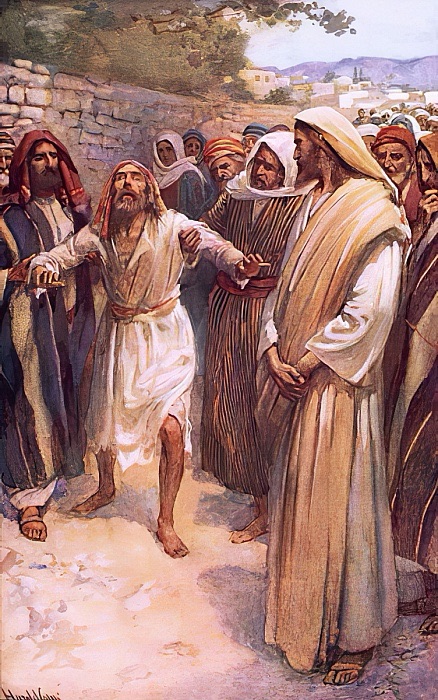
Reproduction from Harold Copping of Copping’s Bible Illustrations in the public domain retrieved at Wikimedia Commons https://commons.wikimedia.org/wiki/File:Harold_Copping_-Bartimaeus-_(MeisterDrucke-52938).jpg
Jeremiah 31:7-9, Psalm 126, Heb. 5:1-6, Mark 10:46-52
The first reading from the prophet Jeremiah reminds us that the Lord God will gather together the blind and lame from the ends of the earth.
If we are truly honest with ourselves, we are also like the blind and lame in our own faith journey. One of the seven deadly sins of pride may hinder our relationship with living out our call to Christian discipleship. We may think that our way is better, and put time for God in a compartmentalized box. The opposing virtue for this flaw is humility. We must ask for God’s grace to recognize that nothing in life is absent from God’s will. Another of the seven deadly sins is envy. Perhaps we wish we had a better body, more wealth or some other attribute in which we compare ourselves to others. We must seek gratitude in our life regardless of the circumstances. Those that sow in tears will reap in joy according to Psalm 126.
The psalm response reminds us to be filled with joy for the Lord God has done great things for us.
Oftentimes we can be burdened by this earthly path which causes us to lose sight of the wonder and awe of God’s creation. A blind person may not have experienced the gift of sight by being able to see a magnificent sunrise or sunset. This same person, however, can feel the warmth of the sun on their skin and hear the wonder of God’s creation with their other senses. A blind or lame person may appear to have physical limitations to those that do not, but it is the heart and soul of mankind that is without limit in which God, the Divine Weaver, will create a rich tapestry using all of His creation.
The late Fred Rogers who created the long running USA based program of Mr. Rogers Neighborhood had an episode with a quadriplegic boy named Jeff Erlanger. Jeff was confined to a wheelchair due to a tumor at the age of four. Despite his condition, Mr. Erlanger never let his condition impede the joy of living. Mr. Erlanger said it wasn’t what he could not do, but what he could do that impacted his joy in life. (See the following Jeff & Mister Rogers https://youtu.be/wxl4SPiKQDE?si=DhIOZV5bE_7B_8e2 via @YouTube). We too must have that same attitude as Christian disciples & be grateful just as Mr. Erlanger was to have the precious gift of life.
When blind Bartimaeus hears of Jesus entering the town of Jericho, his humbled response can only be one of “Jesus, son of David, have pity on me.” Such a recognition of Jesus as Messiah by Bartimaeus foreshadows Jesus’s upcoming Passion and death upon the cross and entry into Jerusalem. Jericho is 15 miles outside of Jerusalem. This land of Jericho also recalls the place where Aaron, a high priest under the Mosaic covenant numbered the Israelites along with Eleazar upon the plains of Moab at Jericho (Numbers 26:63-64). Paul’s epistle to the Hebrews and the second reading recalls this high priesthood and the priesthood of Jesus where he will become the ultimate sacrifice for our human condition.
Although the crowd rebuked Bartimaeus for his loud pleas for help, he persisted. When Jesus called forth for him to come, the crowd told Bartimaeus to take courage in which he sprang up, dropped the cloak and asked the Master for his sight to be restored. Go your way; your faith has saved you. The gospel writer also mentions that Bartimaeus followed Jesus on the way after such a miraculous healing event takes place. Bartimaeus follows Jesus upon the way toward Jerusalem to witness the Passion, death, carrying of the cross and eventual resurrection that is the joy we should find in life according to the Psalm verse.
We can choose to remain by the roadside and let life pass us by. It is easy to mope and be apathetic about our state of affairs. However, Bartimaeus, did not let the crowd stand in his way to become closer to Jesus. Mr. Erlanger did not let his disability ruin his mission and outlook in life. We must ask for the grace to have the steadfast faith of Bartimaeus to cast aside our worries, problems & concerns and seek out Jesus to follow Him on the way. Let us ask for God’s grace to seek out the courage to come to Jesus with our problems and let faith be our guide this day.
St. John Paul II, Pray For Us

John Paul II is a beloved servant of God and saint that many will not forget as we reflect upon the many achievements from this great & holy man.
Pope John Paul II was the most traveled pope, having paved the way for the church’s mission to go forth and bring Christ’s light to others ushering forth a “new evangelization” (https://www.usccb.org/beliefs-and-teachings/how-we-teach/catechesis/catechetical-sunday/new-evangelization/upload/What-is-New-About-Evangelization-2.pdf).
John Paul II gave us hope. He gave us by God’s grace, new mysteries of the rosary with the Luminous mysteries in his apostolic letter Rosarium Virginis Mariae. Recalling the biblical accounts of the Baptism of Jesus, Wedding at Cana miracle, Proclamation of the Kingdom by our Lord, Transfiguration event, and Institution of the Eucharist are the Luminous Mysteries (https://www.vatican.va/content/john-paul-ii/en/apost_letters/2002/documents/hf_jp-ii_apl_20021016_rosarium-virginis-mariae.html).
John Paul II taught us forgiveness when he forgave his assassin. This man later converted to Christianity (https://www.buzzfeednews.com/article/davidmack/ali-agca-flowers-pope-john-paul).
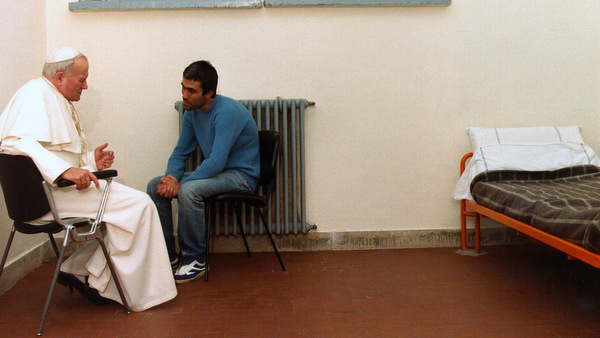
St. John Paul II reminded us of the sanctity of all life with his Theology of the Body imagery and reflections (https://www.usccb.org/issues-and-action/marriage-and-family/natural-family-planning/catholic-teaching/theology-of-the-body)
For a man who achieved so much during his life and lost a great deal, St. John Paul II continues to show us the way to heaven and to the saints in glory by his example and way he lived his life. Having lost his father at the age of 20 and his mother and siblings at a young age, St. John Paul II grew up during the totalitarian takeover of his native Poland by the Nazis and later communist regime and dedicated his life to God as a priest (https://www.catholicnewsagency.com/news/21953/death-of-john-paul-iis-father-propelled-him-to-his-future-vocation).
Many journalists and modern day scholars attribute the fact that St. John Paul II was instrumental in breaking down the walls of communism (https://www.pbs.org/wgbh/pages/frontline/shows/pope/communism/). St. John Paul II is a pope that reminded us that no barrier was too great in bringing the image of Jesus to the ends of the earth and was truly a millennial pope for the ages.
St. John Paul II’s last words were “Let me go to the house of my Father” (https://www.nytimes.com/2005/09/18/international/europe/vatican-details-final-days-of-pope-john-paul-ii.html).
Let us recall the words from our beloved papa, “Do not be afraid. Open wide the doors to Christ!” (https://www.vatican.va/content/john-paul-ii/en/homilies/1978/documents/hf_jp-ii_hom_19781022_inizio-pontificato.html)
Let us ask St. John Paul II to pray for us from the heavenly choirs of angels this day as we labor in the Lord’s vineyard here on earth. Let us recall the words from St. John Paul II from his Angelus message in 1986 in which he proclaimed “we are an Easter people and Alleluia is our song” (https://www.vatican.va/content/john-paul-ii/en/angelus/1986/documents/hf_jp-ii_ang_19861130.html).
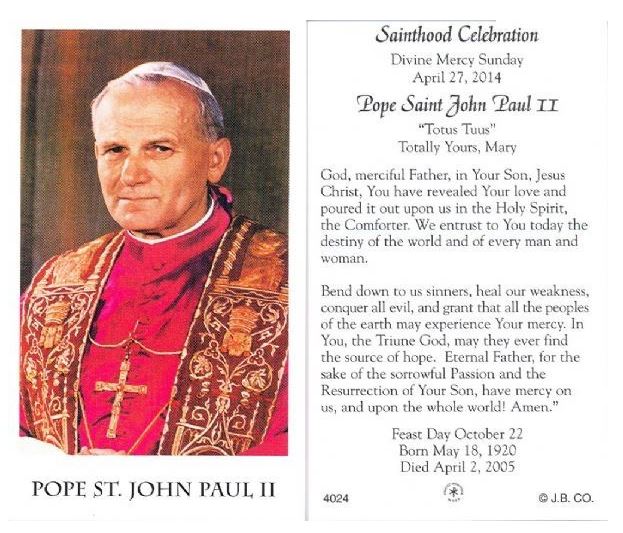
May the Lord bless us, protect us from all evil and bring us to everlasting life. St. Pope John Paul II, pray for us and look upon us this day as we strive to do His will. Amen.
Memorial of St. Luke the Evangelist
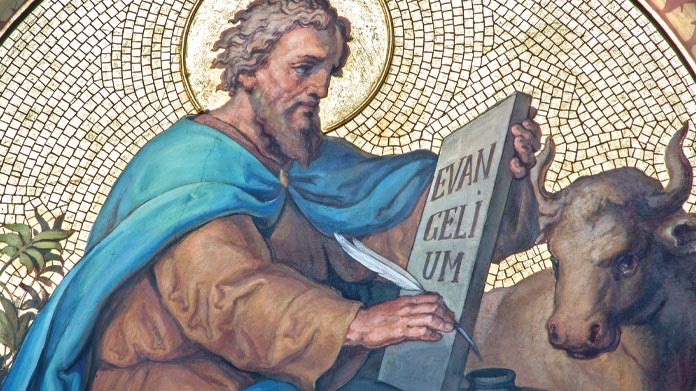
Today the church commemorates the memorial of St. Luke, the gospel writer and author of the Gospel and book of Acts. He was most likely trained as a physician and healer and was a Greek gentile being associated with St. Paul & Barnabas per the Acts of the Apostles account. St. Luke is the patron of physicians and surgeons with a writing style that represents a healing and merciful aspect to the fallen. It is believed by scholars that St. Luke may have been born a slave trained to be a healer to provide services to a wealthy family as a resident family healer for which his writings show a sense of social justice and compassion (https://www.catholic.org/saints/saint.php?saint_id=76).
The unique item about St. Luke in the synoptic gospels unlike the others is St. Luke’s inclusion of the Magnificat of Mary from Lk. 1:46-55
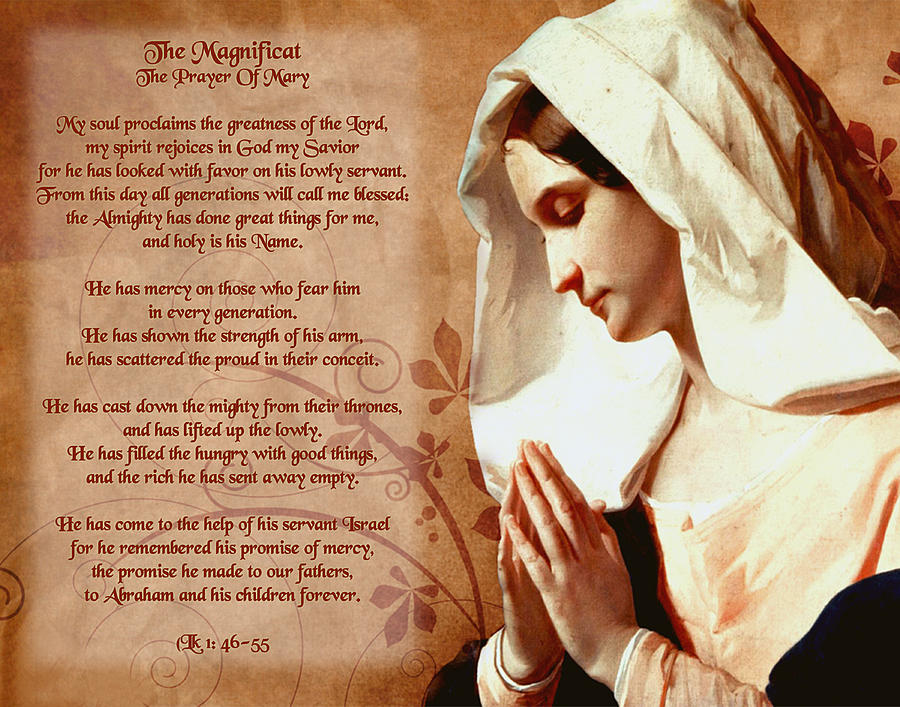
Another item to reflect on is the encounter of Lazarus with the rich man for which all of us have a moral obligation to be of assistance to others regardless of our station in life or the appearance of our suffering and impoverished among us:
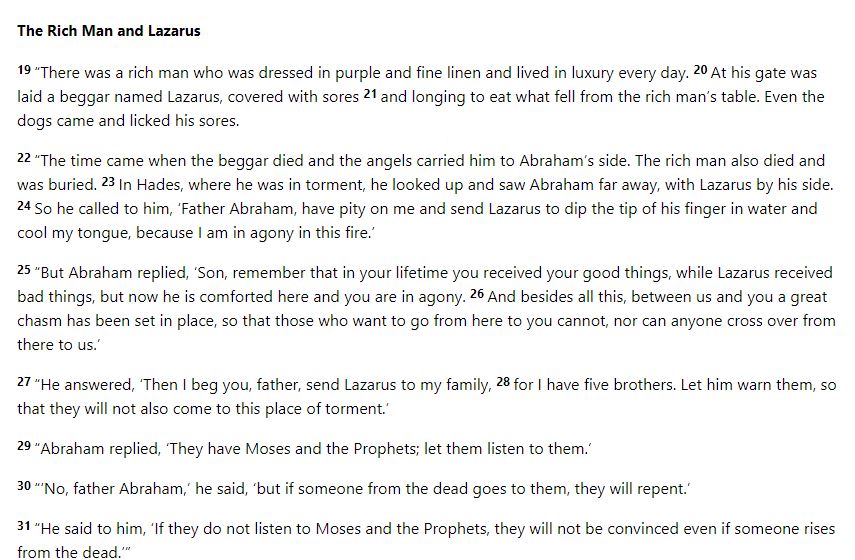
St. Luke’s image is often portrayed as that of a winged ox assigned by St. Jerome and St Irenaeus for it represents the old sacrificial offering image in the temple. St. Luke’s Gospel recalls the presentation of Jesus in the temple and the closing of Luke’s gospel tells of the destruction of the temple and the end times. Of course, we also recall all of the gospel writers were assigned symbols per Revelation 4:7 of a lion (St. Mark), ox, (St. Luke) man (St. Matthew) and eagle (St. John) to which St. Jerome’s presentation differed a bit from St Irenaeus (https://scotland.op.org/the-ox-as-a-symbol-of-st-luke/).
St. Luke reminds us of the nature and actions of our Lord Jesus, the Divine Healer in his writings to us. He reminds us of Mary’s fiat and her role with what we can become as Christians. May we look to St. Luke’s gospel this day to go out and be another Christ to our brothers and sisters in need.
St. Luke, pray for us.
St. Ignatius of Antioch, Bishop & Martyr

An excerpt from the Office of Readings Liturgy of the Hours in which St. Ignatius of Antioch on his way to Rome to be martyred for the faith writes about:
I am God’s wheat and shall be ground by the teeth of wild animals
I am writing to all the churches to let it be known that I will gladly die for God if only you do not stand in my way. I plead with you: show me no untimely kindness. Let me be food for the wild beasts, for they are my way to God. I am God’s wheat and shall be ground by their teeth so that I may become Christ’s pure bread. Pray to Christ for me that the animals will be the means of making me a sacrificial victim for God.
No earthly pleasures, no kingdoms of this world can benefit me in any way. I prefer death in Christ Jesus to power over the farthest limits of the earth. He who died in place of us is the one object of my quest. He who rose for our sakes is my one desire.
The time for my birth is close at hand. Forgive me, my brothers. Do not stand in the way of my birth to real life; do not wish me stillborn. My desire is to belong to God. Do not, then, hand me back to the world. Do not try to tempt me with material things. Let me attain pure light. Only on my arrival there can I be fully a human being. Give me the privilege of imitating the passion of my God. If you have him in your heart, you will understand what I wish. You will sympathise with me because you will know what urges me on.
I am writing to all the churches to let it be known that I will gladly die for God if only you do not stand in my way. I plead with you: show me no untimely kindness. Let me be food for the wild beasts, for they are my way to God. I am God’s wheat and shall be ground by their teeth so that I may become Christ’s pure bread. Pray to Christ for me that the animals will be the means of making me a sacrificial victim for God.
The prince of this world is determined to lay hold of me and to undermine my will which is intent on God. Let none of you here help him; instead show yourselves on my side, which is also God’s side. Do not talk about Jesus Christ as long as you love this world. Do not harbour envious thoughts. And supposing I should see you, if then I should beg you to intervene on my behalf, do not believe what I say. Believe instead what I am now writing to you. For though I am alive as I write to you, still my real desire is to die. My love of this life has been crucified, and there is no yearning in me for any earthly thing. Rather within me is the living water which says deep inside me: “Come to the Father.” I no longer take pleasure in perishable food or in the delights of this world. I want only God’s bread, which is the flesh of Jesus Christ, formed of the seed of David, and for drink I crave his blood, which is love that cannot perish.
I am no longer willing to live a merely human life, and you can bring about my wish if you will. Please, then, do me this favour, so that you in turn may meet with equal kindness. Put briefly, this is my request: believe what I am saying to you. Jesus Christ himself will make it clear to you that I am saying the truth. Only truth can come from that mouth by which the Father has truly spoken. Pray for me that I may obtain my desire. I have not written to you as a mere man would, but as one who knows the mind of God. If I am condemned to suffer, I will take it that you wish me well. If my case is postponed, I can only think that you wish me harm.
To learn more about this great saint visit the following link: https://www.christianity.com/wiki/people/who-was-ignatius-of-antioch.html
28th Sunday Ordinary Time – What Must I Do To Inherit Eternal Life With Jesus?
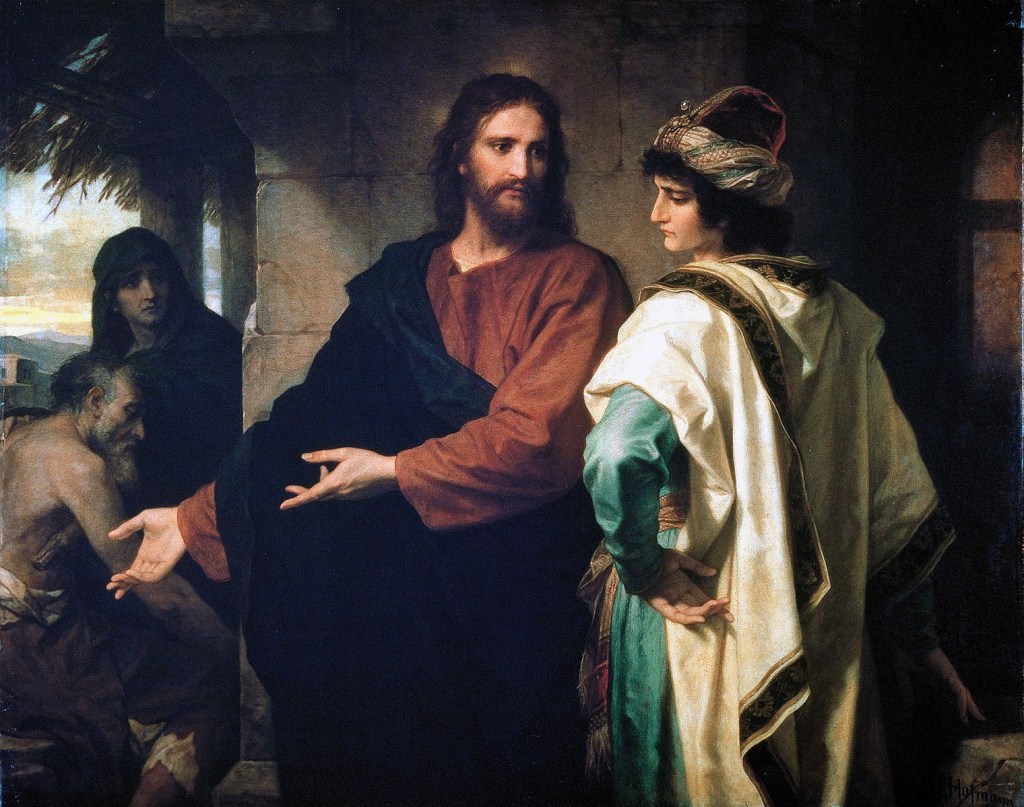
Today’s Gospel reading from Mark’s Gospel chapter 10 has us contemplating the meaning of life. “What must I do to inherit eternal life?” (Mk. 10:17). The parable of the rich man is an example that can include our life as well. While we don’t necessarily have to sell off all of our possessions to follow Jesus, nor do we have to give up other luxuries in life to be a Christian disciple, the interior question should be where is our heart and soul at this moment in our earthly journey? When Jesus informs his disciples that it is difficult for a rich man to enter the kingdom of heaven and easier for a camel to enter through the eye of a needle (Mk 10:25) it is confusing imagery. After all, the rich man could not part with his possessions because his heart was dependent on something else, something that was not geared toward the dependency of God’s will and His love.
The second reading from Hebrews chapter 4:12-13 has us contemplating God’s Word being sharper than any two edged sword, penetrating to the interior depths of our heart. We must not let the words from holy scripture go in one ear and out another. Our selective hearing must be open to this message in which we are a lot like the rich man, hearing only those teachings from Jesus that coincide with my status quo, but don’t always line up with the sacrifice we as disciples are called to make.
What prevents us from going all in to be Jesus’s disciple? As the responsorial psalm reminds us (Psalm 90) Fill us with your love Lord, and we will sing of your joy!
The personification and imagery from the book of Wisdom (7:7-11) in the first reading reminds us that the goal of attaining wisdom that comes from the Lord God is superior to all else.
Take some time this week and reflect on what you should give up to follow Christ Jesus more closely.
One great spiritual habit to take up is to do the Examen Prayer Meditation by Saint Ignatius of Loyola:
The five steps as clarified by the Jesuit Institute found in Saint Ignatius’s Spiritual Exercises Retrieved January 14, 2024, from https://jesuitinstitute.org/Pages/Examen.htmre) are as follows:
1. Give Thanks – How do we show gratitude for the blessings God gave us for the day?
2. Ask for light – How do we ask God to enlighten our hearts and minds by being attentive to His presence with us throughout the day at work, school, leisure or otherwise?
3. Examine the day – How has God been present in those moments with consolation in my actions and reactions to others? How has God not been present with my actions and reactions to others with desolation?
4. Ask for forgiveness – ask for forgiveness for the times when we reacted contrary to His will and reception to His grace in our day. How were we not spreading the good news of the gospel by our actions both in word and deed?
5. Resolution to change – determine what can be done the next day to change our demeanor, our attitude and behavior of reflecting God’s love in the world.
 StreetEvangelist


