Finding Holiday Cheer & Inner Peace

For many, the consumerism of the holiday season and the pressure to buy gifts can create stress. For others, this time of year is filled with grief and desolation. Not everyone experiences holiday cheer or finds inner peace during this season.

It’s worth reflecting on the true nature of the season—where the simple pleasures of seeing beautiful lights, sipping hot chocolate, and enjoying festive treats may bring a bit of cheer. If we look back to the first Christmas celebration, we remember that Joseph and Mary had no lodging for Mary, who was heavily pregnant. Mary is believed to have traveled about 90 miles from Nazareth to Bethlehem, enduring a long and difficult journey due to a census ordered by Caesar. Traveling while about to give birth, with only animal transport, was no easy task. The holiday cheer of Joseph and Mary likely wasn’t as clear as often depicted in paintings, but despite the hardships, something deep within their hearts and souls kept them going. Jesus, the Light of the World, and God’s grace moved them to face these challenges. Giving birth to Jesus in the humble surroundings of livestock was not easy, but Christians believe Jesus came into the world to uplift the lowest of the low and to offer God’s grace, love, and mercy to all who are impoverished and desolate.

Perhaps you’re not a Christian, and that’s okay. The “reason for the season” might make you think of the Grinch and how some might view you in a similar light. But at its core, the season is about finding peace—a pursuit that can be difficult, especially if you are grappling with the loss of a loved one, facing health challenges, or feeling overwhelmed. Think about those moments in life that brought you happiness. Reflect on the kindness a neighbor has shown you or a small act of goodwill you once did for someone else.

Seeking the love and peace of the season can feel like an arduous task. I encourage you to find peace in the silence. Contemplate the joyful memories and places that once brought you happiness—that is the heart of the season and a path toward inner peace.

To be cheerful is often a matter of changing your perspective—even if this time of year makes you feel like shutting the door and becoming an Ebenezer Scrooge or the Grinch. Finding peace requires escaping the distractions of the mind and the pains of the body, and following the heart toward those cherished moments of joy. It is not an easy task, but it is worth the effort to experience the true cheer of the season.

May the reason for the season bring you holiday cheer. May your quest for peace lead you to a moment of calm and joy.

In love & light.

Saint John of the Cross, Priest, Doctor 

Bio: https://www.franciscanmedia.org/saint-of-the-day/saint-john-of-the-cross/

From a spiritual Canticle by John of the Cross:  The knowledge of the mystery hidden in Christ Jesus

Though holy doctors have uncovered many mysteries and wonders, and devout souls have understood them in this earthly condition of ours, yet the greater part still remains to be unfolded by them, and even to be understood by them.

We must, then, dig deeply in Christ. He is like a rich mine with many pockets containing treasures. However deep we dig, we will never find their end or their limit. Indeed, in every pocket new seams of fresh riches are discovered on all sides.

For this reason the apostle Paul said of Christ: In him are hidden all the treasures of the wisdom and knowledge of God. The soul cannot enter into these treasures, nor attain them, unless it first crosses into and enters the thicket of suffering, enduring interior and exterior labors, and unless it first receives from God very many blessings in the intellect and in the senses, and has undergone long spiritual training.

All these are lesser things, disposing the soul for the lofty sanctuary of the knowledge of the mysteries of Christ: this is the highest wisdom attainable in this life. Would that men might come at last to see that is it is quite impossible to reach the thicket of the riches and wisdom of God except by first entering the thicket of much suffering, in such a way that the soul finds there its consolation and desire. The soul that longs for the divine wisdom chooses first, and in truth, to enter the thicket of the cross.

Saint Paul, therefore, urges the Ephesians not to grow weary in the midst of tribulations, but to be rooted and grounded in love, so that they may know with all the saints the breadth, the length, the height and the depth – to know what is beyond the knowledge – the love of Christ, so as to be filled with all the fullness of God.

The gate that gives entry into these riches of his wisdom is the cross; because it is a narrow gate. While many seek the joys that can be gained though it, it is given to few to desire to pass through it.

Quote: “Where there is no love, put love, and you will draw love out.” 

Source: The Liturgy of the Hours, Office of Readings, December 14

Advent – Making Room Within The Inn of Our Hearts for the Christ child Jesus

As many Christians prepare to think about shopping for Christmas gifts, decorating with lights and the secular push to conform with society, it’s good to ponder the seasons of life. Let us await with gentle patience the coming of Jesus, the Christ child. Making room within the inn of our hearts during the penitential time of Advent is crucial for a spectacular incarnation to occur for us on this earthly pilgrimage. Such a season not only reminds us of the first coming of our Lord & King Jesus born in a manger, but of the time when He will return with the second coming.

This first week of Advent reminds us of the need to have hope. We are to be watchful and to be on guard. As Saint Luke’s reminds us there will be apocalyptic signs when Jesus returns again, but we should not fear if we place our trust and hope in the Lord.

Will we make this season of Advent one where we prepare the way for the Lord? We oftentimes think that Lent is the time for penance, but Advent is a penitential time of preparation as well. Such a season reminds us of the need to give alms, declutter, attend the sacrament of reconciliation and increase our prayer. Just as in Luke’s gospel describing that there was no room for Jesus and the holy family in the inn, will you make this advent season one where there is room in the inn of your heart?

Advent songs: https://catholicreview.org/advent-hymns-and-songs/

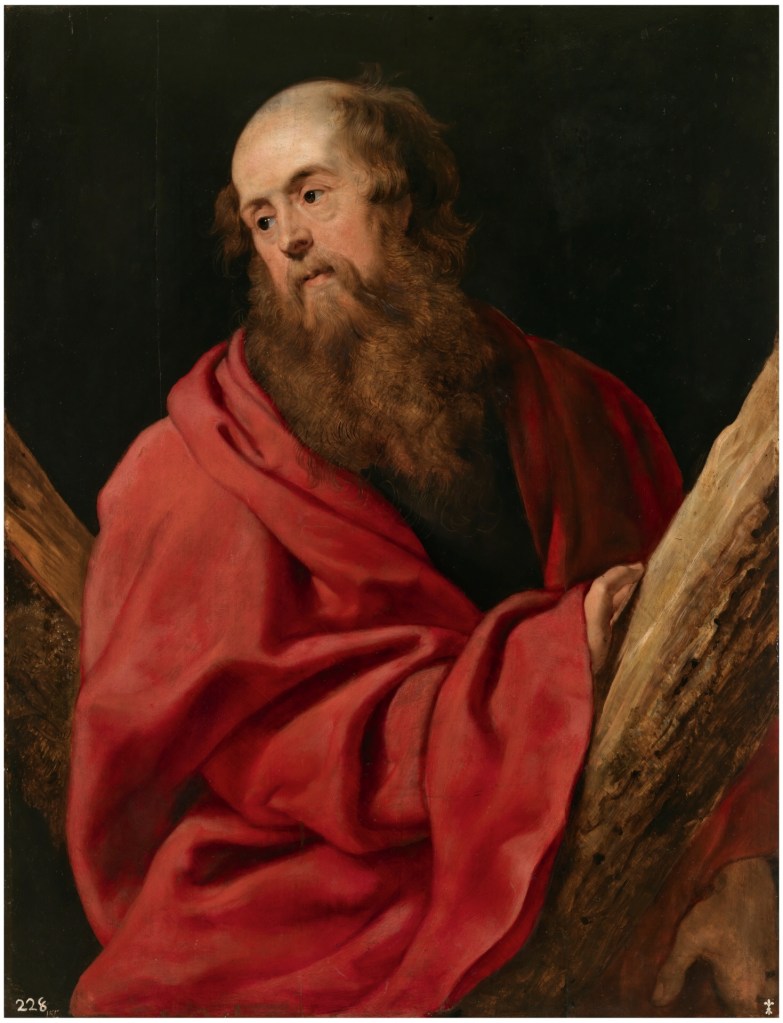
St. Andrew, Pray for Us

St. Andrew by Peter Paul Rubens on the public domain at Wikimedia Commons https://commons.wikimedia.org/wiki/File:Rubens_apostel_andreas_grt.jpg

Today the church recalls St. Andrew, the first apostle and humble fisherman and brother of Simon Peter. St. Andrew, a follower of John the Baptist, led a bunch of followers to Christ Jesus as a strong witness of the Holy Spirit & ventured out to Greece and Asia Minor spreading the good news of the gospel.

St. Andrew was martyred for the faith on an x shaped cross or saltire cross in Greece and legend states he preached the faith from the cross for two days before his demise.

Gospel (Mt. 4:18-22)

As Jesus was walking by the Sea of Galilee, he saw two brothers,
Simon who is called Peter, and his brother Andrew, casting a net into the sea; they were fishermen. He said to them,
“Come after me, and I will make you fishers of men.” At once they left their nets and followed him. He walked along from there and saw two other brothers, James, the son of Zebedee, and his brother John. They were in a boat, with their father Zebedee, mending their nets. He called them, and immediately they left their boat and their father and followed him.

What is holding you back from leaving all of your concerns, worries and roadblocks of life to come follow Jesus? St. Andrew along with Simon Peter immediately left their nets, their livelihoods to follow Jesus. Can you say the same thing with where you are in your faith life?

A reflection from St John Chrysostom from the Breviary office of readings has an interesting reflection for us to ponder:

After Andrew had stayed with Jesus and had learned much from him, he did not keep this treasure to himself, but hastened to share it with his brother. Notice what Andrew said to him: We have found the Messiah, that is to say, the Christ. Notice how his words reveal what he has learned in so short a time. They show the power of the master who has convinced them of this truth. They reveal the zeal and concern of men preoccupied with this question from the very beginning. Andrew’s words reveal a soul waiting with the utmost longing for the coming of the Messiah, looking forward to his appearing from heaven, rejoicing when he does appear, and hastening to announce so great an event to others. To support one another in the things of the spirit is the true sign of good will between brothers, of loving kinship and sincere affection.

Notice, too, how, even from the beginning, Peter is docile and receptive in spirit. He hastens to Jesus without delay. He brought him to Jesus, says the evangelist. But Peter must not be condemned for his readiness to accept Andrew’s word without much weighing of it. It is probable that his brother had given him, and many others, a careful account of the event; the evangelists, in the interest of brevity, regularly summarise a lengthy narrative. Saint John does not say that Peter believed immediately, but that he brought him to Jesus. Andrew was to hand him over to Jesus, to learn everything for himself. There was also another disciple present, and he hastened with them for the same purpose.

When John the Baptist said: This is the Lamb, and he baptizes in the Spirit, he left the deeper understanding of these things to be received from Christ. All the more so would Andrew act in the same way, since he did not think himself able to give a complete explanation. He brought his brother to the very source of light, and Peter was so joyful and eager that he would not delay even for a moment.

Sources:

https://www.catholic.org/saints/saint.php?saint_id=109

Roman Office of Readings for the Feast of Saint Andrew from a homily excerpt from St John Chrysostom on St John’s gospel

Give Thanks To The Lord

Our very life and the source of all goodness and mercy come from the Lord God. As Psalm 107:1 reminds us, “Give thanks to the Lord, for He is good; His love endures forever.” Saint Paul also calls us to gratitude, urging us to offer thanksgiving for all that we have in Christ Jesus: “And let the peace of Christ rule in your hearts, to which indeed you were called in one body. And be thankful” (Colossians 3:15).

Every time we gather at the altar and receive Jesus in the Eucharist—whose very name, derived from the Greek eucharistia, means “thanksgiving”—we are called to something greater. While it’s easy to focus on complaints about our circumstances, or lament how the paycheck no longer stretches as far for our Thanksgiving meals, we must not allow these worries to overshadow the light of Christ that dwells in each of us. A grateful heart is a joyous heart. When we cultivate gratitude—whether for the gift of life, our family and friends, or even that one coworker, friend, or family member who challenges us—we open our hearts to something higher.

As we gather around the table today, let us take a moment to reflect on what we are thankful for. Let us lift up all our worries, concerns, and troubles to the Lord God.

From today’s Collect Prayer at Mass:
“Father all-powerful, Your gifts of love are countless and Your goodness infinite. As we come before You on Thanksgiving Day with gratitude for Your kindness, open our hearts to concern for every man, woman, and child, so that we may share Your gifts in loving service. Through our Lord Jesus Christ, Your Son, who lives and reigns with You in the unity of the Holy Spirit, God, forever and ever. Amen.”

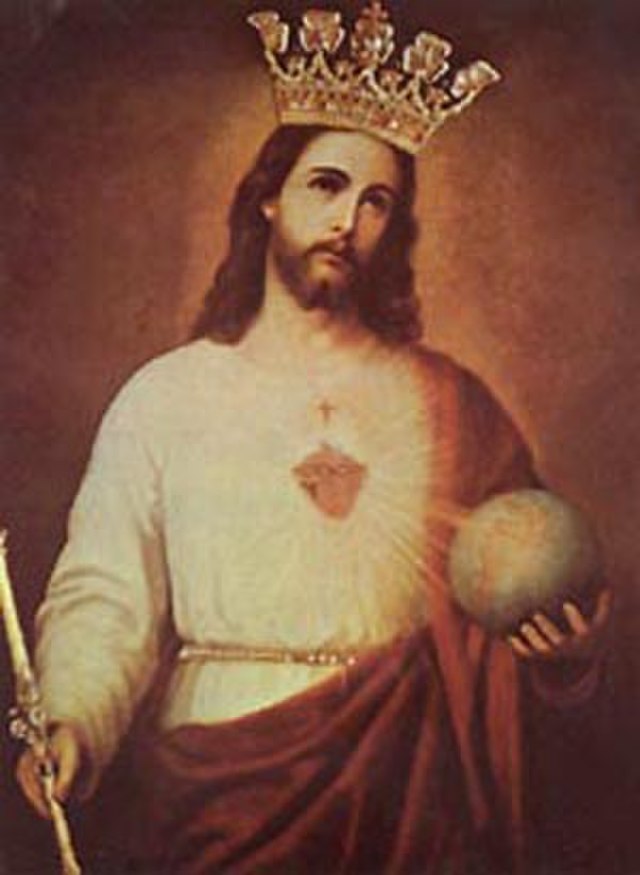
The Solemnity of Jesus Christ the King of the Universe

Image of the Consecracion of Ecuador to the Sacred Heart of Jesus by President Garcia Moreno in 1873, propagated by Father Mateo Image in Public Domain Retrieved from Wikimedia Commons

Book of Daniel 7:13-14 Psalm 93:1 Book of Revelation 1:5-8 Gospel of John 18:33b-37

Today, the Catholic Church honors Jesus Christ as the Lord and King of the Universe, reigning over both earth and heaven. This solemnity was first instituted by Pope Pius XI in 1925, originally celebrated in late October. Later, Pope St. Paul VI moved the commemoration to the Sunday before Advent, a fitting placement as we anticipate the incarnation of Christ and reflect on God’s plan of redemption through His Son, our King.

The Gospel of John proclaimed on this solemnity invites us to reflect on a central tenet of our faith: the search for truth as citizens longing for heaven.

“You say I am a king. For this I was born, and for this I came into the world, to testify to the truth. Everyone who belongs to the truth listens to my voice” (John 18:37). Pilate’s rhetorical question, “What is truth?” (Quid est veritas?) prompts us to explore the eternal nature of Christ’s Kingship. As the prophet Daniel reminds us, this Kingship is everlasting and will never be destroyed.

In today’s politicized world, we often find ourselves distracted by false truths, divided by partisan politics, and quick to cast judgment on those who do not share our values or beliefs. Yet, the truth our King Jesus testifies to is one of perfect, self-giving love. By surrendering His very life, Christ established a covenant of love, offering us the opportunity to become citizens of His perfect kingdom in heaven.

This kingdom is not a distant reality—it is here and now, present in the way we live our lives among the Church Militant. The Beatitudes and the commands to aid the stranger, nourish the poor, and uplift the downtrodden are not optional; they are the very fabric of Christ’s reign. To follow this King, crowned with thorns and pierced with nails, we must cast aside selfish and sinful behaviors, take up our cross, and embrace the sacrificial love He exemplifies.

The truth that Jesus reminds Pilate of cannot be found in the fleeting pleasures or luxuries of this world. Rather, it lies in the transformative love of the Holy Trinity. The love between the Father and the Son, poured out through the Holy Spirit, invites us into communion with God as citizens of His kingdom—both on earth and in heaven.

This week, let us reflect on these profound truths. Who is the ruler of our lives? Do we fully surrender ourselves to Christ, seeking the truth and beauty of His kingdom?

As the hymn often sung on this solemnity reminds us:

“To Jesus Christ, our Sovereign King,
Who is the world’s salvation,
All praise and homage do we bring,
And thanks and adoration.
Christ Jesus Victor, Christ Jesus Ruler!
Christ Jesus, Lord and Redeemer!”

Written by Fr. Martin Hellriegel during the rise of the Third Reich, this hymn calls us to turn away from worldly powers and submit ourselves to Christ, the King of all powers and principalities.

May Christ the King reign in our hearts and guide us to live as faithful citizens of His eternal kingdom.

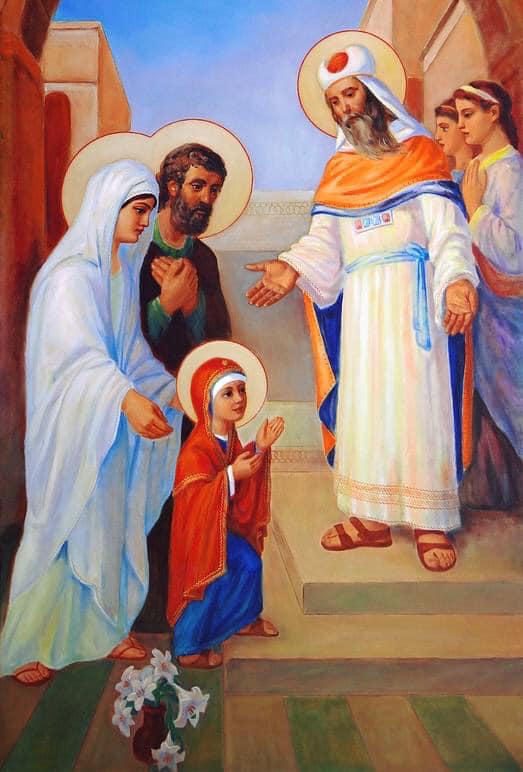
The Presentation of The Theotokos, the Blessed Virgin Mary to the Temple

Retrieved from https://www.marypages.com/the-presentation-of-the-lord-en.html

From a sermon by Saint Augustine

By faith she believed; by faith, conceived

Stretching out his hand over his disciples, the Lord Christ declared: Here are my mother and my brothers; anyone who does the will of my Father who sent me is my brother and sister and my mother. I would urge you to ponder these words. Did the Virgin Mary, who believed by faith and conceived by faith, who was the chosen one from whom our Saviour was born among men, who was created by Christ before Christ was created in her – did she not do the will of the Father? Indeed the blessed Mary certainly did the Father’s will, and so it was for her a greater thing to have been Christ’s disciple than to have been his mother, and she was more blessed in her discipleship than in her motherhood. Hers was the happiness of first bearing in her womb him whom she would obey as her master.

Now listen and see if the words of Scripture do not agree with what I have said. The Lord was passing by and crowds were following him. His miracles gave proof of divine power, and a woman cried out: Happy is the womb that bore you, blessed is that womb! But the Lord, not wishing people to seek happiness in a purely physical relationship, replied: More blessed are those who hear the word of God and keep it. Mary heard God’s word and kept it, and so she is blessed. She kept God’s truth in her mind, a nobler thing than carrying his body in her womb. The truth and the body were both Christ: he was kept in Mary’s mind insofar as he is truth, he was carried in her womb insofar as he is man; but what is kept in the mind is of a higher order than what is carried in the womb.

The Virgin Mary is both holy and blessed, and yet the Church is greater than she. Mary is a part of the Church, a member of the Church, a holy, an eminent – the most eminent – member, but still only a member of the entire body. The body undoubtedly is greater than she, one of its members. This body has the Lord for its head, and head and body together make up the whole Christ. In other words, our head is divine – our head is God.

Now, beloved, give me your whole attention, for you also are members of Christ; you also are the body of Christ. Consider how you yourselves can be among those of whom the Lord said: Here are my mother and my brothers. Do you wonder how you can be the mother of Christ? He himself said: Whoever hears and fulfils the will of my Father in heaven is my brother and my sister and my mother. As for our being the brothers and sisters of Christ, we can understand this because although there is only one inheritance and Christ is the only Son, his mercy would not allow him to remain alone. It was his wish that we too should be heirs of the Father, and co-heirs with himself.

Now having said that all of you are brothers of Christ, shall I not dare to call you his mother? Much less would I dare to deny his own words. Tell me how Mary became the mother of Christ, if it was not by giving birth to the members of Christ? You, to whom I am speaking, are the members of Christ. Of whom were you born? “Of Mother Church,” I hear the reply of your hearts. You became sons of this mother at your baptism, you came to birth then as members of Christ. Now you in your turn must draw to the font of baptism as many as you possibly can. You became sons when you were born there yourselves, and now by bringing others to birth in the same way, you have it in your power to become the mothers of Christ.

From Excerpts from the English translation of The Liturgy of the Hours (Four Volumes) © 1974, International Commission on English in the Liturgy Corporation. All rights reserved.

Blessed is the womb of the Virgin Mary, which bore the Son of the eternal Father. (From the communion antiphon at the mass today, cf. Lk 11:27).

Continuing To Live Out The Gospel Message Post Election Season

Image of a Roman Coun from the public Domain

The Gospel from Matthew (22:15-22) reminds us of our call as Christians. The Pharisees wish to entrap Jesus along with the followers of Herod by asking Jesus if it is lawful to pay a tax with a pagan image of Cesar in which the Romans worshipped their emperor as a god/deity.

Jesus’s response reminds us that we should abide by the laws of the world and render unto Cesar’s what is Cesar’s while giving to God what is owed to God. It is easy for us to place labels and chastise individuals in our family and among our friends for how they cast their vote.

For those that are Christian, we must be mindful that we respect those duly appointed leaders and the laws of this nation by fulfilling our Christian call of discipleship. Of course, this does not mean we are not to petition and address our grievances for unjust laws that go against our faith.

A good guide to follow is how we live out the primary call of God’s commandment in loving God with our whole heart, mind, soul & strength. With the second commandment, Jesus reminds us to love our neighbor as ourself – (even if they voted for the other political opponent).

At the end of the day, letting trivial matters like politics divide us as Christians is not befitting of our baptismal call as new creations being wonderfully made in the light of Jesus. Many politicians of today’s time like to take sides and disparage the character of another. In doing so, they are not living up to the Christian Call of solidarity, charity, compassion, or loving others. We should take the high road for that is our call as Jesus’s disciples.

Blessed Miguel Pro, a martyr for the faith was executed in 1927 during the Cristeros War in Mexico. The Mexican government was opposed to the Catholic clerical influence. The chant of the Cristeros movement was ¡Viva Cristo Rey! or Long Live Christ the King!

If we as chosen disciples of Jesus truly want to honor Christ, our glorious king, we should practice loving our neighbor as ourselves regardless of who they voted for. There will be winners and losers after this election season is over. We must be mindful, that when we love God with our whole heart, mind, soul, and strength then it does not matter what is given to Cesar or the ruling class of the day. Our life is geared toward heavenly matters of citizenship. As Jesus reminds us, heaven and earth will pass away, but his words will not pass away (Mt. 24:35).

This earthly life is not our end goal. Being transformed and made perfect by God’s love is our goal. Jesus was crucified for the weight of the sin of all mankind is the only choice we should be concerned about. Getting caught up in the vitriol and mudslinging of which political party is in charge does not keep us on the path that Jesus wants for us as his chosen disciples.

Despite what outcome occurs at the ballot box, let love for God and love for our brother be our guide. When Christ our King is leading us, it does not matter who our neighbor voted for because God’s love is what should guide us.

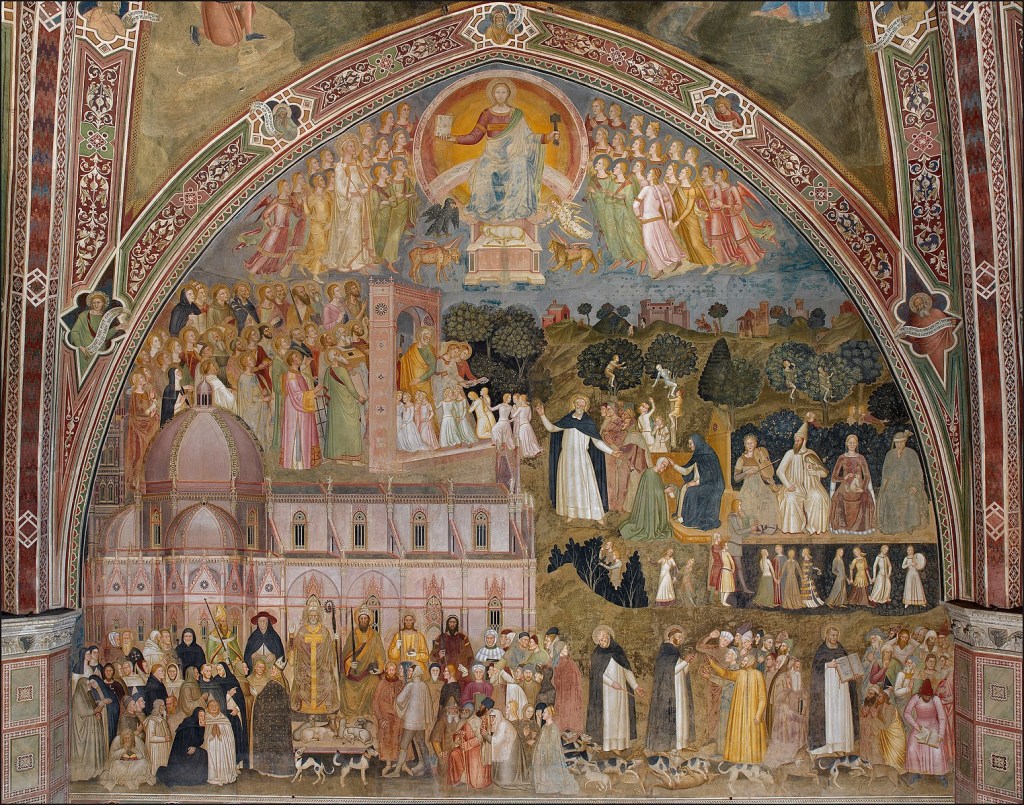
All Hallow’s Eve & Recalling Our Christian Call to be Saints

The Church Militant and Church Triumphant, A. Firenze fresco/ Santa Maria Novella (1365)

All Hallow’s Eve is a special day that has become secularized over the years in which we have lost the meaning and sacredness of the day. The day before All Saints asks us to contemplate the four last tenets of our eschatological and ontological journey. We will die. We will face judgment. There will be the prospect of heaven (or purgatory – a state of purification before a soul is ready to receive the merits of the beatific vision). Some may receive the possibility of hell or life without God’s love. This of course is a choice in which every human being is offered in how they conduct their affairs. We can respond to God’s continual call of grace and mercy or reject it by the way we live our life.

Our true ontological nature with our baptismal call as part of the Church militant is to be saints. We further reflect upon such a call from being new beings, born into the family of Christ, with our confirmation and choice of a Christian saintly name in which we wish to emulate. How we allow God’s will to become our Northern star is our why. How we respond to the grace and merits of the Holy Spirit on this earthly journey equips us toward becoming part of the church triumphant in heaven.

What then is a Saint? “All Christians are called to be saints. Saints are persons in heaven (officially canonized or not), who lived heroically virtuous lives, offered their life for others, or were martyred for the faith, and who are worthy of imitation” (https://www.usccb.org/offices/public-affairs/saints).

Our life is short and we must use our time wisely (Ps. 90:12). The Church has a phrase for such a reflection…Memento Mori, Tempus Fugit (remember death, time flies from the Latin).

If we are to truly recall this day where we wish to be frightened, ask thyself if you are ready for the next life? Will the Master reply, “well done good and faithful servant? (Mt. 25:23).

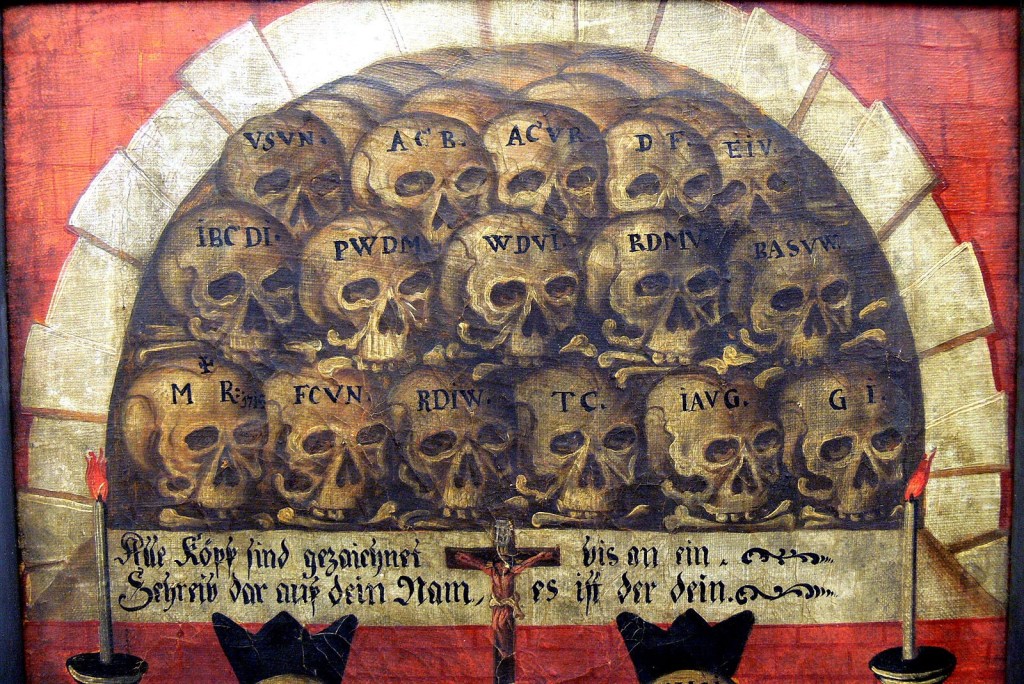
Rattenberg (Tyrol). Augustine museum – Memento-mori-painting ( 1694 ) from Kitzbühl – detail with inscription: “All skulls are signed but one; write your name on it, it is yours.”

The Book of Revelation recalls this great vision of what we can become as saintly beings striving for greatness.

(NABRE)

Rev. 7:9-12

After this I had a vision of a great multitude, which no one could count, from every nation, race, people, and tongue. They stood before the throne and before the Lamb, wearing white robes and holding palm branches in their hands. They cried out in a loud voice:

“Salvation comes from our God, who is seated on the throne, and from the Lamb.” All the angels stood around the throne and around the elders and the four living creatures. They prostrated themselves before the throne, worshiped God, and exclaimed: “Amen. Blessing and glory, wisdom and thanksgiving, honor, power, and might be to our God forever and ever. Amen.”

Who is your favorite Saint? Feel free to dress the kids up in Halloween costumes & enjoy the festivities. Also, be sure to encourage saintly costumes the next day for the great and hallowed (holy) day where we recall All Saints Day. May we seek to emulate those saintly men & women on our earthly journey!

St. Mark Evangelist & St. Thérèse of Lisieux

As Saint Catherine of Siena once remarked, “be who God wants you to be and you will set the world onfire.” Let us go forth and be saintly women & men with the time we are blessed with.

As the song When The Saints Go Marching In reminds us – do we wish to be in that number?

Happy Hallow’s Eve.

God bless.

Overcoming Our Blindness: Come, See & Follow Jesus (30th Sunday Ordinary Time Reflection)

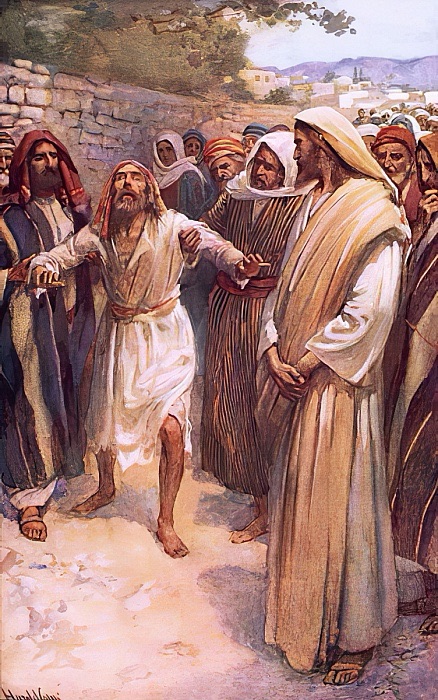
Reproduction from Harold Copping of Copping’s Bible Illustrations in the public domain retrieved at Wikimedia Commons https://commons.wikimedia.org/wiki/File:Harold_Copping_-Bartimaeus-_(MeisterDrucke-52938).jpg

Jeremiah 31:7-9, Psalm 126, Heb. 5:1-6, Mark 10:46-52

The first reading from the prophet Jeremiah reminds us that the Lord God will gather together the blind and lame from the ends of the earth.

If we are truly honest with ourselves, we are also like the blind and lame in our own faith journey. One of the seven deadly sins of pride may hinder our relationship with living out our call to Christian discipleship. We may think that our way is better, and put time for God in a compartmentalized box. The opposing virtue for this flaw is humility. We must ask for God’s grace to recognize that nothing in life is absent from God’s will. Another of the seven deadly sins is envy. Perhaps we wish we had a better body, more wealth or some other attribute in which we compare ourselves to others. We must seek gratitude in our life regardless of the circumstances. Those that sow in tears will reap in joy according to Psalm 126.

The psalm response reminds us to be filled with joy for the Lord God has done great things for us.

Oftentimes we can be burdened by this earthly path which causes us to lose sight of the wonder and awe of God’s creation. A blind person may not have experienced the gift of sight by being able to see a magnificent sunrise or sunset. This same person, however, can feel the warmth of the sun on their skin and hear the wonder of God’s creation with their other senses. A blind or lame person may appear to have physical limitations to those that do not, but it is the heart and soul of mankind that is without limit in which God, the Divine Weaver, will create a rich tapestry using all of His creation.

The late Fred Rogers who created the long running USA based program of Mr. Rogers Neighborhood had an episode with a quadriplegic boy named Jeff Erlanger. Jeff was confined to a wheelchair due to a tumor at the age of four. Despite his condition, Mr. Erlanger never let his condition impede the joy of living. Mr. Erlanger said it wasn’t what he could not do, but what he could do that impacted his joy in life. (See the following Jeff & Mister Rogers https://youtu.be/wxl4SPiKQDE?si=DhIOZV5bE_7B_8e2 via @YouTube). We too must have that same attitude as Christian disciples & be grateful just as Mr. Erlanger was to have the precious gift of life.

When blind Bartimaeus hears of Jesus entering the town of Jericho, his humbled response can only be one of “Jesus, son of David, have pity on me.” Such a recognition of Jesus as Messiah by Bartimaeus foreshadows Jesus’s upcoming Passion and death upon the cross and entry into Jerusalem. Jericho is 15 miles outside of Jerusalem. This land of Jericho also recalls the place where Aaron, a high priest under the Mosaic covenant numbered the Israelites along with Eleazar upon the plains of Moab at Jericho (Numbers 26:63-64). Paul’s epistle to the Hebrews and the second reading recalls this high priesthood and the priesthood of Jesus where he will become the ultimate sacrifice for our human condition.

Although the crowd rebuked Bartimaeus for his loud pleas for help, he persisted. When Jesus called forth for him to come, the crowd told Bartimaeus to take courage in which he sprang up, dropped the cloak and asked the Master for his sight to be restored. Go your way; your faith has saved you. The gospel writer also mentions that Bartimaeus followed Jesus on the way after such a miraculous healing event takes place. Bartimaeus follows Jesus upon the way toward Jerusalem to witness the Passion, death, carrying of the cross and eventual resurrection that is the joy we should find in life according to the Psalm verse.

We can choose to remain by the roadside and let life pass us by. It is easy to mope and be apathetic about our state of affairs. However, Bartimaeus, did not let the crowd stand in his way to become closer to Jesus. Mr. Erlanger did not let his disability ruin his mission and outlook in life. We must ask for the grace to have the steadfast faith of Bartimaeus to cast aside our worries, problems & concerns and seek out Jesus to follow Him on the way. Let us ask for God’s grace to seek out the courage to come to Jesus with our problems and let faith be our guide this day.

St. John Paul II, Pray For Us

Claudio Luffoli—AP/REX/Shutterstock.com

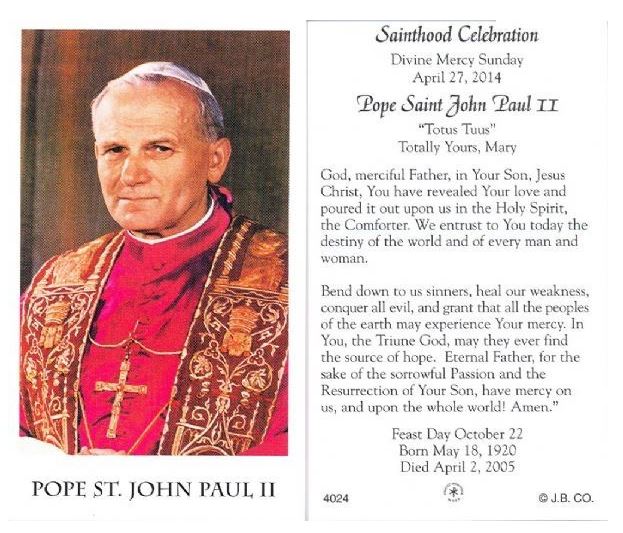
John Paul II is a beloved servant of God and saint that many will not forget as we reflect upon the many achievements from this great & holy man.

Pope John Paul II was the most traveled pope, having paved the way for the church’s mission to go forth and bring Christ’s light to others ushering forth a “new evangelization” (https://www.usccb.org/beliefs-and-teachings/how-we-teach/catechesis/catechetical-sunday/new-evangelization/upload/What-is-New-About-Evangelization-2.pdf).

John Paul II gave us hope. He gave us by God’s grace, new mysteries of the rosary with the Luminous mysteries in his apostolic letter Rosarium Virginis Mariae. Recalling the biblical accounts of the Baptism of Jesus, Wedding at Cana miracle, Proclamation of the Kingdom by our Lord, Transfiguration event, and Institution of the Eucharist are the Luminous Mysteries (https://www.vatican.va/content/john-paul-ii/en/apost_letters/2002/documents/hf_jp-ii_apl_20021016_rosarium-virginis-mariae.html).

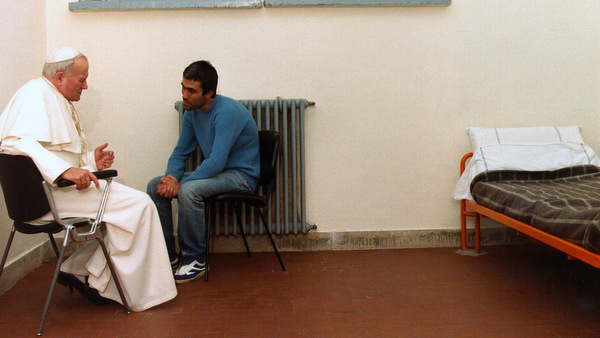
John Paul II taught us forgiveness when he forgave his assassin. This man later converted to Christianity (https://www.buzzfeednews.com/article/davidmack/ali-agca-flowers-pope-john-paul).

Pope John Paul II visits with Mehmet Ali Agca in a Rome prison Dec. 27, 1983. Their meeting came two years after Agca was arrested for shooting the pontiff in St. Peter’s Square. The pope publicly forgave his assailant. In 2000 Italy pardoned Agca and returned him to his homeland, Turkey. (CNS file photo by Arturo Mari) (Feb. 25, 2005)

St. John Paul II reminded us of the sanctity of all life with his Theology of the Body imagery and reflections (https://www.usccb.org/issues-and-action/marriage-and-family/natural-family-planning/catholic-teaching/theology-of-the-body)

For a man who achieved so much during his life and lost a great deal, St. John Paul II continues to show us the way to heaven and to the saints in glory by his example and way he lived his life. Having lost his father at the age of 20 and his mother and siblings at a young age, St. John Paul II grew up during the totalitarian takeover of his native Poland by the Nazis and later communist regime and dedicated his life to God as a priest (https://www.catholicnewsagency.com/news/21953/death-of-john-paul-iis-father-propelled-him-to-his-future-vocation).

Many journalists and modern day scholars attribute the fact that St. John Paul II was instrumental in breaking down the walls of communism (https://www.pbs.org/wgbh/pages/frontline/shows/pope/communism/). St. John Paul II is a pope that reminded us that no barrier was too great in bringing the image of Jesus to the ends of the earth and was truly a millennial pope for the ages.

St. John Paul II’s last words were “Let me go to the house of my Father” (https://www.nytimes.com/2005/09/18/international/europe/vatican-details-final-days-of-pope-john-paul-ii.html).

Let us recall the words from our beloved papa, “Do not be afraid. Open wide the doors to Christ!” (https://www.vatican.va/content/john-paul-ii/en/homilies/1978/documents/hf_jp-ii_hom_19781022_inizio-pontificato.html)

Let us ask St. John Paul II to pray for us from the heavenly choirs of angels this day as we labor in the Lord’s vineyard here on earth. Let us recall the words from St. John Paul II from his Angelus message in 1986 in which he proclaimed “we are an Easter people and Alleluia is our song” (https://www.vatican.va/content/john-paul-ii/en/angelus/1986/documents/hf_jp-ii_ang_19861130.html).

May the Lord bless us, protect us from all evil and bring us to everlasting life. St. Pope John Paul II, pray for us and look upon us this day as we strive to do His will. Amen.

Memorial of St. Luke the Evangelist

Image retrieved from https://www.episcopalchurch.org/lectionary/saint-luke/

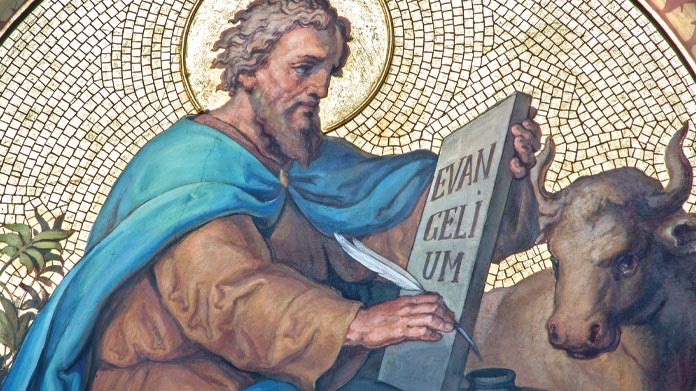
Today the church commemorates the memorial of St. Luke, the gospel writer and author of the Gospel and book of Acts. He was most likely trained as a physician and healer and was a Greek gentile being associated with St. Paul & Barnabas per the Acts of the Apostles account. St. Luke is the patron of physicians and surgeons with a writing style that represents a healing and merciful aspect to the fallen. It is believed by scholars that St. Luke may have been born a slave trained to be a healer to provide services to a wealthy family as a resident family healer for which his writings show a sense of social justice and compassion (https://www.catholic.org/saints/saint.php?saint_id=76).

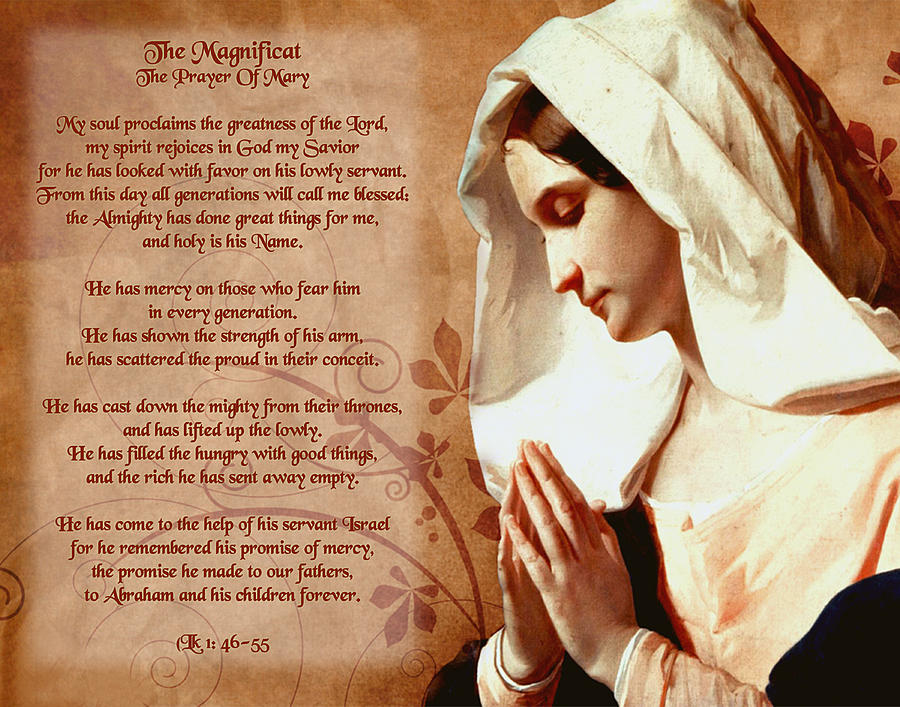
The unique item about St. Luke in the synoptic gospels unlike the others is St. Luke’s inclusion of the Magnificat of Mary from Lk. 1:46-55

Image retrieved from https://fineartamerica.com/featured/the-magnificat-prayer-samuel-epperly.html

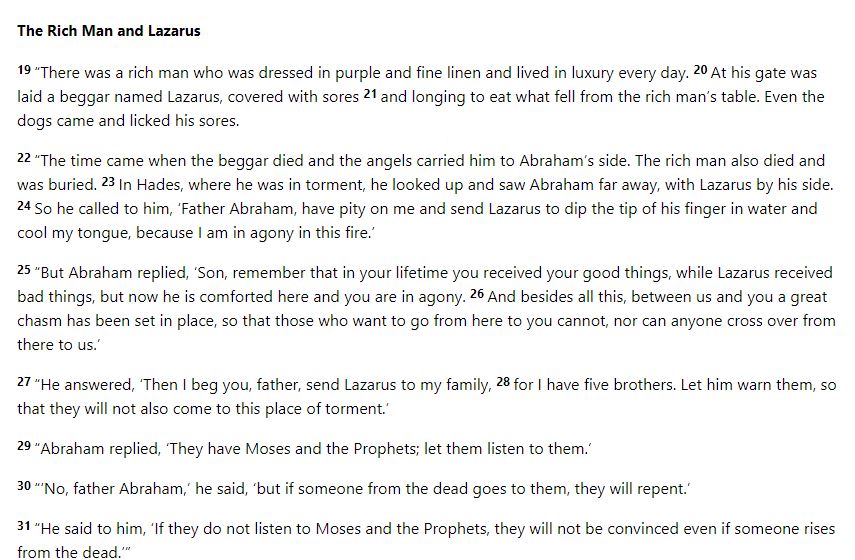
Another item to reflect on is the encounter of Lazarus with the rich man for which all of us have a moral obligation to be of assistance to others regardless of our station in life or the appearance of our suffering and impoverished among us:

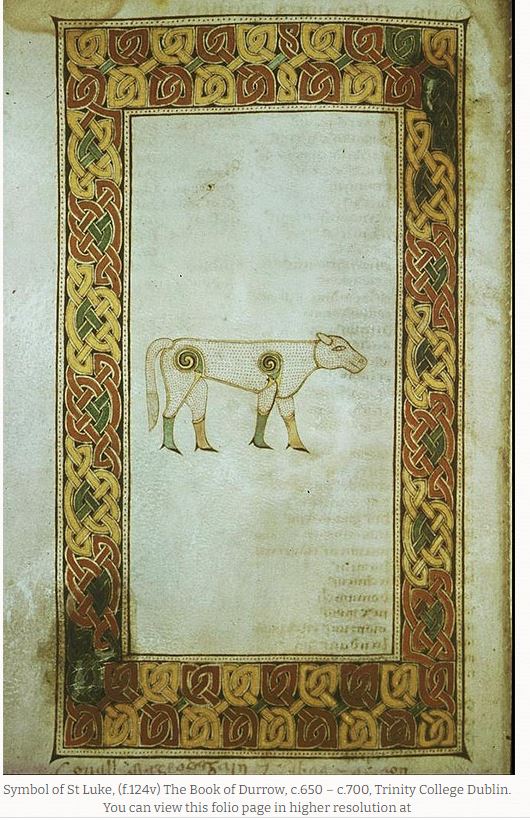
St. Luke’s image is often portrayed as that of a winged ox assigned by St. Jerome and St Irenaeus for it represents the old sacrificial offering image in the temple. St. Luke’s Gospel recalls the presentation of Jesus in the temple and the closing of Luke’s gospel tells of the destruction of the temple and the end times. Of course, we also recall all of the gospel writers were assigned symbols per Revelation 4:7 of a lion (St. Mark), ox, (St. Luke) man (St. Matthew) and eagle (St. John) to which St. Jerome’s presentation differed a bit from St Irenaeus (https://scotland.op.org/the-ox-as-a-symbol-of-st-luke/).

St. Luke reminds us of the nature and actions of our Lord Jesus, the Divine Healer in his writings to us. He reminds us of Mary’s fiat and her role with what we can become as Christians. May we look to St. Luke’s gospel this day to go out and be another Christ to our brothers and sisters in need.

St. Luke, pray for us.

St. Ignatius of Antioch, Bishop & Martyr

Neapolitan School of Painting, possibly Cesare Fracanzano (1605-1651) retrieved from public domain at Wikimedia Commons

An excerpt from the Office of Readings Liturgy of the Hours in which St. Ignatius of Antioch on his way to Rome to be martyred for the faith writes about:

I am God’s wheat and shall be ground by the teeth of wild animals

I am writing to all the churches to let it be known that I will gladly die for God if only you do not stand in my way. I plead with you: show me no untimely kindness. Let me be food for the wild beasts, for they are my way to God. I am God’s wheat and shall be ground by their teeth so that I may become Christ’s pure bread. Pray to Christ for me that the animals will be the means of making me a sacrificial victim for God.

No earthly pleasures, no kingdoms of this world can benefit me in any way. I prefer death in Christ Jesus to power over the farthest limits of the earth. He who died in place of us is the one object of my quest. He who rose for our sakes is my one desire.

The time for my birth is close at hand. Forgive me, my brothers. Do not stand in the way of my birth to real life; do not wish me stillborn. My desire is to belong to God. Do not, then, hand me back to the world. Do not try to tempt me with material things. Let me attain pure light. Only on my arrival there can I be fully a human being. Give me the privilege of imitating the passion of my God. If you have him in your heart, you will understand what I wish. You will sympathise with me because you will know what urges me on.

I am writing to all the churches to let it be known that I will gladly die for God if only you do not stand in my way. I plead with you: show me no untimely kindness. Let me be food for the wild beasts, for they are my way to God. I am God’s wheat and shall be ground by their teeth so that I may become Christ’s pure bread. Pray to Christ for me that the animals will be the means of making me a sacrificial victim for God.

The prince of this world is determined to lay hold of me and to undermine my will which is intent on God. Let none of you here help him; instead show yourselves on my side, which is also God’s side. Do not talk about Jesus Christ as long as you love this world. Do not harbour envious thoughts. And supposing I should see you, if then I should beg you to intervene on my behalf, do not believe what I say. Believe instead what I am now writing to you. For though I am alive as I write to you, still my real desire is to die. My love of this life has been crucified, and there is no yearning in me for any earthly thing. Rather within me is the living water which says deep inside me: “Come to the Father.” I no longer take pleasure in perishable food or in the delights of this world. I want only God’s bread, which is the flesh of Jesus Christ, formed of the seed of David, and for drink I crave his blood, which is love that cannot perish.

I am no longer willing to live a merely human life, and you can bring about my wish if you will. Please, then, do me this favour, so that you in turn may meet with equal kindness. Put briefly, this is my request: believe what I am saying to you. Jesus Christ himself will make it clear to you that I am saying the truth. Only truth can come from that mouth by which the Father has truly spoken. Pray for me that I may obtain my desire. I have not written to you as a mere man would, but as one who knows the mind of God. If I am condemned to suffer, I will take it that you wish me well. If my case is postponed, I can only think that you wish me harm.

To learn more about this great saint visit the following link: https://www.christianity.com/wiki/people/who-was-ignatius-of-antioch.html

28th Sunday Ordinary Time – What Must I Do To Inherit Eternal Life With Jesus?

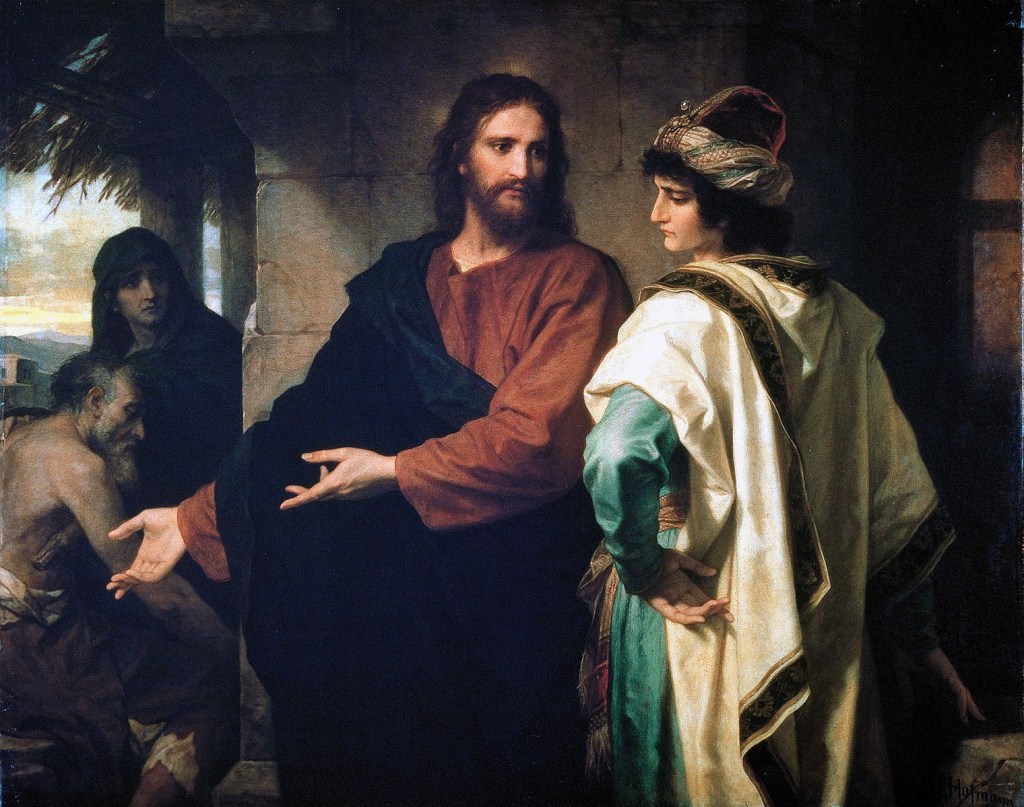
Image from Heinrich Hoffman, Christ and the young rich ruler retrieved from public domain at Wikimedia Commons https://commons.wikimedia.org/wiki/File:Hoffman-ChristAndTheRichYoungRuler.jpg#/media/File:Hoffman-ChristAndTheRichYoungRuler.jpg/3

Today’s Gospel reading from Mark’s Gospel chapter 10 has us contemplating the meaning of life. “What must I do to inherit eternal life?” (Mk. 10:17). The parable of the rich man is an example that can include our life as well. While we don’t necessarily have to sell off all of our possessions to follow Jesus, nor do we have to give up other luxuries in life to be a Christian disciple, the interior question should be where is our heart and soul at this moment in our earthly journey? When Jesus informs his disciples that it is difficult for a rich man to enter the kingdom of heaven and easier for a camel to enter through the eye of a needle (Mk 10:25) it is confusing imagery. After all, the rich man could not part with his possessions because his heart was dependent on something else, something that was not geared toward the dependency of God’s will and His love.

The second reading from Hebrews chapter 4:12-13 has us contemplating God’s Word being sharper than any two edged sword, penetrating to the interior depths of our heart. We must not let the words from holy scripture go in one ear and out another. Our selective hearing must be open to this message in which we are a lot like the rich man, hearing only those teachings from Jesus that coincide with my status quo, but don’t always line up with the sacrifice we as disciples are called to make.

What prevents us from going all in to be Jesus’s disciple? As the responsorial psalm reminds us (Psalm 90) Fill us with your love Lord, and we will sing of your joy!

The personification and imagery from the book of Wisdom (7:7-11) in the first reading reminds us that the goal of attaining wisdom that comes from the Lord God is superior to all else.

Take some time this week and reflect on what you should give up to follow Christ Jesus more closely.

One great spiritual habit to take up is to do the Examen Prayer Meditation by Saint Ignatius of Loyola:

     The five steps as clarified by the Jesuit Institute found in Saint Ignatius’s Spiritual Exercises Retrieved January 14, 2024, from https://jesuitinstitute.org/Pages/Examen.htmre) are as follows:

1. ​Give Thanks – How do we show gratitude for the blessings God gave us for the day?

2. ​Ask for light – How do we ask God to enlighten our hearts and minds by being attentive to His presence with us throughout the day at work, school, leisure or otherwise?

3. ​Examine the day – How has God been present in those moments with consolation in my actions and reactions to others? How has God not been present with my actions and reactions to others with desolation?

4. ​Ask for forgiveness – ask for forgiveness for the times when we reacted contrary to His will and reception to His grace in our day. How were we not spreading the good news of the gospel by our actions both in word and deed?

5. Resolution to change – determine what can be done the next day to change our demeanor, our attitude and behavior of reflecting God’s love in the world.

Saint Jerome, Pray For Us

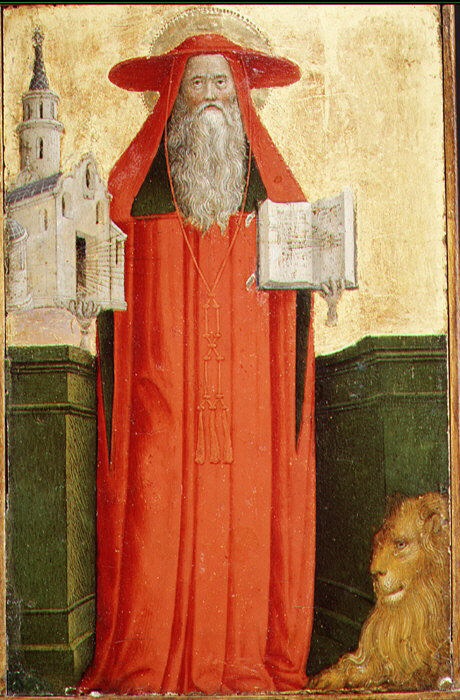
Painting of Saint Jerome by
Antonio Vivarini  retrieved from the public domain

Saint Jerome, the 4th century saint born in Stridon in the historic region of Dalmatia (present day Croatia) was responsible for translating the Bible into the Latin vulgate. After a vision and conversion experience that asked him why he appreciated the words of Cicero more than Christ, Jerome became a hermit and learned Hebrew so that the good work of translating the Bible into Latin could begin.

As Saint Jerome once said, Ignorance of Scripture is Ignorance of Christ. It is important for us as Catholics to prepare ourselves for the Divine Liturgy ahead of time by reflecting on the readings before we come to Mass.

A reflection on the Book of Isiah from the Liturgy of the Hours by Saint Jerome:

I interpret as I should, following the command of Christ: Search the Scriptures, and Seek and you shall find. Christ will not say to me what he said to the Jews: You erred, not knowing the Scriptures and not knowing the power of God. For if, as Paul says, Christ is the power of God and the wisdom of God, and if the man who does not know Scripture does not know the power and wisdom of God, then ignorance of Scripture is ignorance of Christ.

Therefore, I will imitate the head of a household who brings out of his storehouse things both new and old, and says to his spouse in the Song of Songs: I have kept for you things new and old, my beloved. In this way permit me to explain Isaiah, showing that he was not only a prophet, but an evangelist and an apostle as well. For he says about himself and the other evangelists: How beautiful are the feet of those who preach good news, of those who announce peace. And God speaks to him as if he were an apostle: Whom shall I send, who will go to my people? And he answers: Here I am; send me.

For more about Saint Jerome, visit https://thecatholicheroes.com/history-biographies/st-jerome-the-greatest-translator-of-the-bible-and-defender-of-scripture/

Saint Jerome, Pray for us!

Saints Andrew Kim Taegon, Priest, and Paul Chong Hasang, and their Companions, Martyrs 

The Exaltation of the Holy Cross

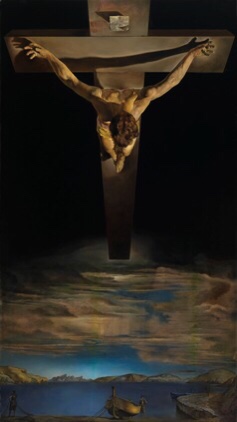
‘Christ of St John of the Cross’ by Salvador Dalí. Image © CSG CIC Glasgow Museums Collection.

From the entrance antiphon:

We should glory in the Cross of our Lord Jesus Christ,

in whom is our salvation, life and resurrection,

through whom we are saved and delivered.

A discourse of St. Andrew of Crete (from the Office of Readings):

We are celebrating the feast of the cross which drove away darkness and brought in the light. As we keep this feast, we are lifted up with the crucified Christ, leaving behind us earth and sin so that we may gain the things above. So great and outstanding a possession is the cross that he who wins it has won a treasure. Rightly could I call this treasure the fairest of all fair things and the costliest, in fact as well as in name, for on it and through it and for its sake the riches of salvation that had been lost were restored to us.

Had there been no cross, Christ could not have been crucified. Had there been no cross, life itself could not have been nailed to the tree. And if life had not been nailed to it, there would be no streams of immortality pouring from Christ’s side, blood and water for the world’s cleansing. The legal bond of our sin would not be cancelled, we should not have attained our freedom, we should not have enjoyed the fruit of the tree of life and the gates of paradise would not stand open. Had there been no cross, death would not have been trodden underfoot, nor hell despoiled.

Therefore, the cross is something wonderfully great and honourable. It is great because through the cross the many noble acts of Christ found their consummation – very many indeed, for both his miracles and his sufferings were fully rewarded with victory. The cross is honourable because it is both the sign of God’s suffering and the trophy of his victory. It stands for his suffering because on it he freely suffered unto death. But it is also his trophy because it was the means by which the devil was wounded and death conquered; the barred gates of hell were smashed, and the cross became the one common salvation of the whole world.

The cross is called Christ’s glory; it is saluted as his his triumph. We recognise it as the cup he longed to drink and the climax of the sufferings he endured for our sake. As to the cross being Christ’s glory, listen to his words: Now is the Son of Man glorified, and in him God is glorified, and God will glorify him at once. And again: Father, glorify me with the glory I had with you before the world came to be. And once more: “Father, glorify your name”. Then a voice came from heaven: “I have glorified it and will glorify it again”. Here he speaks of the glory that would accrue to him through the cross. And if you would understand that the cross is Christ’s triumph, hear what he himself also said: When I am lifted up, then I will draw all men to myself. Now you can see that the cross is Christ’s glory and triumph.

The Most Holy Name of Mary


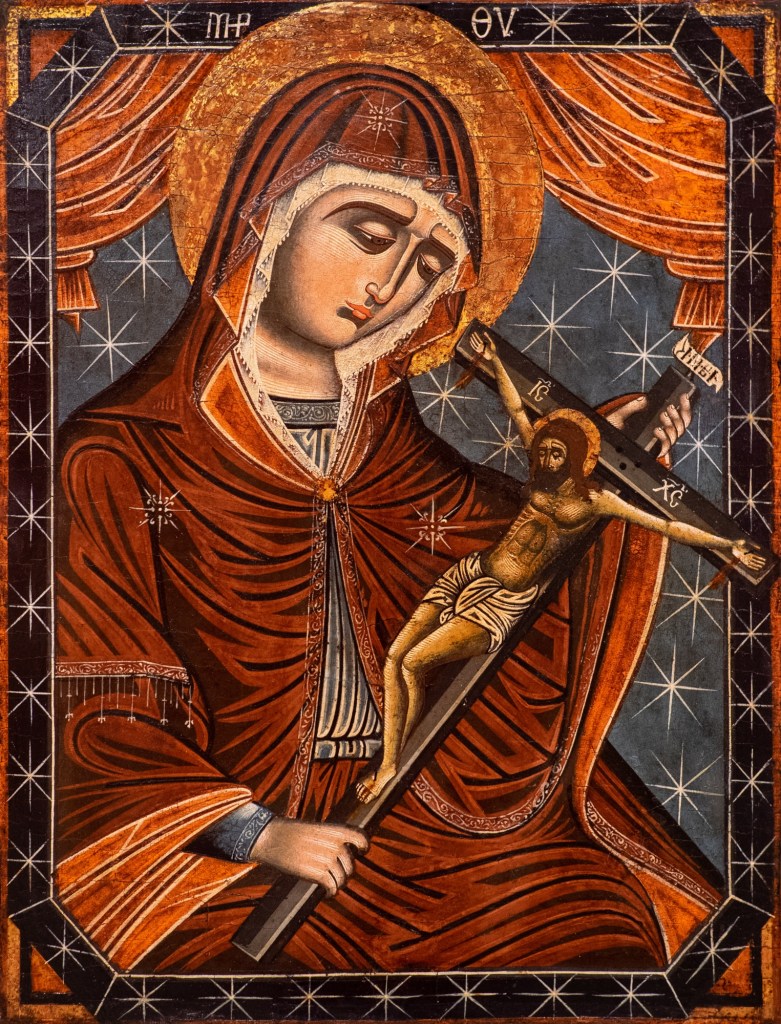
The Mother of God Trenousa (17th-18th century). National Museum of Serbia retrieved from public domain at Wikimedia Commons

What is in a name? As baptized & Confirmed Christians we receive the indelible spiritual mark from the Holy Spirit in which we belong to Christ (CCC 1272). The ancient Greek philosopher & theologian Dionysius the Areopagite wrote of The Divine Names. It would make sense that Mary, Queen of Saints, & Mother of God’s Son Jesus would have such a name recognition too. Contemplate & reflect on the name of Mary today by reciting the Litany of Mary: https://www.ewtn.com/catholicism/devotions/litany-of-loreto-246

For further reflection, check out St. Bernard’s homily from the Divine Office this day.

From the homilies of St Bernard of Clairvaux on the glories of the Virgin Mother

“And the Virgin’s name was Mary”. Let us speak a little about this name, which is said to mean “star of the sea,” and which so well befits the Virgin Mother. Rightly is she likened to a star. As a star emits a ray without being dimmed, so the Virgin brought forth her Son without receiving any injury. The ray takes naught from the brightness of the star, nor the Son from His Mother’s virginal integrity. This is the noble star risen out of Jacob, whose ray illumines the whole world, whose splendour shines in the heavens, penetrates the abyss, and, traversing the whole earth, gives warmth rather to souls than to bodies, cherishing virtues, withering vices. Mary is that bright and incomparable star, whom we need to see raised above this vast sea, shining by her merits, and giving us light by her example.

All of you, who see yourselves amid the tides of the world, tossed by storms and tempests rather than walking on the land, do not turn your eyes away from this shining star, unless you want to be overwhelmed by the hurricane. If temptation storms, or you fall upon the rocks of tribulation, look to the star: call upon Mary! If you are tossed by the waves of pride or ambition, detraction or envy, look to the star, call upon Mary. If anger or avarice or the desires of the flesh dash against the ship of your soul, turn your eyes to Mary. If troubled by the enormity of your crimes, ashamed of your guilty conscience, terrified by dread of the judgement, you begin to sink into the gulf of sadness or the abyss of despair, think of Mary.

In dangers, in anguish, in doubt, think of Mary, call upon Mary. Let her name be ever on your lips, ever in your heart; and the better to obtain the help of her prayers, imitate the example of her life. Following her, you do not stray; invoking her, you do not despair; thinking of her, you do not wander; upheld by her, you do not fall; shielded by her, you do not fear; guided by her, you do not grow weary; favoured by her, you reach the goal. And thus you experience in yourself how good is that saying: “And the Virgin’s name was Mary”.

Excerpts from the English translation of The Liturgy of the Hours (Four Volumes) © 1974, International Commission on English in the Liturgy Corporation. All rights reserved.

Mystical rose, Pray for us.

Saint Augustine, Pray For Us

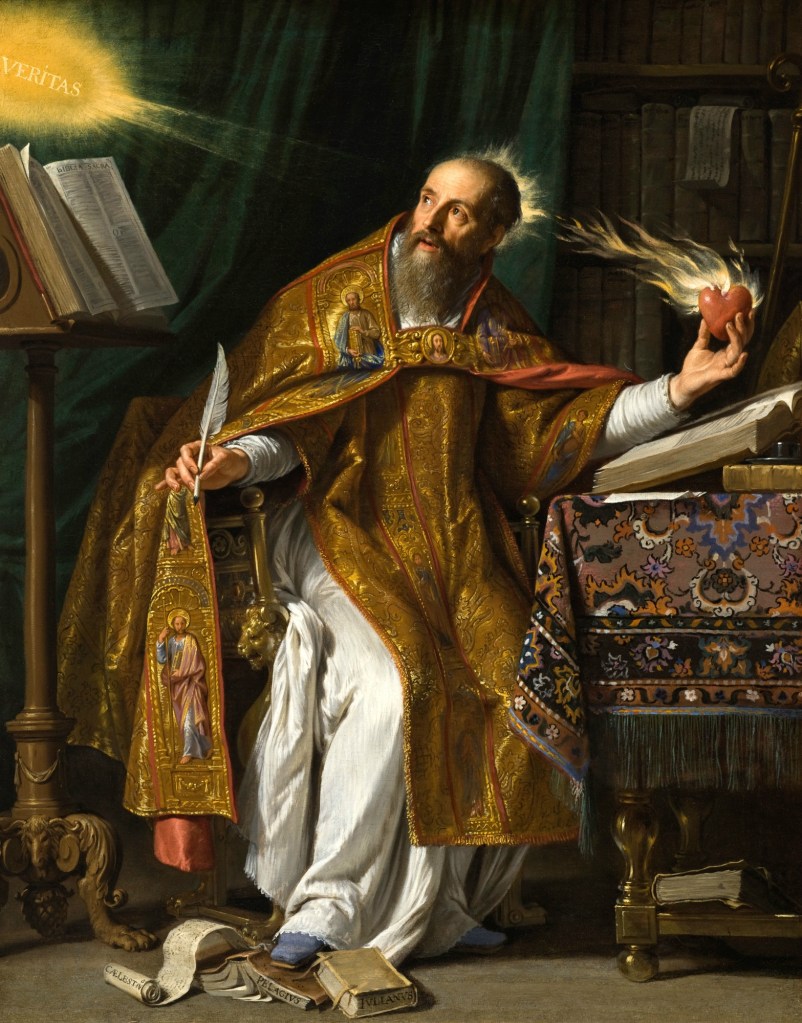
Saint Augustine of Hippo by Philippe de Champagne located in the Los Angeles Museum of Art in the public domain and retrieved from Wikimedia Commons

Today the Church commemorates the solemnity of Saint Augustine of Hippo. Yesterday we recognized Saint Augustine’s mother who wept and prayed fervently for her son’s conversion experience. As a Bishop and Doctor of the Church, Saint Augustine is influential in setting the foundational theological principles of the early church in which topics of predestination, grace, the sacramental life, the mystery of the Trinity were explained. His well known work, Confessions describes his journey from being a pagan to finding the truth of our Catholic Christian faith with the famous line, “You have made us for yourself, O Lord, and our hearts are restless until they rest in you.” After his baptism and conversion in 386, he was instrumental in defining and contemplating early church doctrines and principles of the faith. Saint Augustine was influential in discerning the mystery of the Holy Trinity in which the Council of Nicaea and Constantinople. Saint Augustine also wrote about original sin, grace, predestination, just war theory, infant baptism and the formation of religious communities. Saint Ambrose of Milan was also a big part of his conversion experience as an orator. Saint Augustine heard a child’s voice that said “take up and read” in discovering the writings of the monastic Saint Anthony of the Desert.

Late Have I Loved You

Accordingly I looked for a way to gain the strength I needed to enjoy you, but I did not find it until I embraced the mediator between God and man, the man Christ Jesus, who is also God, supreme over all things and blessed for ever. He called out, proclaiming I am the Way and Truth and the Life, nor had I known him as the food which, though I was not yet strong enough to eat it, he had mingled with our flesh, for the Word became flesh so that your Wisdom, through whom you created all things, might become for us the milk adapted to our infancy.

Late have I loved you, O Beauty ever ancient, ever new, late have I loved you! You were within me, but I was outside, and it was there that I searched for you. In my unloveliness I plunged into the lovely things which you created. You were with me, but I was not with you. Created things kept me from you; yet if they had not been in you they would not have been at all.

You called, you shouted, and you broke through my deafness. You flashed, you shone, and you dispelled my blindness. You breathed your fragrance on me; I drew in breath and now I pant for you. I have tasted you, now I hunger and thirst for more. You touched me, and I burned for your peace.

Excerpt from the Confessions, Roman Office of Readings for the solemnity of Saint Augustine.

Saint Augustine, Pray for us!

Saint Monica, Pray For Us

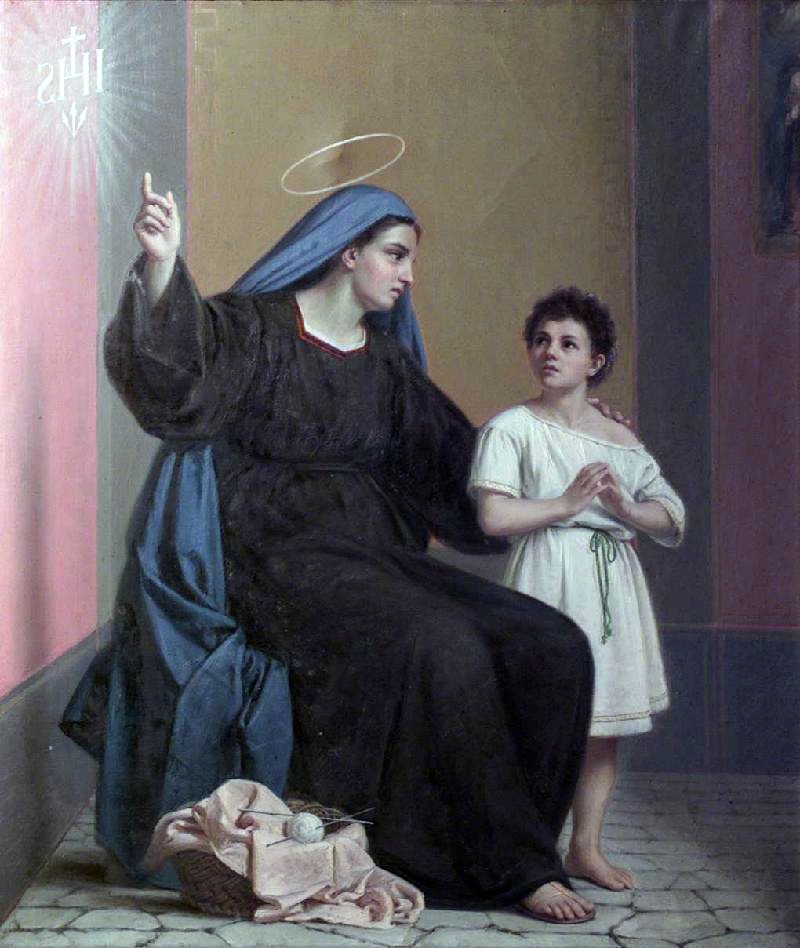
Image from the public domain at Wikimedia Commons https://www.beweb.chiesacattolica.it/benistorici/bene/5641392/

Today the Church commemorates the life of Saint Monica, mother of Saint Augustine of Hippo who was instrumental in converting her son to the faith. Monica was born circa 322 AD in in North Africa & died in 387 AD in Italy. Monica was given in marriage to an ill tempered pagan named Patricius and bore thee sons, one of whom is Saint Augustine of Hippo. As a Christian witness to the faith she prayed for the conversion of her husband who came to know the Lord on his deathbed and of her sons. Saint Augustine wrote his well know work Confessions in which he wrote about his mother, St. Monica in his own conversion experience. Below is an excerpt describing Saint Monica from the Confessions

“‘You put forth your hand from on high, and you drew my soul out of that pit of darkness, when before you my mother, your faithful servant, wept more for me than mothers weep over their children’s dead bodies. By that spirit of faith which she had from you, she saw my death, and you graciously heard her, O Lord. Graciously you hear her, and you did not despise her tears when they flowed down from her eyes and watered the earth beneath, in whatsoever place she prayed.” (Book III, Chapter 11)

We too should have the same courage & conviction of thy holy servant Monica where we can only weep & pray for the conversion of our family to come to know the Lord Jesus in a deep & profound way.

Saint Monica is known as the patroness of wives, abuse victims, alcoholics, mothers, and widows.

From the collect at Mass:

O God, who console the sorrowful and who mercifully accepted the motherly tears of Saint Monica for the conversion of her son Augustine, grant us, through the intercession of them both, that we may bitterly regret our sins that we may bitterly regret our sins and find the grace of your pardon. Through our Lord Jesus Christ, your Son, who lives and reigns with you in the unity of the Holy Spirit, God, for ever and ever.

Saint Monica, Pray for us.

To Whom Shall We Go? The Word Of Eternal Life (21st Sunday Ordinary Time, B)

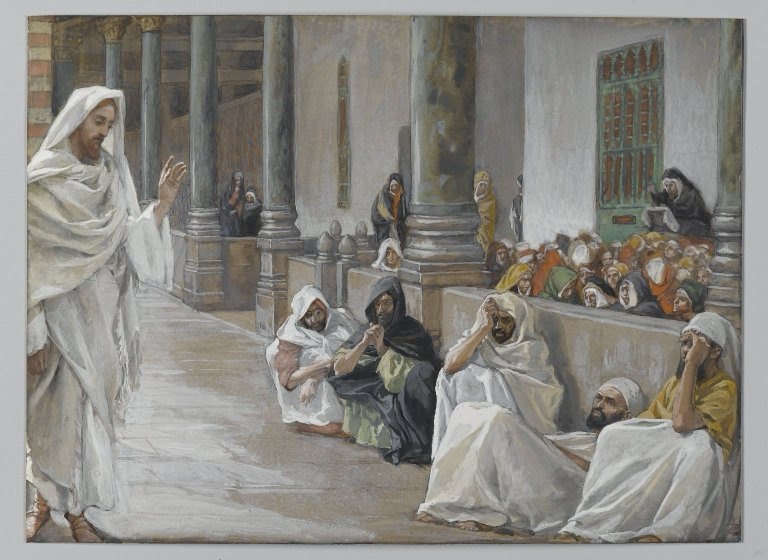
James Tissot He Who is of God Hears the Word of God from the public https://commons.wikimedia.org/wiki/File:Brooklyn_Museum_-He_Who_is_of_God_Hears_the_Word_of_God(Celui_de_Dieu_entend_la_parole_de_Dieu)_-_James_Tissot.jpg

(Joshua 24:1-2a, 15-17, 18b Psalms 34 Ephesians 5:21-32 or 5:2a, 25-32 John 6:60-69)

Today’s Gospel from John Chapter six has his followers questioning Jesus. Jesus reminds us that the Spirit gives life while the flesh is weak in describing his ascension. Our embodied souls long for more. Some of Jesus’s followers turned away from Jesus and went back to their former way of life because they could not comprehend that Jesus has the words of eternal life and is the path to God the Father. Peter’s proclamation of “where should we go…Jesus has the Words of Eternal life when some are leaving and going their separate ways is something for us to contemplate. Where shall we go?

Just like it was in the times of Jesus, we find in today’s time that some turn away from longing and living for the Word, Jesus, to give us life sustaining nourishment. We probably know some fallen away Christians that no longer believe. Perhaps we may sometimes allow the words of the world instead of the words of Jesus to consume our thoughts and taint our soul. It is easy to allow sin and the culture of complacency and conformity to maintain our status quo in life where we become like shallow roots without a firm foundation rooted in Christ Jesus (Mt. 13:23), who is the Word come down from heaven and has the words of eternal life (Jn. 1:1).

The Old Testament reading from Joshua also has a challenging and similar question for the ancient Israelites: to whom will you serve? Will they serve the one true God or other false gods? Many times in life we can let our faith life become weak where we put God in a compartmentalized box and allow shallow words of today’s culture to permeate our hearts and minds. We can become complacent and go in a different direction that is not of the Holy Spirit, which empowers us on our journey. We may serve other gods that take away from our prayer life and focus to place God first. Sometimes on our faith journey we can develop a form of selective hearing in which we hear only those words we want to hear that don’t challenge us to go deeper.

We must become contemplative Christians longing to immerse ourselves in the Holy Scripture and find the living Jesus in our midst where Jesus has the words of eternal life. Many times at Mass, we as Catholics lose sight of the importance of the first part of the Liturgy, with the Liturgy of the Word. To truly receive Jesus in the Eucharist…body, blood soul and divinity is to be attentive to the readings and meditate on the core truth from the responsorial psalm (34): Taste and see the goodness of the Lord. Where else can we go in this life, but to Jesus, who has the words of eternal life.

As the song lyrics from Guns N Roses Sweet Child O’ Mine reminds us – “Where do we go now, sweet child o’ mine” can lead to one answer – to the outstretched arms of Jesus who is the way, the truth and the life (Jn.14:6) as all of God’s adopted children made in His image.

Assumption of the Blessed Virgin Mary

Masolino da Panicale, Public domain, via Wikimedia Commons https://upload.wikimedia.org/wikipedia/commons/5/57/Masolino_da_Panicale_-The_Assumption_of_the_Virgin-_1423-28.jpg

The Solemnity of the Assumption of the Blessed Virgin Mary is one of great joy and hope for us to reflect on. Our second reading from Paul’s letter to the Corinthians (1. Cor 15) reminds us that “Christ has been raised from the dead, the first fruits of those who have fallen asleep.” It is fitting then that Mary, as one of us in every way with the exception that she was preserved from the stain of original sin by God’s sanctifying grace (CCC 493) should naturally be assumed into heaven body and soul and not await the last day of final judgement (CCC 1038). The reading from Revelation chapter 11, verse 19 and chapter 12 in which Mary is representative of the ark and Queen of heaven who vanquishes the dragon (Satan/sin, etc) is an awesome image to contemplate. In one sense we can look at the Ark as a boat that carried Noah and his family/creatures with that covenant. Another Ark is a box carrying the Ten Commandments given to Moses. Mary, however, carries Jesus in her womb who brings forth a new covenant. Mary is a most holy vessel that God has chosen as a different and most unique ark. We like Mary are chosen when we are baptized, confirmed and receive our spiritual nourishment of Jesus in the Eucharist as holy arks and temples of the Lord. As Saint Paul reminds us, our bodies are temples of the Holy Spirit in which the Holy Spirit wishes to dwell and our bodies our not our own (1 Cor. 6:19). We should keep this in mind on our earthly journey with the hope that we too will be glorified one day as saints destined for greatness! Our trust and hope to one day have holy and glorified bodies that are free from imperfections, frailties and weakness will come to fruition in which Christ Jesus will come again to raise the dead is His promise to us faithful. While it may be a struggle for some in which our bodies get old, don’t work the way they used to or have imperfections; we should not lose our faith. Jesus suffered greatly on the cross at Calvary and sacrificed his body to fulfill the new covenant made to all of us in which there is the promise of a Resurrection Day. Our eternal souls will be united with our glorious, holy and perfect body on this day and Mary is the great exemplar of this promise.

The Gospel reading from Luke and Mary’s Magnificat in visiting her cousin Elizabeth in which her baby leapt at Mary’s greeting can be summed up with “my soul proclaims the greatness of the Lord; my spirit rejoices in God my savior” (Lk. 1:46-47). Let us reflect on this mystery of the Assumption and not take for granted the part of the Apostle’s Creed proclaiming the resurrection of the body. Truly, Mary is the Queen that stands on the Lord’s right hand, arrayed in gold per the responsorial psalm 45.

I believe in God,
the Father Almighty,
Creator of heaven and earth,
and in Jesus Christ, His only Son, our Lord,
who was conceived by the Holy Spirit,
born of the Virgin Mary,
suffered under Pontius Pilate,
was crucified, died and was buried;
He descended into hell;
on the third day He rose again from the dead;
He ascended into heaven,
and is seated at the right hand of God the Father Almighty;
from there He will come to judge the living and the dead.
I believe in the Holy Spirit,
the Holy Catholic Church,
the communion of Saints,
the forgiveness of sins,
the resurrection of the body,
and life everlasting.

Amen.

St. Maximilian Kolbe, priest & martyr

Father Maximilian Kolbe in 1939.

Franciscan friar and priest Maximilian Kolbe died at the hands of the Nazis at the death camp at Auschwitz fulfilling the Christian command in that “there is no greater love than to lay down one’s life for a friend” (Jn. 15:13). St Kolbe volunteered to take the place of a fellow prisoner chosen for death at the camp. https://saintmaximiliankolbe.com/biography/

A letter of St Maximilian Kolbe

From a letter of Maximillian Mary Kolbe
(Scritti del P. Massimiliano M. Kolbe, Italian translation, vol. I, pt, 1 [Padua, 1971], 75-77,166)

Apostolic zeal for the salvation and sanctification of souls

The burning zeal for God’s glory that motivates you fills my heart with joy. It is sad for us to see in our own time that indifferentism in its many forms is spreading like an epidemic not only among the laity but also among religious. But God is worthy of glory beyond measure, and therefore it is of absolute and supreme importance to seek that glory with all the power of our feeble resources. Since we are mere creatures we can never return to him all that is his due. The most resplendent manifestation of God’s glory is the salvation of souls, whom Christ redeemed by shedding his blood. To work for the salvation and sanctification of as many souls as possible, therefore, is the preeminent purpose of the apostolic life. Let me, then, say a few words that may show the way toward achieving God’s glory and the sanctification of many souls.

God, who is all-knowing and all-wise, knows best what we should do to increase his glory. Through his representatives on earth he continually reveals his will to us; thus it is obedience and obedience alone that is the sure sign to us of the divine will. A superior may, it is true, make a mistake; but it is impossible for us to be mistaken in obeying a superior’s command. The only exception to this rule is the case of a superior commanding something that in even the slightest way would contravene God’s law. Such a superior would not be conveying God’s will.

God alone is infinitely wise, holy, merciful, our Lord, Creator, and Father; he is beginning and end, wisdom and power and love; he is all. Everything other than God has value to the degree that it is referred to him, the maker of all and our own redeemer, the final end of all things. It is he who, declaring his adorable will to us through his representatives on earth, draws us to himself and whose plan is to draw others to himself through us and to join us all to himself in an ever deepening love.

Look, then, at the high dignity that by God’s mercy belongs to our state in life. Obedience raises us beyond the limits of our littleness and puts us in harmony with God’s will. In boundless wisdom and care, his will guides us to act rightly. Holding fast to that will, which no creature can thwart, we are filled with unsurpassable strength.

Obedience is the one and the only way of wisdom and prudence for us to offer glory to God. If there were another, Christ would certainly have shown it to us by word and example. Scripture, however, summed up his entire life at Nazareth in the words: He was subject to them; Scripture set obedience as the theme of the rest of his life, repeatedly declaring that he came into the world to do his Father’s will. Let us love our loving Father with all our hearts. Let our obedience increase that love, above all when it requires us to surrender our own will. Jesus Christ crucified is our sublime guide toward growth in God’s love.

We will learn this lesson more quickly through the Immaculate Virgin, whom God has made the dispenser of his mercy. It is beyond all doubt that Mary’s will represents to us the will of God himself. By dedicating ourselves to her we become in her hands instruments of God’s mercy even as she was such an instrument in God’s hands. We should let ourselves be guided and led by Mary and rest quiet and secure in her hands. She will watch out for us, provide for us, answer our needs of body and spirit; she will dissolve all our difficulties and worries.

From the Collect at mass today:
O God, who filled the Priest and Martyr Saint Maximilian Kolbe
with a burning love for the Immaculate Virgin Mary
and with zeal for souls and love of neighbor,
graciously grant, through his intercession,
that, striving for your glory by eagerly serving others,
we may be conformed, even until death, to your Son.
Who lives and reigns with you in the unity of the Holy Spirit,
God, for ever and ever. Amen.

The Transfiguration of Jesus, Our Lord

Image from Rafael Sanzio, The Transfiguration (1516-1520)

Mk. 9:2-10

Jesus took Peter, James, and his brother John, and led them up a high mountain apart by themselves. And he was transfigured before them, and his clothes became dazzling white, such as no fuller on earth could bleach them. Then Elijah appeared to them along with Moses, and they were conversing with Jesus. Then Peter said to Jesus in reply, “Rabbi, it is good that we are here! Let us make three tents: one for you, one for Moses, and one for Elijah.” He hardly knew what to say, they were so terrified. Then a cloud came, casting a shadow over them; from the cloud came a voice, “This is my beloved Son. Listen to him.” Suddenly, looking around, they no longer saw anyone but Jesus alone with them.

As they were coming down from the mountain, he charged them not to relate what they had seen to anyone, except when the Son of Man had risen from the dead. So they kept the matter to themselves, questioning what rising from the dead meant.

Oftentimes in life we are walking the earthly road of hardship faced with many difficulties. The blindfold of life does not always allow us to see the Transfigured Jesus in our midst. What we can gain from this gospel from Mark recalling the Transfiguration in which Jesus leads Peter, James & John up a high mountain is that Jesus leads them.

Jesus wishes to lead us as well during this earthly pilgrimage. Perhaps we have already had our moment where the Lord Jesus revealed Himself to us in prayer or from some miraculous encounter? If we haven’t had that moment, are you open to casting aside all your doubts, fears and weaknesses and putting them before the Lord God in prayer? Do you want Jesus to lead you up to that high mountain of this thing called life?

We are reminded of another time in scripture where Matthew makes the same proclamation at Jesus’s divinity being revealed by his baptism. “After Jesus was baptized, he came up from the water and behold, the heavens were opened and he saw the Spirit of God descending like a dove coming upon him.” (And a voice came from the heavens, saying, “This is my beloved Son, with whom I am well pleased” (Mt. 3:16-17).

The common feature we share with Jesus’s humanity is our baptismal call and fact that we too will die an earthly death. As a reminder, the Catechism of the Catholic Church says the following about baptism: 1265 Baptism not only purifies from all sins, but also makes the neophyte “a new creature,” an adopted son of God, who has become a “partaker of the divine nature,” member of Christ and co-heir with him, and a temple of the Holy Spirit. 1266 The Most Holy Trinity gives the baptized sanctifying grace, the grace of justification…” Furthermore, 1271 states “Baptism, therefore constitutes the sacramental bond of unity existing among all who through it are reborn.” (CCC 2nd Edition, USCCB, 3211 Fourth St, NE, Washington DC, 2019, 2020).

As we reflect on this gospel from Mark, we see a couple of themes. The first is being led. Many don’t like to be led anywhere and don’t wish to be dependent on anyone or anything. On the other end of the spectrum, once we are led somewhere we don’t spend enough time to “smell the roses” and are rushed for time. Peter acknowledges that it is “good we are here” before the Lord Jesus. Do we make the same remarks from our Sunday obligation or during prayer? Perhaps we are just checking the boxes of our prayer life, always petitioning, but never being thankful for being “here.”

The last theme of Jesus asking his disciples not to say anything about His divinity is due to the fact that He must undergo the test or the trial of dying to our sin before being risen. We too can never truly understand or grasp His full divinity until that time we die to our sins and are raised up in new life just as occurred with us in baptism where we become new creatures. Our participation in the sacramental life gives us a glimpse of His divinity. The definition of a sacrament is an outward sign of inward grace instituted by Jesus for our sanctification. Just as Jesus’s apostles fell prostrate out of fear – a sign of worship, we too should acknowledge the same at the feast of the Eucharistic banquet during the mass. We must be led and we must be thankful for being here in those moments with our participation of the sacraments as well as ministry to others. In time Jesus will be transfigured before us. Are we in a place to be led and revel in the moment before Jesus? Spend some time this week reflecting on this gospel. Picture yourself with Peter, James & John being led up the high mountain. What will your response be?

Saint Peter Chrysologus, Bishop & Doctor, Pray For Us

Saint Peter, Bishop of Ravenna, Italy, until 433 in the year of Our Lord was nicknamed Chrysologus or golden words for his rich homilies and is known as patron of homilies. As Bishop he was responsible for converting many of the last pagans in his diocese and winning souls to Christ Jesus! St. Peter once said, “anyone who wishes to frolic with the devil, cannot rejoice with Christ” (https://www.catholic.org/saints/saint.php?saint_id=464). In 1729 he was declared a Doctor of the Church by Pope Benedict XIII (https://marian.org/articles/peter-golden-words-st-peter-chrysologus-bishop).

From a sermon by Saint Peter Chrysologus, bishop
(Sermo 148: PL 52, 596-598) from the Office of Readings of the Roman Breviary:

The Incarnation and Human Dignity

A virgin conceived, bore a son, and yet remained a virgin. This is no common occurrence, but a sign; no reason here, but God’s power, for he is the cause, and not nature. It is a special event, not shared by others; it is divine, not human. Christ’s birth was not necessity, but an expression of omnipotence, a sacrament of piety for the redemption of men. He who made man without generation from pure clay made man again and was born from a pure body. The hand that assumed clay to make our flesh deigned to assume a body for our salvation. That the Creator is in his creature and God is in the flesh brings dignity to man without dishonor to him who made him.

Why then, man, are you so worthless in your own eyes and yet so precious to God? Why render yourself such dishonor when you are honored by him? Why do you ask how you were created and do not seek to know why you were made? Was not this entire visible universe made for your dwelling? It was for you that the light dispelled the overshadowing gloom; for your sake was the night regulated and the day measured, and for you were the heavens embellished with the varying brilliance of the sun, the moon and the stars. The earth was adorned with flowers, groves and fruit; and the constant marvellous variety of lovely living things was created in the air, the fields, and the seas for you, lest sad solitude destroy the joy of God’s new creation. And the Creator still works to devise things that can add to your glory. He has made you in his image that you might in your person make the invisible Creator present on earth; he has made you his legate, so that the vast empire of the world might have the Lord’s representative. Then in his mercy God assumed what he made in you; he wanted now to be truly manifest in man, just as he had wished to be revealed in man as in an image. Now he would be in reality what he had submitted to be in symbol.

And so Christ is born that by his birth he might restore our nature. He became a child, was fed, and grew that he might inaugurate the one perfect age to remain for ever as he had created it. He supports man that man might no longer fall. And the creature he had formed of earth he now makes heavenly; and what he had endowed with a human soul he now vivifies to become a heavenly spirit. In this way he fully raised man to God, and left in him neither sin, nor death, nor travail, nor pain, nor anything earthly, with the grace of our Lord Christ Jesus, who lives and reigns with the Father in the unity of the Holy Spirit, now and for ever, for all the ages of eternity. Amen.

Saint Peter Chrysologus, Pray for us!

St. Joachim & Anne, parents of the Blessed Virgin Mary

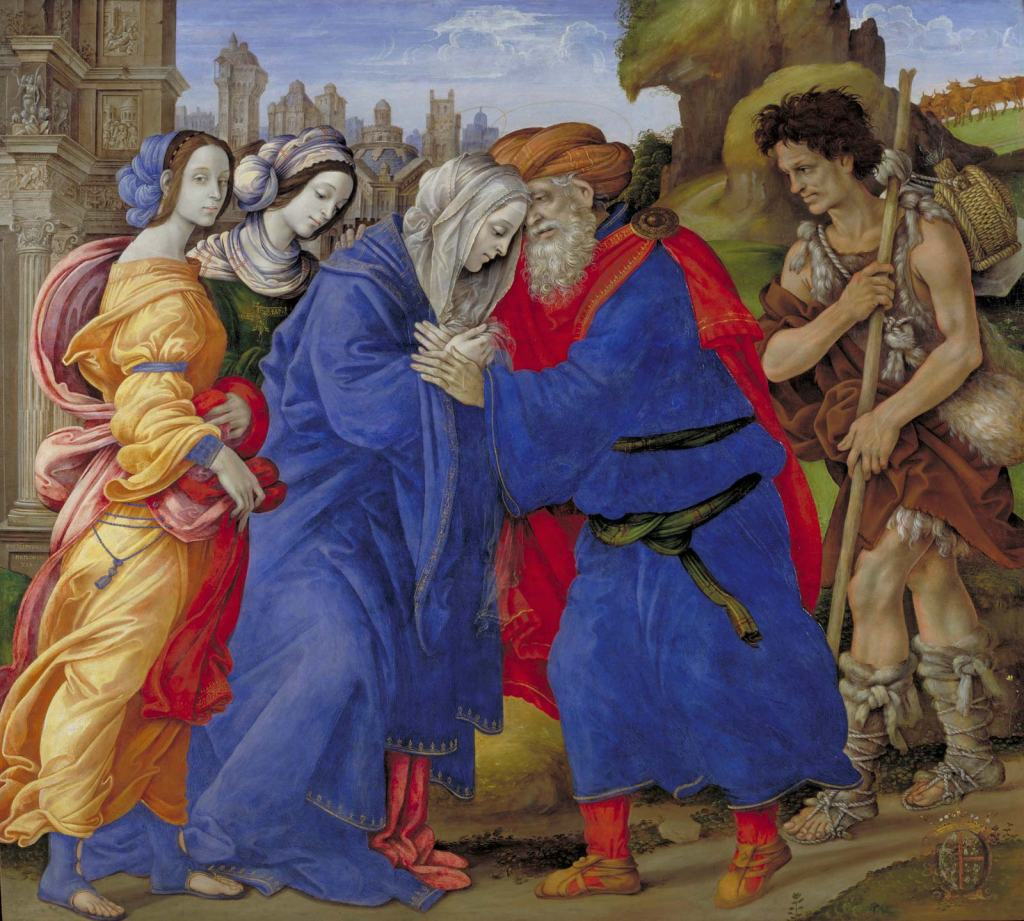
Image retrieved from https://www.britannica.com/biography/Saints-Anne-and-Joachim Caption credit: Lippi, Filippino: The Meeting of Joachim and Anne Outside the Golden Gate of Jerusalem
The Meeting of Joachim and Anna Outside the Golden Gate of Jerusalem, tempera on panel by Filippino Lippi, 1497; in the National Gallery of Denmark, Copenhagen.
Statens Museum for Kunst (National Gallery of Denmark); http://www.smk.dk (Public domain)

Today the Church recalls the parents of the Blessed Virgin Mary, Saints Joachim and Anne.

Not much is known about Joachim and Anne other than from folklore and apocryphal writings. What we do know is that God’s plan of salvation history and the ability for all of us to become saints one day is shaped and molded in our hearts by those who surround us. The parents of Mary and her ability to say yes to God’s will must have had a profound impact in her upbringing. Oftentimes, we as a culture take for granted the role of the family unit and how our domestic church at home calls us to something greater – to be open to God’s will and to be Saints! Mary’s parents taught her the ways of the Lord in which she had the courage to say yes to God and bring forth Christ Jesus into our life as the Virgin Mother, undefiled, & Queen of Heaven that she is.

Saint John Damascene offers this reflection on the parents of Mary, the theotokos (God-bearer) of our Lord Jesus:

Joachim and Anne, how chaste a couple! While safeguarding the chastity prescribed by the law of nature, you achieved with God’s help something which transcends nature in giving the world the Virgin Mother of God as your daughter. While leading a devout and holy life in your human nature, you gave birth to a daughter nobler than the angels, whose queen she now is. Girl of utter beauty and delight, daughter of Adam and mother of God, blessed the loins and blessed the womb from which you come! Blessed the arms that carried you, and blessed your parents’ lips, which you were allowed to cover with chaste kisses, ever maintaining your virginity. Rejoice in God, all the earth. Sing, exult and sing hymns. Raise your voice, raise it and not be afraid. (Retrieved from the Office of Readings in the Roman Breviary and Orat. 6 in Nativitatem B. Mariae V. 2, 4, 5, 6: PG 96, 663, 667, 670).

St. Anne and Joachim, pray for us and enable us the same chaste and fervent example you bestowed upon your daughter, Mary.

The Rise of True Christian Nationalism for The Church Militant

Image Retrieved from public domain

There has been some discussion of the topic of Christian Nationalism as the United States finds itself in another political divide with election season in full swing.

I would posit to my fellow Christians that true Christian Nationalism includes being a witness and portraying the love of Christ regardless of thy neighbor’s belief system. As the Greatest Commandment from Jesus reminds us: “love the Lord your God with all your heart, with all your soul, with all your mind, and with all your strength.’ You shall love your neighbor as yourself.’ There is no other commandment greater than these (Mk. 12:30-31). What a difficult concept to live by in our divided society where the lack of civil dialogue and respect for the dignity of one’s neighbor is not commonplace.

If we need another reminder of what true Christian Nationalism should look like, we should turn to the beatitudes:

“Blessed are the poor in spirit,

for theirs is the kingdom of heaven.

Blessed are they who mourn,

for they will be comforted.

Blessed are the meek,

for they will inherit the land.

Blessed are they who hunger and thirst for righteousness,

for they will be satisfied.

Blessed are the merciful,

for they will be shown mercy.

Blessed are the clean of heart,

for they will see God.

Blessed are the peacemakers,

for they will be called children of God.

Blessed are they who are persecuted for the sake of righteousness,

for theirs is the kingdom of heaven.

Blessed are you when they insult you and persecute you and utter every kind of evil against you [falsely] because of me. Rejoice and be glad, for your reward will be great in heaven.

(Mt. 5:3-12).

As Jesus reminds us, give to Caesar what is Caesar’s and to God what belongs to God (Lk. 20:25). This reminder is our call to see the face of God in one another regardless of political ideology, religious affiliation or lack thereof. We are in a battle in this nation among the church militant longing to be part of the church triumphant to be saints! Go out and start a real movement of Christian Nationalism to live and proclaim the Gospel. They will know we are Christians by our love, by our love!

From NABRE

16th Sunday Ordinary Time: They Were Like Sheep Without A Shepherd

Jeremiah 23:1–6, Psalm 23:1–3, 3–4, 5, 6, Ephesians 2:13–18, Mark 6:30–34

Jesus Went Out into a Desert Place by James Tissot in the public domain

Today’s gospel from Mark reminds us that we can become like sheep without our shepherd when we become entrenched in ministering to our brothers and sisters of Christ in which we can lose focus. We might attribute such talents of our ministry to our own achievements. Perhaps, we might place ourselves upon a pedestal of pride and forget the one who is leading us. Maybe there is someone in ministry that has stumbled and fallen from grace leading to confusion and making us feel as if the whole church is in disarray. Sometimes even those in ministry including our clergy can lose focus and become burnt out misplacing Jesus as the sheep gone astray. We may become like Martha and Mary where we are task oriented and get off track, losing focus like Martha instead of resting and enjoying the Lord’s presence like Mary (Lk. 10:38-42). As the prophet Jeremiah says in the first reading, “Woe to the Shepherds who mislead and scatter the flock of my pasture says the Lord” (Jer. 23:1). As Saint Paul reminds us we should not be distracted by getting off track for he reminds us what Jesus came to do as the Good Shepherd! “He came and preached peace to you who were far off and peace to those who were near, for through him we both have access in one Spirit to the Father” (Eph. 2:17-18). It is Jesus that asks us in today’s gospel to not get lost when we are overwhelmed by the crowd. “Come away by yourselves to a deserted place and rest a while.” People were coming and going in great numbers, and they had no opportunity even to eat (Mk. 6:31).

The weeklong National Eucharistic Congress in Indianapolis, Indiana that took place recently reminds us that our Shepherd, Jesus, is not far away (https://www.eucharisticcongress.org). We should take some time this week to find time to get away and rest in His presence in the Eucharistic chapel or in silent adoration. When it seems like we are being led astray or we are in need of rest in our ministry, ask for strength before Jesus truly alive in the holy host. The Holy Spirit will lead us back to the Good Shepherd, Jesus, if we take the time to rest and meditate by getting away in prayer.

The Lord is my Shepherd; there is nothing I shall want (Ps. 23).

Our Lady of Mt. Carmel, Pray For Us


Our Lady of Mount Carmel and Saints (Simon Stock, Angelus of Jerusalem, Mary Magdalene de’Pazzi, Teresa of Avila) by Pietro Novelli from the public domain

Today the Church commemorates the Feast of Our Lady of Mount Carmel, patroness of the Carmelite Order in which she appeared to St. Simon Stock, and bestowed upon him the brown scapular in 1251. According to The Sisters of Carmel, Our Lady bestowed the following promise to those wearing the scapular: “This shall be a privilege for you and all Carmelites, that anyone dying in this habit shall not suffer eternal fire.” In time, the Church extended this magnificent privilege to all the laity who are willing to be invested in the Brown Scapular of the Carmelites and who perpetually wear it.”

To be eligible to be enrolled in the Brown Scapular Confraternity, one must go through a simple ceremony and receive the blessing from a priest in which the scapular should be worn at all times.

Our Lady of Mount Carmel, Pray For Us

Image of Brown Scapular

Source: https://www.sistersofcarmel.com/brown-scapular-information.php

A faith built upon the love of God

Written by Adam Stengel

Early in the pontificate of Pope Francis I was, generally speaking, what could be called a “Francis skeptic.” To be honest I didn’t pay that much attention to him at first. As the father of three little kids, I primarily focused on survival in those days. I wasn’t even aware of the dubiaor the original Viganò bombshell but, being a conservative in a conservative family, I had absorbed the idea that at the bare minimum his style was suspect. I have to admit, I was late to the game. When I finally got around to looking at the websites and material that family and others recommended to me, I was shocked. The sheer lack of charity and bombastic insults being leveled at the Holy Father was unbelievable. I began to read Pope Francis’ writings and found the opposite: warmth, joy, peace, and an overwhelming love of Jesus. I still didn’t agree with every word he said, but—if one reads his words in context and in their entirety—his deep love for Jesus was undeniable. I could understand having a disagreement with the Pope, but the lack of charity towards him was a clear sign that this was not the work of the Spirit.

It is this lack of charity, which is so ubiquitous, that has perplexed me for quite some time. What is its root? How has it taken hold in so many people, many of whom I know are good and holy people? I think the answer—or at least part of it—can be found in the true meaning of charity as it is lived and in its relationship with the other two theological virtues, faith and hope.

Let us look at what the Church teaches us about faith. First of all, the Catechism of the Catholic Church defines faith as obedience: “to obey in faith is to submit freely to the word that has been heard, because its truth is guaranteed by God, who is Truth itself,” and describes Abraham as a model and the Virgin Mary as “its most perfect embodiment” (CCC 144) and “the purest realization of faith” (CCC 149), who never wavered in her faith, even when she did not fully understand.

The Catechism also teaches that faith is first prompted by “interior helps of the Holy Spirit” but then requires “the full submission of intellect and will to God who reveals” (CCC 153-154). It cautions us that “What moves us to believe is not the fact that revealed truths appear as true and intelligible in the light of our natural reason: we believe because of the authority of God himself who reveals them.” Thankfully we are provided with “motives of credibility” that make this submission easier, but it is this submission that is faith itself (CCC 156).

Springing from this submission we get to the theological virtue of hope. The Catechism defines hope as: “the theological virtue by which we desire the kingdom of heaven and eternal life as our happiness, placing our trust in Christ’s promises and relying not on our own strength, but on the help of the grace of the Holy Spirit” (CCC 1817). Once we place our faith in the reality of Christ, we can then hope in that which he promises. True hope produces in us humility and piety as we reorient our lives to the reality of God’s greatness in relation to our smallness. The Catechism points to another product in a Christian as well: “Buoyed up by hope, he is preserved from selfishness and led to the happiness that flows from charity” (CCC 1818).

Finally, we come to charity. Paragraph 1822 of the Catechism defines charity as, “The theological virtue by which we love God above all things for his own sake, and our neighbor as ourselves for the love of God.” The following paragraph says “by loving one another, the disciples imitate the love of Jesus which they themselves receive.” This definition shows us that the foundation of charity is faith in the reality of God’s love for us. This reality, that God the Father loves us beyond measure gives us an unshakable hope, which allows us to radiate this love to others.

The Catechism describes this reality beautifully as: “The practice of the moral life animated by charity gives to the Christian the spiritual freedom of the children of God. He no longer stands before God as a slave, in servile fear, or as a mercenary looking for wages, but as a son responding to the love of him who first loved us” (CCC 1828).

How might this picture of the theological virtues be related to the loss of charity among so many people, seemingly overnight? I believe the key is found in one of Pope Francis’s foundational principles: “realities are greater than ideas.” Our faith is based upon the reality of God’s love for us, which is demonstrated in the life, death, and resurrection of Christ. We also find it in the many real and concrete promises he made to us about how he would safeguard his Church. In the realm of ideas, there are many beautiful and important descriptions and explanations about this reality that help us to better understand it, but these ideas are always secondary to the reality of the Gospel. We are not a people of a philosophy, but a people of a reality. We find this profoundly in the outward, physical signs of our sacraments. This is also reflected in the great importance we place on relics, good works, and other tangible and physical signs of God’s love in our physical world.

The division found today in the Church and the malice towards the pope are caused, in large part, by people placing their faith in their ideas more than in realities. We might expect this, of course, in the secular world where—lacking the faith in the love of God—people put their faith in ideologies, political parties, and other worldly things. People often refuse to see the reality of the truths that they might find if they were open to listening to both sides of a discussion. Instead, many people choose to celebrate their own narrow-mindedness. Rather than being open to other perspectives in search for the truth, many will obstinately place their hope in the success of a political party or the proliferation of an ideology, and will only give charity to those who are in agreement. Anyone who disagrees is seen as an obstacle. At the extreme end of this phenomenon, people will begin to create alternate realities to safeguard their ideas. This is what causes the proliferation of conspiracy theories.

Regretfully, we see this in the Church as well. Many Catholics have placed their faith (and subsequently, their hope) in their own ideas about doctrine or in their own interpretations of the Gospel. Quite often, these are conflated with secular ideologies or political platforms. Rather than placing their hope and faith in the reality of the Gospel and Christ’s guarantee that he will protect the Church, many Catholics treat the faith in the same way as the secular world: forming divisions and only showing charity to those in their camp. When someone challenges their narrow understanding and tries to broaden their rigid worldview, they see it as a direct challenge to their faith, since their faith is built only on the sand of their own ideas and conclusions.

When our faith is built upon the solid rock of the Love of Christ and his promises to us there is never a reason for fear and no reason to lack charity. In fact, when the reality of God’s love is the foundation of our faith, we will want to love as he loves, which means even loving our enemies. “God proves his love for us in that while we were still sinners Christ died for us” (Rom 5:8).

When I began to recognize that this is the fundamental reason why there is so much division in the Church and so much malice towards the Holy Father, empathy for those in this situation began to well up in me. I have sorrow and love for them, not contempt, and this helps give me certainty that I was on the right track. May we all pray for the unity of the Church. We can only make this a reality by taking Christ at his word and trusting, with faith, hope, and charity, in the Holy Spirit who guides the Church.

Article originally appeared in https://wherepeteris.com/a-faith-built-upon-the-love-of-god/

St. Thomas the Apostle: My Lord & My God

The Incredulity of St Thomas Ludovico Mazzolino https://commons.wikimedia.org/wiki/File:Incredul.jpg

Today the church celebrates the memorial of Saint Thomas the Apostle. Saint Thomas may be known as doubting Thomas but it was that faithful encounter where he touched the wounds of Jesus that led to his belief in Jesus’s resurrection. Oftentimes we can be like Thomas where we may be witnesses to God’s graces working in us and among us in our world, but still doubt the risen Christ Jesus in our midst. I too have oftentimes doubted God’s presence in a chaotic world. I wanted proof only to realize that the Holy Spirit was leading me to our risen Lord all along. Our encounters with others in ministry, with our family, friends and coworkers is one way where we can find the risen Jesus in our midst by being a Christ & seeing Christ in our brothers and sisters as being made in the Creator’s image. Continually seeking an encounter with God in a daily prayer routine will also aide us on our faith journey to find the risen Lord. To have faith and say “my Lord and my God” allows us to admit that we are not the rulers of our life nor the captain of our ship. Being dependent on the belief that the risen Jesus is in our midst despite not having the encounter that Thomas did allows us to go outside our comfort zone and be truly vulnerable for what may come our way. When we cast aside our doubt, the grace of the Holy Spirit can transform our limited human perception into one of awareness and belief in God’s power to lead us into a better place where the risen Lord wishes to dwell.

One place of prayer we can renew our faith in the risen Lord is within Eucharistic adoration. A National event taking place this month in Indianapolis will call all pilgrims in attendance to renew such a tradition of adoration in which we profess our faith in Jesus being present with us in the consecrated host. https://www.eucharisticcongress.org

My Lord & My God

John 20:24-29 Thomas, called Didymus, one of the Twelve, was not with them when Jesus came. So the other disciples said to him, “We have seen the Lord.” But Thomas said to them, “Unless I see the mark of the nails in his hands and put my finger into the nailmarks and put my hand into his side, I will not believe.” Now a week later his disciples were again inside and Thomas was with them. Jesus came, although the doors were locked, and stood in their midst and said, “Peace be with you.” Then he said to Thomas, “Put your finger here and see my hands, and bring your hand and put it into my side, and do not be unbelieving, but believe.” Thomas answered and said to him, “My Lord and my God!” Jesus said to him, “Have you come to believe because you have seen me? Blessed are those who have not seen and have believed.”

It is believed that St. Thomas ventured to Parthia and India spreading the good news of the gospel in that region under which the Syro Malabar Christian church was started. Thomas was tasked with building a palace for the king in India and is a patron saint or architects as in some depictions Thomas holds a carpenter’s square with a book in the other hand signifying his evangelical work. It is believed that Thomas was killed by a spear in India as a martyr of the faith.

Retrieved from https://www.stainedglassinc.com/window/5382-st-thomas-the-apostle/

Saint Thomas, Apostle, pray for us.

Solemnity of The Nativity of Saint John the Baptist

Saint John the Baptist Bearing Witness – painting by Annibale Carracci

We are all made for a purpose. St. John the Baptist’s purpose was to testify to the light of the world, preparing others for Christ Jesus to enter. How do we imitate this saintly figure in leading others to Jesus? What is our purpose? As St. John the Baptist said about Jesus, “He must increase, I must decrease” (Jn. 3:30). How will we make straight the path of the Lord to lead others to Jesus. How can we be a messenger of the good news of the gospel? Will we decrease so that He can increase?

Luke 1:57-66, 80

“When the time arrived for Elizabeth to have her child she gave birth to a son. Her neighbors and relatives heard that the Lord had shown his great mercy toward her, and they rejoiced with her. When they came on the eighth day to circumcise the child, they were going to call him Zechariah after his father, but his mother said in reply, “No. He will be called John.” But they answered her, “There is no one among your relatives who has this name.” So they made signs, asking his father what he wished him to be called. He asked for a tablet and wrote, “John is his name,” and all were amazed. Immediately his mouth was opened, his tongue freed, and he spoke blessing God. Then fear came upon all their neighbors, and all these matters were discussed throughout the hill country of Judea. All who heard these things took them to heart, saying, “What, then, will this child be?” For surely the hand of the Lord was with him. The child grew and became strong in spirit, and he was in the desert until the day of his manifestation to Israel.”

From a sermon by Saint Augustine, bishop

John is born of an old woman who is barren; Christ is born of a young woman who is a virgin. That John will be born is not believed, and his father is struck dumb; that Christ will be born is believed, and he is conceived by faith.

I have proposed some matters for inquiry, and listed in advance some things that need to be discussed. I have introduced these points even if we are not up to examining all the twists and turns of such a great mystery, either for lack of capacity or for lack of time. You will be taught much better by the one who speaks in you even when I am not here; the one about whom you think loving thoughts, the one whom you have taken into your hearts and whose temple you have become.

John, it seems, has been inserted as a kind of boundary between the two Testaments, the Old and the New. That he is somehow or other a boundary is something that the Lord himself indicates when he says, The Law and the prophets were until John. So he represents the old and heralds the new. Because he represents the old, he is born of an elderly couple; because he represents the new, he is revealed as a prophet in his mother’s womb. You will remember that, before he was born, at Mary’s arrival he leapt in his mother’s womb. Already he had been marked out there, designated before he was born; it was already shown whose forerunner he would be, even before he saw him. These are divine matters, and exceed the measure of human frailty. Finally, he is born, he receives a name, and his father’s tongue is loosed.

Zachary is struck dumb and loses his voice, until John, the Lord’s forerunner, is born and releases his voice for him. What does Zachary’s silence mean, but that prophecy was obscure and, before the proclamation of Christ, somehow concealed and shut up? It is released and opened up by his arrival, it becomes clear when the one who was being prophesied is about to come. The releasing of Zachary’s voice at the birth of John has the same significance as the tearing of the veil of the Temple at the crucifixion of Christ. If John were meant to proclaim himself, he would not be opening Zachary’s mouth. The tongue is released because a voice is being born – for when John was already heralding the Lord, he was asked, Who are you and he replied I am the voice of one crying in the wilderness.

John is the voice, but the Lord in the beginning was the Word. John is a voice for a time, but Christ is the eternal Word from the beginning.

(From the Office of Readings, Sermo 293,3: PI, 1328-1329 by St. Augustine)

12th Sunday in Ordinary Time: Calming Your Own Storms

Christ in the Storm on the Sea of Galilee by Rembrandt

The gospel from Mark (4:35-41) reminds us of the storm at sea and how the disciples were terrified while Jesus slept in the boat. When the disciples woke Jesus up, he commanded the wind and the sea to be quiet and still. Jesus asked why they didn’t have faith. Oftentimes in life we are filled with the same fear and trepidation when a storm wreaks havoc in our life. We are terrified because like the disciples we don’t have faith. What is our prayer life like? Do we actively ask Jesus to be a part of our life during not only the good times, but the bad times and storms of life? Sometimes it may seem like God is not answering our prayers and is silent, but must recall that Jesus is in the boat with us and asks each one of us to have faith. Let us place our faith in Jesus and seek a foundation of prayer in which we know that our Lord will be there to calm the storms in our life and ask for the grace to overcome such moments.

Saint Anthony of Padua, Pray for Us

Painting of Saint Anthony of Padua with the Christ Child by Giovanni Battista Tiepolo. Image from public domain at Wikimedia Commons

Born in Lisbon Portugal in 1195 and died in Padua Italy in 1231

Patron Saint of Lost Items

Came from a wealthy family and was a great orator. Saint Anthony joined the Canons Regular of St Augustine and then found his place with the Franciscan Friars. Saint Francis in seeing the humility of Anthony assigned him to teach theology to the other friars.

Canonized in 1232 and proclaimed a Doctor of the Church by Pope Pius XII.

A Sermon by Saint Anthony

(From the Office of Readings in the Memorial for St Anthony)

The man who is filled with the Holy Spirit speaks in different languages. These different languages are different ways of witnessing to Christ, such as humility, poverty, patience and obedience; we speak in those languages when we reveal in ourselves these virtues to others. Actions speak louder than words; let your words teach and your actions speak. We are full of words but empty of actions, and therefore are cursed by the Lord, since he himself cursed the fig tree when he found no fruit but only leaves. Gregory says: “A law is laid upon the preacher to practise what he preaches.” It is useless for a man to flaunt his knowledge of the law if he undermines its teaching by his actions.

But the apostles spoke as the Spirit gave them the gift of speech. Happy the man whose words issue from the Holy Spirit and not from himself! For some men speak as their own character dictates, but steal the words of others and present them as their own and claim the credit for them. The Lord refers to such men and others like them in Jeremiah: So, then, I have a quarrel with the prophets that steal my words from each other. I have a quarrel with the prophets, says the Lord, who have only to move their tongues to utter oracles. I have a quarrel with the prophets who make prophecies out of lying dreams, who recount them and lead my people astray with their lies and their pretensions. I certainly never sent them or commissioned them, and they serve no good purpose for this people, says the Lord.

We should speak, then, as the Holy Spirit gives us the gift of speech. Our humble and sincere request to the Spirit for ourselves should be that we may bring the day of Pentecost to fulfilment, insofar as he infuses us with his grace, by using our bodily senses in a perfect manner and by keeping the commandments. Likewise we shall request that we may be filled with a keen sense of sorrow and with fiery tongues for confessing the faith, so that our deserved reward may be to stand in the blazing splendour of the saints and to look upon the triune God.

Offertory Gifts: The Art of Giving at Mass

When we give God our tithe, both in treasure, talent or time according to the needs of the Church, we are allowing ourselves to not be attached to the things of this world. Recently our family was asked to bring up the offertory gifts of bread and wine at mass. My 9 year old daughter was sad because we didn’t place money in the collection basket. I explained that we represented the parish church in bringing up bread & wine, a symbol of all of the church’s labor and sacrifice just as we do when placing our individual offerings in the collection basket. Typically we donate online, but our daughter always likes to put a tangible monetary donation in the basket.

Of course she was excited when she was able to put money in the Saint Vincent de Paul box at the end of Mass too. Nevertheless these symbols of giving to God at the offertory collection are more than just monetary exchanges. We are giving to God in return that which we were blessed with as stewards of His benevolent will for our life. Some have more than others financially and that is ok because we give according to status in life. In the book of Acts of the Apostles, it describes how people would give before the apostles’ feet and the distribution divided according to need (Acts 4:5). Then there is the story of the widow’s mite who put all she had in the treasury (Mk. 12:44). In both instances, such an instance reveals how we should not be attached to worldly possessions for all that we have been blessed with comes from God.

When we give to God our gifts at each Mass and lift up hearts to Him and place our worries & fears before the altar where Jesus’s great sacrifice is commemorated, we are united together in solidarity. At the Eucharistic meal we partake in, God will provide us with something greater. When we receive holy communion we are receiving the grace we need from the supernatural food that nourishes our soul and unites our bond with Jesus.

If we worry about finances in our life and this is a reason for not giving, ask God to be the ruler of your life.

We can pray to God to allow us to get through difficult moments. While praying to win the lottery won’t help, God may provide in other ways and provide us with peace and solace to get through the storm. Remember that we cannot only give to God our treasure, but can also give to God our talent and time in volunteering in the ministry of the church. Give freely and let go, let God so that we can be dependent on His grace. As Matthew’s gospel reminds us: “No one can serve two masters. He will either hate one and love the other, or be devoted to one and despise the other. You cannot serve God and mammon” (Mt. 6:24).

A good prayer of intercession to Saint Matthew:

O Saint Matthew, former tax collector and patron saint of financial matters, I humbly come before you, seeking your intercession as I struggle with my finances. I ask for your guidance in managing my resources wisely, and for the grace to trust in the Lord Jesus Christ’s provision for my needs.

Offer Of The Poor Widow retrieved from the public domain

Solemnity of Corpus Christi

Brunn am Gebirge ( Lower Austria ). Saint Kunigunde parish church – Processional banner: Two angels adoring the eucharist. https://commons.wikimedia.org/wiki/File:Brunn_Pfarrkirche_-_Prozessionsfahne_1.jpg
A procession of the Blessed Sacrament during the first Annual Southeastern Eucharistic Congress in Charlotte, North Carolina, USA. https://commons.wikimedia.org/wiki/File:Blessed_Sacrament_procession,First_Annual_Southeastern_Eucharistic_Congress,_Charlotte,_North_Carolina-_20050924-01.jpg

The solemnity of Corpus Christi or the Body of Christ reminds us that Jesus is truly present in the bread and wine that become His body and His blood through transubstantiation at the mass. John’s gospel in the bread of life discourse reminds us of the following:

Jesus said to them, “Amen, amen, I say to you, unless you eat the flesh of the Son of Man and drink his blood, you do not have life within you. Whoever eats my flesh and drinks my blood has eternal life, and I will raise him on the last day.” (Jn. 6:53-54)

The Old Testament reading from Exodus reminds us of the Mosaic covenant & the sprinkling from the blood of the lamb on the Israelite people. Jesus came to fulfill a new covenant per today’s gospel from Mark in which his body & blood becomes a symbol of everlasting life as found in the breaking of the bread at Passover. God’s people no longer have to make sacrificial offerings of animals for the atonement of their sins because it is Jesus that reminds us that He is the Lamb of God that will be the ultimate sacrifice to remove our sin & brokenness. Every Mass is a commemoration of the sacrifice made by Jesus on Calvary. Every Mass reminds us that Jesus has never left us and will be with us always when heaven meets earth and the bread & wine become life giving nourishment for us.

Blessed Carlo Acutis, a millennial soon to be Saint born in 1991 passed from this life due to leukemia had a great devotion to the Eucharist. Carlo once said, “The more Eucharist we receive, the more we will become like Jesus, so that on earth we will have a foretaste of heaven.” If our hearts & souls are not ready to receive His body & blood in holy communion, Carlo reminds us of the following “Our soul is like a hot air balloon. If by chance there is a mortal sin, the soul falls to the ground. Confession is like the fire underneath the balloon enabling the soul to rise again. . . It is important to go to confession often.” His website documents the miracles of the Eucharist http://www.miracolieucaristici.org/en/Liste/list.html

As Saint Thomas Aquinas once remarked, “The Eucharist is the sacrament of love: It signifies love, it produces love. The Eucharist is the consummation of the whole spiritual life.” (https://www.catholicnewsagency.com/news/251543/corpus-christi-sunday-2022-inspiring-words-from-the-saints-on-the-eucharist). The Eucharistic hymns of Thomas Aquinas are also worth reflecting on https://www.dominicanajournal.org/wp-content/files/old-journal-archive/vol11/no1/dominicanav11n1theucharistichymnsstthomasaqui.pdf

Let us reflect more deeply today at the pinnacle of our faith where Jesus becomes truly present for us in the Holy Eucharist. Let our Amen be strong as we receive Jesus, the living bread come down from heaven.

One of the prayers I recite after receiving Holy Communion is the following:

Anima Christi

Soul of Christ, sanctify me. Body of Christ, save me. Blood of Christ, inebriate me. Water from the side of Christ, wash me. Passion of Christ, strengthen me. O good Jesus, hear me. Within Thy wounds hide me. Separated from Thee let me never be. From the malignant enemy, defend me. At the hour of death, call me. And close to Thee bid me. That with Thy saints I may be Praising Thee, forever and ever. Amen.

Quotes from Blessed Carlo retrieved from https://www.ncregister.com/blog/17-inspiring-quotes-from-carlo-acutis

The Sacred Heart of Jesus

Pompeo Batoni: Sacred Heart of Jesus retrieved from the public domain

During the month of June and after the octave of the Feast of Corpus Christi, the devotion to the Sacred Heart of Jesus becomes popular for us Catholics. Such a devotion reminds us that we must come to the Lord in prayer and humility to the divine heart that is on fire for His creation. We are reminded that “we love because he first loved us” (1. Jn. 4:19). This month should be a reflection for all of us to love God with our whole heart and mind and to love our neighbor.

On December of 1674, Saint Margaret Mary received the first visitation from our Lord Jesus regarding His unconditional love through His sacred heart. St. Margaret Mary didn’t have the best life at home and had rheumatic fever off and on for four years until pledging a vow to the Blessed Virgin Mary to enter religious life. She was humble and had a fondness for Eucharistic adoration at an early age. Her work La Devotion au Sacre-Coeur de Jesus or Devotion to the Sacred Heart is a popular work among many Catholics. (https://www.newmanministry.com/saints/saint-margaret-mary-alacoque).

It is customary to start a novena to the Sacred Heart at the beginning of the Feast of Corpus Christi. 

Stained glass, depiction Christ appearing to St. Margaret Mary Alacoque and showing her His Sacred Heart, St. Francis Xavier Basilica, Vincennes, IN

The Sacred Heart Solemnity and reparation to His sacred Heart reminds us of His merciful love where we unite our sacrifices for another. It was through Jesus’s redemptive suffering and amazing love that he bore the weight of sin for all mankind. Throughout this month we can fast and pray a rosary for someone. We can do a charitable act for someone. We can visit the tabernacle & offer our heart to His divine heart. We can perform an examination of conscience and look at our sins and ask God to instill in us the virtues for which we should strive to abide by.

The Sacred Heart reminds us of the true essence of love which is one of sacrifice and mortification for the love and good of one another. Such a love is not superficial, but a love surrounded by thorns symbolizing the agony of our Lord’s passion & death. Pierced by a lance, his blood was shed for the sin of all. Surrounded by the flame of the Holy Spirit, a heart that burns for all humanity. The cross on top of the heart symbolizes the ultimate sacrifice for all. His sacred heart beats to the eternal drum of merciful love for all. Making reparations to His sacred heart is akin to making merciful love offerings for the good of our soul & our neighbor’s soul as members of the Body of Christ, the church. We are called to share in His redemptive suffering. St. Paul in his letter to the Colossians states “Now I rejoice in my sufferings for your sake, and in my flesh I complete what is lacking in Christ’s afflictions for the sake of his body, that is, the church” (Col. 1:24). The prophet Joel reminds us of the following as well: “Rend your hearts, not your garments, and return to the LORD, your God, For he is gracious and merciful, slow to anger, abounding in steadfast love, and relenting in punishment.” (Jl. 2:13). Truly, our suffering in this life is nothing unless lifted up to His Sacred heart.

Pope Leo XIII’s encyclical Annum Sacrum has the following to reflect upon:

“ Jesus Christ, our God and our Redeemer, is rich in the fullest and perfect possession of all things: we, on the other hand, are so poor and needy that we have nothing of our own to offer Him as a gift. But yet, in His infinite goodness and love, He in no way objects to our giving and consecrating to Him what is already His, as if it were really our own; nay, far from refusing such an offering, He positively desires it and asks for it: “My son, give me thy heart.” We are, therefore, able to be pleasing to Him by the good will and the affection of our soul.”

“And since there is in the Sacred Heart a symbol and a sensible image of the infinite love of Jesus Christ which moves us to love one another, therefore is it fit and proper that we should consecrate ourselves to His most Sacred Heart – an act which is nothing else than an offering and a binding of oneself to Jesus Christ, seeing that whatever honor, veneration and love is given to this divine Heart is really and truly given to Christ Himself.” (https://www.papalencyclicals.net/leo13/l13annum.htm). 

Let us humbly unite our hearts to His Saving Heart this month. The United States Conference of Catholic Bishops advised the faithful to make a reparation to His Sacred Heart and pray this beautiful Litany: https://www.usccb.org/prayers/litany-sacred-heart-jesus

A Solemn Act of Consecration to the Sacred Heart of Jesus
by Saint Margaret Mary Alacoque:

I give myself and consecrate to the Sacred Heart of our Lord Jesus Christ, my person and my life, my actions, pains and sufferings, so that I may be unwilling to make use of any part of my being other than to honor, love and glorify the Sacred Heart.
This is my unchanging purpose, namely, to be all His, and to do all things for the love of Him, at the same time renouncing with all my heart whatever is displeasing to Him.
I therefore take You, O Sacred heart, to be the only object of my love, the guardian of my life, my assurance of salvation, the remedy of my weakness and inconstancy, the atonement for all the faults of my life and my sure refuge at the hour of death.
Be then, O Heart of goodness, my justification before God the Father, and turn away from me the strokes of his righteous anger.
O Heart of love, I put all my confidence in You, for I fear everything from my own wickedness and frailty, but I hope for all things from Your goodness and bounty.
Remove from me all that can displease You or resist Your holy will; let Your pure love imprint Your image so deeply upon my heart, that I shall never be able to forget You or to be separated from You.
May I obtain from all Your loving kindness the grace of having my name written in Your Heart, for in You I desire to place all my happiness and glory, living and dying in bondage to You. Amen.

The Visitation of the Blessed Virgin Mary

Lk. 1:39-556

Mary set out and traveled to the hill country in haste to a town of Judah, where she entered the house of Zechariah and greeted Elizabeth. When Elizabeth heard Mary’s greeting, the infant leaped in her womb, and Elizabeth, filled with the Holy Spirit, cried out in a loud voice and said, “Most blessed are you among women, and blessed is the fruit of your womb. And how does this happen to me, that the mother of my Lord should come to me? For at the moment the sound of your greeting reached my ears, the infant in my womb leaped for joy. Blessed are you who believed that what was spoken to you by the Lord would be fulfilled.”

And Mary said:

“My soul proclaims the greatness of the Lord;

my spirit rejoices in God my Savior,

for he has looked with favor on his lowly servant.

From this day all generations will call me blessed:

the Almighty has done great things for me,

and holy is his Name.

He has mercy on those who fear him

in every generation.

He has shown the strength of his arm,

he has scattered the proud in their conceit.

He has cast down the mighty from their thrones,

and has lifted up the lowly.

He has filled the hungry with good things,

and the rich he has sent away empty.

He has come to the help of his servant Israel

for he has remembered his promise of mercy,

the promise he made to our fathers,

to Abraham and his children for ever.”

Mary remained with her about three months and then returned to her home.

The Holy Spirit filled Mary with pure joy and a sense of holy excitement at the news that she would be the new ark carrying the new covenant, Jesus. Mary traveled in haste to see her kinswoman Elizabeth who bore John the Baptist in which the unborn child John leapt with joy in encountering Jesus in Mary’s womb. The joy that the Holy Spirit provides is one that we cannot keep bottled up for we too must travel in haste to allow the urgency of sharing the good news of God’s love and of the gospel to others. Let us reflect on Mary’s Magnificat this day where we too shall proclaim the greatness of the Lord and rejoice in God our Savior.

Mary, Mother of the Church, Pray for Us

Image retrieved from public domain & taken at Church of Mary Mother of Church, Monterrey, Nuevo Leon, Mexico

Jn. 19:25-27

Standing by the cross of Jesus were his mother and his mother’s sister, Mary the wife of Clopas, and Mary of Magdala. When Jesus saw his mother and the disciple there whom he loved, he said to his mother, “Woman, behold, your son.” Then he said to the disciple, “Behold, your mother.” And from that hour the disciple took her into his home.

Feast of Pentecost

Come Holy Spirit, Creator Blest (Veni, Creator Spiritus)

Come, Holy Spirit, Creator blest,
and in our souls take up Thy rest;
come with Thy grace and heavenly aid
to fill the hearts which Thou hast made.
O comforter, to Thee we cry,
O heavenly gift of God Most High,
O fount of life and fire of love,
and sweet anointing from above.

Thou in Thy sevenfold gifts are known;
Thou, finger of God’s hand we own;
Thou, promise of the Father, Thou
Who dost the tongue with power imbue.

Kindle our sense from above,
and make our hearts o’erflow with love;
with patience firm and virtue high
the weakness of our flesh supply.

Far from us drive the foe we dread,
and grant us Thy peace instead;
so shall we not, with Thee for guide,
turn from the path of life aside.

Oh, may Thy grace on us bestow
the Father and the Son to know;
and Thee, through endless times confessed,
of both the eternal Spirit blest.

Now to the Father and the Son,
Who rose from death, be glory given,
with Thou, O Holy Comforter,
henceforth by all in earth and heaven. Amen.

Ascension of Jesus the Christ

Gotti di Bondone Ascension from the public domain

Pope Saint Leo the Great:

At Easter, beloved brethren, it was the Lord’s resurrection which was the cause of our joy; our present rejoicing is on account of his ascension into heaven. With all due solemnity we are commemorating that day on which our poor human nature was carried up, in Christ, above all the hosts of heaven, above all the ranks of angels, beyond the highest heavenly powers to the very throne of God the Father. It is upon this ordered structure of divine acts that we have been firmly established, so that the grace of God may show itself still more marvellous when, in spite of the withdrawal from men’s sight of everything that is rightly felt to command their reverence, faith does not fail, hope is not shaken, charity does not grow cold.

For such is the power of great minds, such is the light of truly believing souls, that they put unhesitating faith in what is not seen with the bodily eye; they fix their desires on what is beyond sight. Such fidelity could never be born in our hearts, nor could anyone be justified by faith, if our salvation lay only in what was visible.

And so our Redeemer’s visible presence has passed into the sacraments. Our faith is nobler and stronger because sight has been replaced by a doctrine whose authority is accepted by believing hearts, enlightened from on high. This faith was increased by the Lord’s ascension and strengthened by the gift of the Spirit; it would remain unshaken by fetters and imprisonment, exile and hunger, fire and ravening beasts, and the most refined tortures ever devised by brutal persecutors. Throughout the world women no less than men, tender girls as well as boys, have given their life’s blood in the struggle for this faith. It is a faith that has driven out devils, healed the sick and raised the dead.

Even the blessed apostles, though they had been strengthened by so many miracles and instructed by so much teaching, took fright at the cruel suffering of the Lord’s passion and could not accept his resurrection without hesitation. Yet they made such progress through his ascension that they now found joy in what had terrified them before. They were able to fix their minds on Christ’s divinity as he sat at the right hand of his Father, since what was presented to their bodily eyes no longer hindered them from turning all their attention to the realisation that he had not left his Father when he came down to earth, nor had he abandoned his disciples when he ascended into heaven.

The truth is that the Son of Man was revealed as Son of God in a more perfect and transcendent way once he had entered into his Father’s glory; he now began to be indescribably more present in his divinity to those from whom he was further removed in his humanity. A more mature faith enabled their minds to stretch upward to the Son in his equality with the Father; it no longer needed contact with Christ’s tangible body, in which as man he is inferior to the Father. For while his glorified body retained the same nature, the faith of those who believed in him was now summoned to heights where, as the Father’s equal, the only-begotten Son is reached not by physical handling but by spiritual discernment.

Excerpt from St. Leo’s second sermon on the Ascension of the Lord Jesus in the Roman Catholic Office of Readings

Saint Athanasius, Bishop & Doctor

From A Discourse by Saint Athanasius

On the Incarnation of the Word:

The Word of God, incorporeal, incorruptible and immaterial, entered our world. Yet it was not as if he had been remote from it up to that time. For there is no part of the world that was ever without his presence; together with his Father, he continually filled all things and places.

Out of his loving-kindness for us he came to us, and we see this in the way he revealed himself openly to us. Taking pity on mankind’s weakness, and moved by our corruption, he could not stand aside and see death have the mastery over us; he did not want creation to perish and his Father’s work in fashioning man to be in vain. He therefore took to himself a body, no different from our own, for he did not wish simply to be in a body or only to be seen.

If he had wanted simply to be seen, he could indeed have taken another, and nobler, body. Instead, he took our body in its reality.

Within the Virgin he built himself a temple, that is, a body; he made it his own instrument in which to dwell and to reveal himself. In this way he received from mankind a body like our own, and, since all were subject to the corruption of death, he delivered this body over to death for all, and with supreme love offered it to the Father. He did so to destroy the law of corruption passed against all men, since all died in him. The law, which had spent its force on the body of the Lord, could no longer have any power over his fellow-men. Moreover, this was the way in which the Word was to restore mankind to immortality, after it had fallen into corruption, and summon it back from death to life. He utterly destroyed the power death had against mankind – as fire consumes chaff – by means of the body he had taken and the grace of the resurrection.

This is the reason why the Word assumed a body that could die, so that this body, sharing in the Word who is above all, might satisfy death’s requirement in place of all. Because of the Word dwelling in that body, it would remain incorruptible, and all would be freed for ever from corruption by the grace of the resurrection.

In death the Word made a spotless sacrifice and oblation of the body he had taken. By dying for others, he immediately banished death for all mankind.

In this way the Word of God, who is above all, dedicated and offered his temple, the instrument that was his body, for us all, as he said, and so paid by his own death the debt that was owed. The immortal Son of God, united with all men by likeness of nature, thus fulfilled all justice in restoring mankind to immortality by the promise of the resurrection.

The corruption of death no longer holds any power over mankind, thanks to the Word, who has come to dwell among them through his one body. (From the office of readings of the Roman Breviary)

For further study of this great saint, visit https://catholicexchange.com/an-early-christian-saint-for-our-time-st-athanasius/

Saint Joseph the Worker, Pray for Us

Georges de Latour, Saint Joseph the Carpenter; retrieved from the public domain

In 1955 Pope Pius XII created the second feast of Saint Joseph the worker to coincide with the International Worker’s Day on May 1. Christians must not lose sight of the dignity of their labor mandated by God to Adam & Eve. Our labor resembles the creative aspect of God our Creator. Saint Joseph humbly cared for the holy family from his trade as a carpenter & provided for their wellbeing. We too should turn to Saint Joseph in which not much is mentioned. Saint Joseph faithfully carried out his daily labor without complaint and we too should approach our labor with prayer & ask the Lord God to help us grow in holiness just as Saint Joseph.

Here is a prayer attributed to Pope St. Pius X:

O Glorious St. Joseph, model of all those who are devoted to labor, obtain for me the grace to work conscientiously, putting the call of duty above my natural inclinations, to work with gratitude and joy, in a spirit of penance for the remission of my sins, considering it an honor to employ and develop by means of labor the gifts received from God, to work with order, peace, moderation and patience, without ever shrinking from weariness and difficulties, to work above all with purity of intention and detachment from self, having always death before my eyes and the account that I must render of time lost, of talents wasted, of good omitted, of vain complacency in success, so fatal to the work of God. All for Jesus, all through Mary, all after thine example, O Patriarch, St. Joseph. Such shall be my motto in life and in death. Amen.

St Catherine of Siena, Pray for Us

From The Dialogue on Divine Providence by Catherine of Siena from the office of readings in the Roman Breviary

Eternal God, eternal Trinity, you have made the blood of Christ so precious through his sharing in your divine nature. You are a mystery as deep as the sea; the more I search, the more I find, and the more I find the more I search for you. But I can never be satisfied; what I receive will ever leave me desiring more. When you fill my soul I have an even greater hunger, and I grow more famished for your light. I desire above all to see you, the true light, as you really are.

I have tasted and seen the depth of your mystery and the beauty of your creation with the light of my understanding. I have clothed myself with your likeness and have seen what I shall be. Eternal Father, you have given me a share in your power and the wisdom that Christ claims as his own, and your Holy Spirit has given me the desire to love you. You are my Creator, eternal Trinity, and I am your creature. You have made of me a new creation in the blood of your Son, and I know that you are moved with love at the beauty of your creation, for you have enlightened me.

Eternal Trinity, Godhead, mystery deep as the sea, you could give me no greater gift than the gift of yourself. For you are a fire ever burning and never consumed, which itself consumes all the selfish love that fills my being. Yes, you are a fire that takes away the coldness, illuminates the mind with its light and causes me to know your truth. By this light, reflected as it were in a mirror, I recognise that you are the highest good, one we can neither comprehend nor fathom. And I know that you are beauty and wisdom itself. The food of angels, you gave yourself to man in the fire of your love.

You are the garment which covers our nakedness, and in our hunger you are a satisfying food, for you are sweetness and in you there is no taste of bitterness, O triune God!

To learn more about St Catherine of Siena: https://marian.org/articles/super-saint-st-catherine-siena-doctor-church

The Vine: 5th Sunday of Easter Reflection

Retrieved from the public domain Gemälde Jesus, wahrer Weinstock“ aus dem 17. Jh. in der Kirche St. Castor in Karden

Jn. 15:1-8

Jesus said to his disciples: “I am the true vine, and my Father is the vine grower. He takes away every branch in me that does not bear fruit, and every one that does he prunes so that it bears more fruit. You are already pruned because of the word that I spoke to you. Remain in me, as I remain in you. Just as a branch cannot bear fruit on its own unless it remains on the vine, so neither can you unless you remain in me. I am the vine, you are the branches. Whoever remains in me and I in him will bear much fruit, because without me you can do nothing. Anyone who does not remain in me will be thrown out like a branch and wither; people will gather them and throw them into a fire and they will be burned. If you remain in me and my words remain in you, ask for whatever you want and it will be done for you. By this is my Father glorified, that you bear much fruit and become my disciples.”

Today, we hear another I am statement from Jesus in which he says “I am the true vine.” We are reminded from this image Jesus presents that the source and summit of the life we have comes from Jesus, the true vine. In order to be strengthened and bear fruit, we must always come back to Jesus, the Vine of life. In prayer and through the gift of the sacramental life do we receive the nourishment from Jesus as the Vine to nourish our roots that will wither if not firmly connected to His will. Our life in the Spirit finds its nourishment from Jesus and in holy scripture. We are also reminded that we must continuously come back to Jesus as the Vine in which all spiritual and corporal works of mercy are rooted in Jesus, the Lord.

Today, let us ask God for the grace to be firmly connected to the Vine so that we will bear much fruit. Amen.

Good Shepherd Sunday: Reflection for the Fourth Sunday of Easter

Image retrieved from: Jesus: The Good Shepherd (op.org) “The image above is from the stalls of the Thisle Chapel in Edinburgh’s St Giles Cathedral. “

Today’s readings in the Catholic church during this Easter season are oftentimes known as “Good Shepherd” Sunday per the selection from sacred scripture. Today is also the World Day of Prayer for Vocations. We must always remember to pray for our men and women called by God that receive the spiritual call to imitate Jesus as the Divine Shepherd.

In the Gospel passage from John, chapter 10 verses 11-18 Jesus proclaims the following:

Jesus said:
“I am the good shepherd.
A good shepherd lays down his life for the sheep.
A hired man, who is not a shepherd
and whose sheep are not his own,
sees a wolf coming and leaves the sheep and runs away,
and the wolf catches and scatters them.
This is because he works for pay and has no concern for the sheep.
I am the good shepherd,
and I know mine and mine know me,
just as the Father knows me and I know the Father;
and I will lay down my life for the sheep.
I have other sheep that do not belong to this fold.
These also I must lead, and they will hear my voice,
and there will be one flock, one shepherd.
This is why the Father loves me,
because I lay down my life in order to take it up again.
No one takes it from me, but I lay it down on my own.
I have power to lay it down, and power to take it up again.
This command I have received from my Father.”

Oftentimes, as human beings, we are much like sheep. We tend to lose focus of the important aspects of our Christian life and wander off into danger. We let the petty distractions of the world and vainglory dull our senses and higher calling of being an Easter people with eyes always pointed to God and the Parousia or second coming. We are one Christian church despite the many rites, denominations and faith traditions that should always seek the goal of evangelizing others as our primary call. Bringing our fellow “sheep” closer to knowing who our great and awesome God is through the second person of the Trinity, Jesus, should be our ultimate task. Today, as we reflect on the good news, are you like the hired shepherd that wishes to flee and run from danger? Perhaps, we are not ready to have steadfast courage to face the many wolves in our life and possibly lay down our very own life for the “sheep”, or our brothers and sisters in need of His saving mercy in distress or danger? As the first letter from John reminds us, the love that God the Father has bestowed upon us allows us to be called children of God (1 Jn. 3:1). Jesus is the Good Shepherd who will never lead us astray. Those holy men and women that follow the model of our Good Shepherd to find the lost sheep among the wolves and danger should receive our heartfelt prayers and support.

According to the Vatican’s Pontifical Yearbook of 2024 and Statistical Yearbook of 2022 there are more Catholics with fewer vocations. The number of baptized Catholics increased by 1% from 1.376 billion in 2021 to 1.390 billion in 2022. The number of priests globally declined from 407,872 to 407,730. Africa and Asia saw an increase in vocations while the Americas, Europe and Oceania saw declines. Religious communities for men saw a decrease from 49,774 to 49,414. For women religious, there was a 1.6% decrease from 608,958 to 599,228 globally from 2021 to 2022 (https://www.vaticannews.va/en/vatican-city/news/2024-04/vatican-central-statistical-office-church-pontifical-yearbook.html).

Let us pray for those who work in the Lord’s harvest, that they may fully imitate our Good Shepherd, who brings life to others in a troubled world. Let us examine our own Christian worldview and take up our mission to not only serve others, but to boldly and courageously defend ourselves and others from the wolves that distract us from our mission. May we bring our brothers and sisters closer to knowing Him through our very actions, words and deeds this day for Jesus is our Good Shepherd.

Pray for all priests that they may receive God’s grace to be good and holy priests. Pray for those discerning a vocation to the priesthood and religious life. Sometimes we may not like certain priests at a parish – have you prayed for them lately or provided words of encouragement? According to a study conducted by the Catholic Project at the Catholic University of America in Washington DC regarding burnout, “the report says that 45% of priests surveyed reported at least one symptom of ministry burnout, unevenly distributed between diocesan (50%) and religious (33%) priests. Only 9% exhibited severe burnout, the report says, but the report’s authors cautioned that younger priests were significantly more likely than older priests to experience burnout.” (https://www.catholicnewsagency.com/news/252588/major-survey-of-catholic-priests-finds-trust-issues-burnout-fear-of-false-allegations).

One of the prayers we should recite that is attributed to Saint John Vianney, the patron of parish priests, is the following retrieved from (https://www.sjvcenter.org/wp-content/uploads/2020/08/Saint-John-Vianney-Prayers.pdf):

Prayer for Priests by Saint John Vianney
God please give your Church today many more priests after your own heart. May they be worthy representatives of Christ the Good Shepherd.
May they wholeheartedly devote themselves to prayer and penance;
Being examples of humility and poverty;
Shining models of holiness;
Tireless and powerful preachers of the Word of God;
Zealous dispensers of your grace in the sacraments.
May their loving devotion to your Son Jesus in the Eucharist and to Mary his Mother Be the twin fountains of fruitfulness for their ministry.
Amen.

The Breaking of The Bread & Christ Revealed

The supper at Emmaus; Christ sitting behind a table, his nimbus stretching across the entire background, to the right of the table Cleophas, to the left the owner of the inn, both looking surprised as Jesus is breaking the bread. Two lines of letterpress below. 1530 retrieved from public domain

Lk. 24: 35-48

The two disciples recounted what had taken place on the way, and how Jesus was made known to them in the breaking of bread.

While they were still speaking about this, he stood in their midst and said to them, “Peace be with you.” But they were startled and terrified and thought that they were seeing a ghost. Then he said to them, “Why are you troubled? And why do questions arise in your hearts? Look at my hands and my feet, that it is I myself. Touch me and see, because a ghost does not have flesh and bones as you can see I have.” And as he said this, he showed them his hands and his feet. While they were still incredulous for joy and were amazed, he asked them, “Have you anything here to eat?” They gave him a piece of baked fish; he took it and ate it in front of them.

He said to them, “These are my words that I spoke to you while I was still with you, that everything written about me in the law of Moses and in the prophets and psalms must be fulfilled.” Then he opened their minds to understand the Scriptures. And he said to them, “Thus it is written that the Christ would suffer and rise from the dead on the third day and that repentance, for the forgiveness of sins, would be preached in his name to all the nations, beginning from Jerusalem. You are witnesses of these things.”