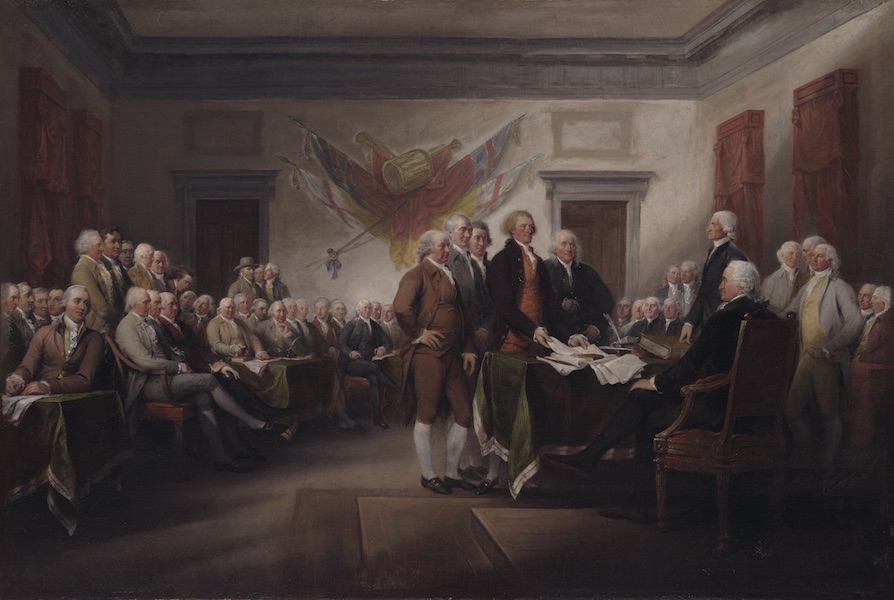
John Trumbull, The Declaration of Independence, July 4, 1776, 1786–1820, oil on canvas, 20 7/8 x 31 inches / 53 x 78.7 cm (Yale University Art Gallery)
The signing of the Declaration of Independence nearly 250 years ago marked the beginning of a bold political experiment. Its purpose was not merely to separate from Great Britain, but to establish a new nation founded on the principles of self-government and individual liberty. The newly independent states first united as a confederation before eventually forming the United States under the Constitution, underscored the notion that nation-building was a deliberate and carefully considered process.
The decision to declare independence did not emerge as a novel idea. It was shaped by the ideas of the Enlightenment, particularly the writings of John Locke, whose theory of the social contract and natural rights profoundly influenced the Founders. They also drew upon the works of Jean-Jacques Rousseau and Montesquieu, whose ideas about popular sovereignty and the separation of powers helped shape modern political thought. While the American Revolution later inspired the French Revolution, the philosophical foundations of American independence were already well established in Enlightenment thought.
The idea that human beings possess natural, inalienable rights endowed by their Creator developed over centuries. Aristotle’s teleological ethics in the Nicomachean Ethics and Politics laid an important philosophical foundation by arguing that human nature has an objective purpose and that the good life consists in living according to reason and virtue. Building on this tradition, Thomas Aquinas integrated Aristotelian philosophy with Christian theology, teaching that God’s eternal law is reflected in the natural law, which human beings can know through reason and which grounds the dignity of every person. Later, thinkers such as John Locke further articulated the concept of natural rights that profoundly influenced America’s Founders.
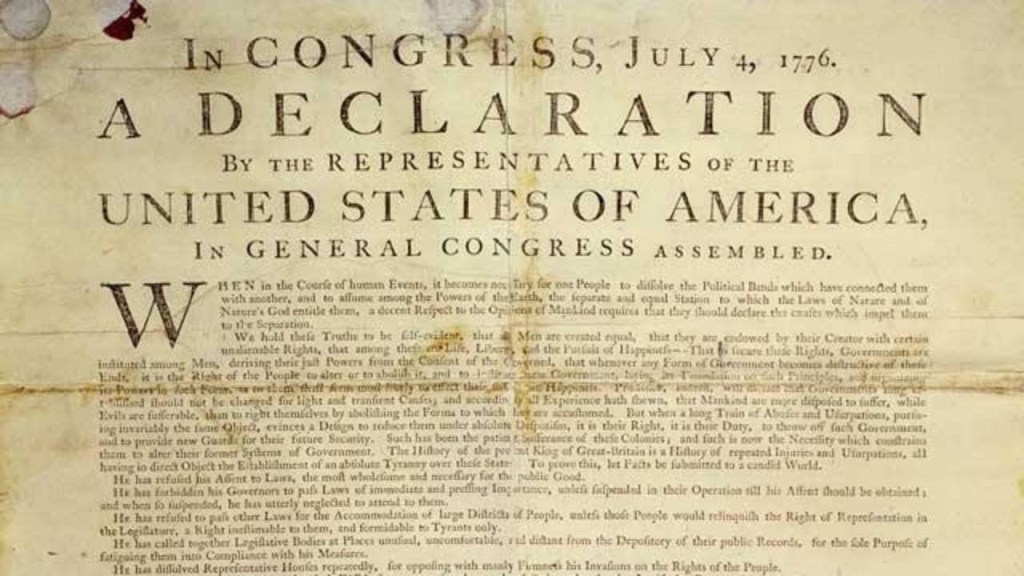
As we celebrate our nation’s founding this year, the Declaration of Independence invites us to reflect on this enduring principle: “We hold these truths to be self-evident, that all men are created equal, that they are endowed by their Creator with certain unalienable Rights, that among these are Life, Liberty and the pursuit of Happiness.”
Despite the tumultuous seasons of upheaval and strife that the United States has endured, from the Civil War to two World Wars and periods of intense political polarization and partisan division, our nation’s grand experiment has endured and prospered. We should never take this remarkable inheritance for granted.
As we celebrate our Nation’s independence today, may we reflect on the liberties with which we have been endowed and the responsibilities that accompany them. Consider taking a few moments to read the Declaration of Independence that our Founding Fathers adopted and reflect on the principles that continue to shape our republic.
https://www.archives.gov/founding-docs/declaration-transcript
Do not take for granted what the United States of America and its Founding Fathers envisioned. In keeping with your own faith tradition, pray for our leaders and for all those who strive to govern our society with justice, wisdom, and peace.
May God bless our country and all who celebrate this milestone of American independence and the enduring ideals of American exceptionalism.
 StreetEvangelist