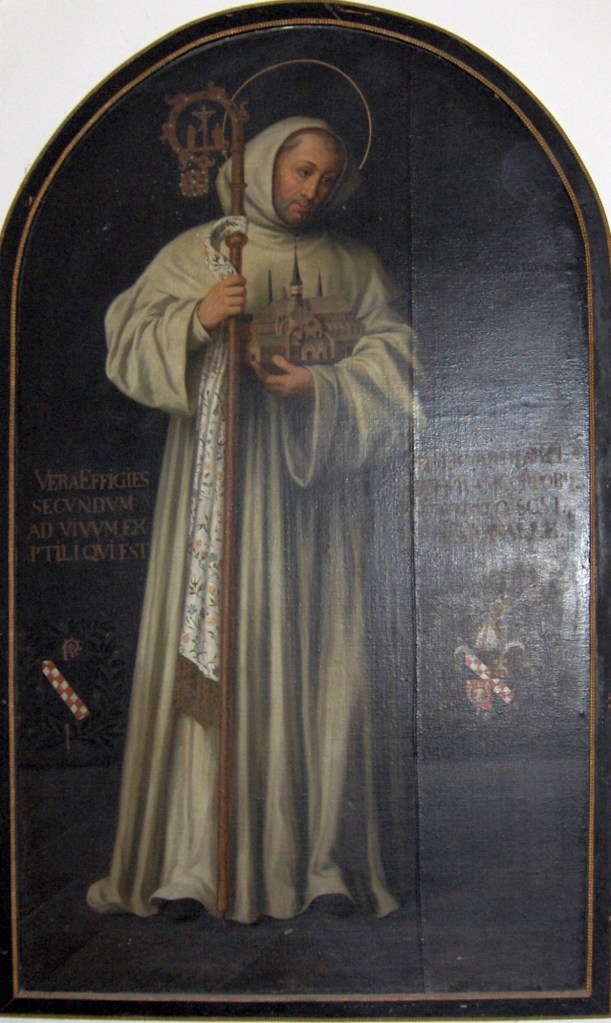
Bernard of Clairvaux, as shown in the church of Heiligenkreuz Abbey near Baden bei Wien, Lower Austria. Georg Andreas Wasshuber (1650-1732), (painted after a statue in Clairvaux with the true effigy of the saint) from Public Domain at Wikimedia Commons
St. Bernard of Clairvaux (1090–1153) was a French abbot, theologian, and mystic, and one of the most influential churchmen of the 12th century. He is recognized as a Doctor of the Church for his profound spiritual writings and teachings.
Key points of his life:
- Early Life: Born into a noble family near Dijon, France, Bernard was well-educated and drawn to a life of piety and study.
- Monastic Vocation: In 1113, he joined the Cistercian Order at the monastery of Cîteaux, bringing with him around 30 companions, including relatives. His zeal reinvigorated the order.
- Founding Clairvaux: In 1115, Bernard was sent to found a new monastery in Clairvaux, where he became abbot. His leadership turned it into a center of spiritual renewal and influence.
- Influence in the Church: Bernard became a powerful voice in Church affairs:
- Preached against heresies.
- Advised popes and kings.
- Played a major role in resolving disputes, including supporting Pope Innocent II during a schism.
- Preached the Second Crusade in 1146, though its failure later brought him criticism.
- Theology and Writings: Bernard emphasized love of God, contemplation, and humility. His writings, such as On Loving God and Sermons on the Song of Songs, had a lasting impact on Christian mysticism and theology.
- Death and Legacy: He died in 1153. In 1174, he was canonized, and in 1830, he was declared a Doctor of the Church.
From an excerpt from the Divine Office, Liturgy of the Hours, Office of Readings:
A sermon of St Bernard of Clairvaux
“I love because I love, I love that I may love
Love is sufficient of itself, it gives pleasure by itself and because of itself. It is its own merit, its own reward. Love looks for no cause outside itself, no effect beyond itself. Its profit lies in its practice. I love because I love, I love that I may love. Love is a great thing so long as it continually returns to its fountainhead, flows back to its source, always drawing from there the water which constantly replenishes it. Of all the movements, sensations and feelings of the soul, love is the only one in which the creature can respond to the Creator and make some sort of similar return however unequal it may be. For when God loves, all he desires is to be loved in return; the sole purpose of his love is to be loved, in the knowledge that those who love him are made happy by their love of him.
The Bridegroom’s love, or rather the love which is the Bridegroom, asks in return nothing but faithful love. Let the beloved, then, love in return. Should not a bride love, and above all, Love’s bride?”
St Bernard beautifully personifies this emotion of love. Among all human emotions, love uniquely enables the soul to respond to God, who desires only to be loved in return. The love between the soul and God is likened to that of a bride and bridegroom, where faithful, mutual love is both the goal and the joy.
Saint Bernard, Pray for Us!
 StreetEvangelist