From the author of The Wandering Gyrovague:
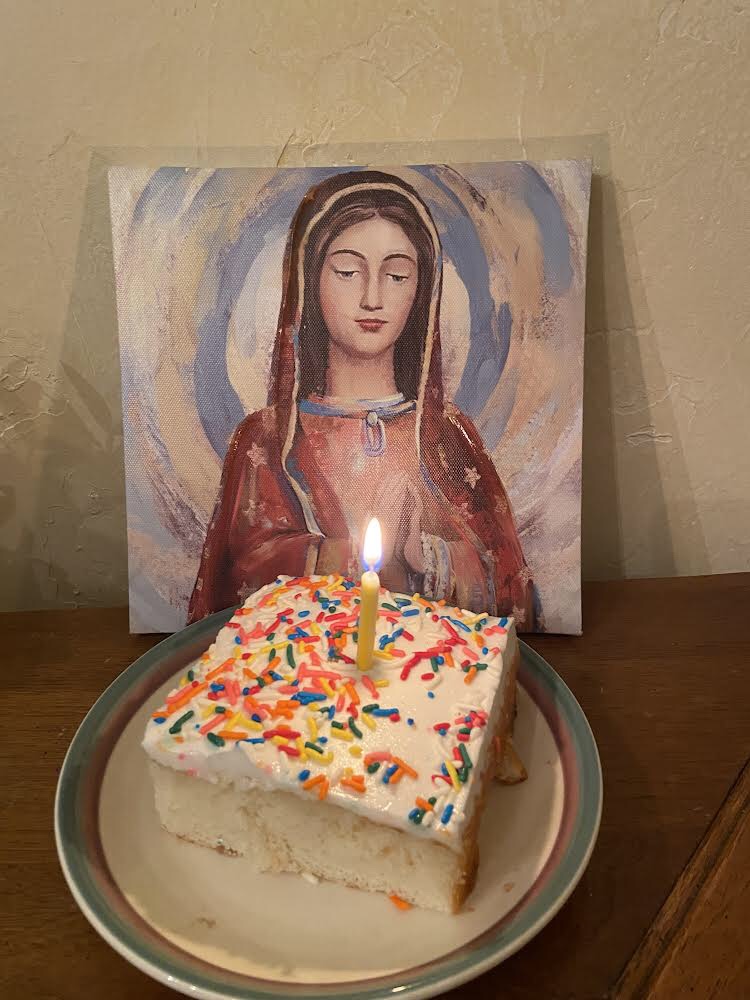
There is a certain irony that a feast that celebrates a birthday, something one may find at least mundane, or at best an historical remembrance is framed and defined by one of the most pithy eschatological (end-time) statements in Paul’s corpus, this selection from Romans:
God’s Indomitable Love in Christ. We know that all things work for good for those who love God, who are called according to his purpose. For those he foreknew he also predestined to be conformed to the image of his Son, so that he might be the firstborn among many brothers. And those he predestined he also called; and those he called he also justified; and those he justified he also glorified.—- Romans 8:28–30 (NABRE)
This short passage is ultimately a call to hope; a hope based in the knowledge that God has an eternal plan which has been set in motion by the very voice or command or God who calls it into being. It began when God called for the universe to be created, when he “called” all things into being. But more to the point, it continued with the call of the Jewish people to be a people set apart. From there we see his interlinking argument about the meaning of that call.
God claimed a people whom he foreknew and from that people, he called out a nation. When St. Paul says that he then predestined those to be conformed to the image of his Son, he did not merely mean that they would imitate Jesus, or be holy people like Jesus. The phrase he uses is symmorphous tes eikonos autou. This is a technical phrase for St. Paul which is roughly translated as “sharing in the same way of being as the icon, or the inner reflection, of the Son.”
The whole passage is meant to reassure Christians in their times of suffering that a plan has been unfolding for a long time of which the individual Christian is a small part of a grand plan wherein the whole universe is remade. But this remake is not a spackle job or a painting over—it is a renewal from the inside out. Those who belong to Christ will be transformed as he was at the resurrection into a totally new creation in the fullness of time. Firstborn refers to Jesus as the first to experience this Glory but it is something which others will share as his brothers and sisters.
One cannot help but then connect today’s liturgy with that of three weeks ago. The Solemn Feast of the Assumption, which celebrates the other side of Mary’s journey, is the quintessential Marian eschatological feast because it is not about the death of Mary, but is instead about the fact that the unusual occasion of her Dormition points to the fact that she was allowed to share in the life of grace of her Son in powerful and significant ways. The Assumption is a feast which shows us the promise of the future. And it seems that the Feast of the Nativity brings that to mind as well.
Indeed, based on the scriptures provided for us today, one can take two roads in celebrating this feast, but they both tend to converge. The other scriptures today do well to establish the genealogy of Mary and the place of the Lord in the plan of salvation history which parallels to the Great Design theme of our reading from Romans above. We are meant to understand that there has always been a great plan and that this plan is for us and for our salvation.
And as an eschatological or end-time liturgy, the over-riding virtue of the day is hope. When all seems lost, when all seems confusing, and when all seems to be absurd, to know that there is a plan is a comforting thought. And when one sees the complex web of history and salvific actions implied by our First Reading today (which would include everything from creation to the history of the Jewish people to the choice of Mary to say yes to Gabriel) it is moving. Then we must couple that with the knowledge we get from the Genealogy provided for us in Gospel today.
The Matthean genealogy differs from that provided by St. Luke but it still surprises. It includes Rahab (a “harlot of Jericho who hides spies) and the Moabite Ruth who follows Yahweh, Tamar (a very unlucky bride), and the wife of Uriah. Salvation history often includes unexpected heroes, including women, who may seem like they are only playing a small role in the grand story of life, but whom, upon a second look, are important links in a chain of relationships which are necessary for the whole fabric of history to hold together.
What do we learn when we couple our knowledge of salvation with the knowledge from the genealogy, the reason to honor Mary for her part in weaving this great fabric of history, of gratitude for her agreeing to do her part in saying Fiat to the angel, and to greatly honor her for who she became in becoming the First Disciple of her own Son and therefore, in a sense a “sister” to him in the glory of the Resurrection which we know she shared in through the mystery of the Assumption.
I would conclude this celebration then with a review of the Prayer over the Gifts written for today’s liturgy. It emphasizes the humanity of Jesus and Mary which I think adds just the right kind of seasoning to an eschatological celebration like this one.
May the humanity of your Only Begotten Son
come, O Lord, to our aid,
and may he, who at his birth from the Blessed Virgin
did not diminish but consecrated her integrity,
by taking from us now our wicked deeds,
make our oblation acceptable to you.
When one gets lost in talk of great plans and generations working together toward a lofty goal, theology can turn into talk about destiny and eschatology and hope can turn into talk about destiny, fate, and predetermination which makes the contributions of human beings seem like nothing. If nothing else, we hold this Feast, mindful of all that salvation history behind it, to remember that each person born is a link in a chain, a thread in a long-woven fabric. And their birth is worthy of celebration.
 StreetEvangelist